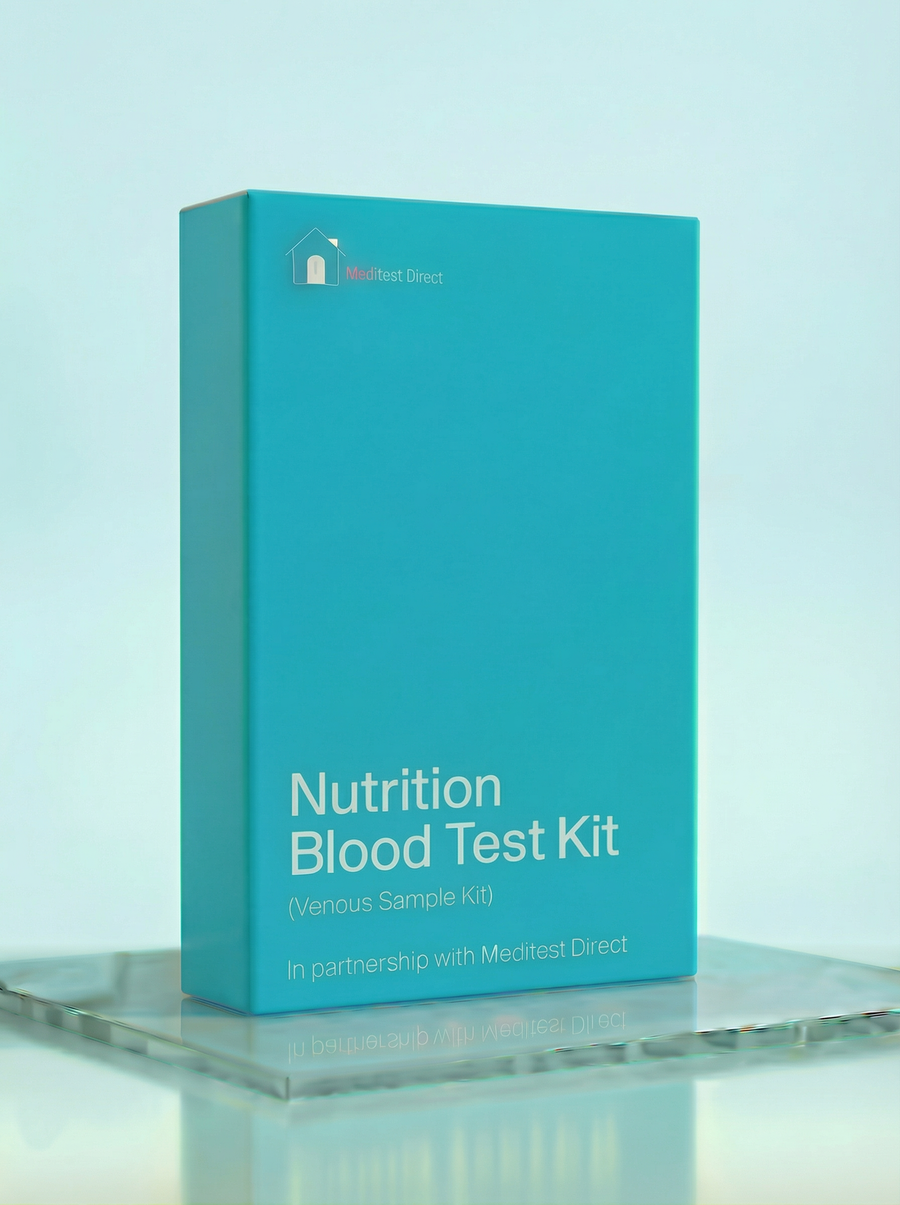
Nutrition Blood Test Kit
£88 ✓ In Stock
Your sample goes to a UKAS accredited laboratory meeting ISO 15189 standards.
After you receive your order confirmation email, please reply with your date of birth.
How it works
Your testing journey
From order to results in four simple steps. Full transparency on where each step happens and what it costs.

Receive your kit by post
Dispatched same working day if ordered before 3pm. Royal Mail Tracked delivery, typically 1–3 working days. 90% of kits arrive within 24 hours.

Visit a partner clinic
Book a phlebotomy appointment at one of our 365+ UK partner clinics. Take your kit with you — the phlebotomist will collect your sample using the materials provided.
Phlebotomy fee applies (paid at clinic)
Venous blood draw at a clinic
A trained phlebotomist takes a small blood sample from a vein in your arm using the vacutainers provided in your kit. The appointment takes around 10 minutes.

Return by prepaid envelope
Seal your sample in the biohazard bag provided and drop it in any Royal Mail postbox using the prepaid Tracked 24 envelope. Post Monday–Thursday for best results.
Venous Blood Collection Kit
This kit is sent to you and taken to your chosen clinic. The phlebotomist will collect your sample using the materials provided.
- 1Vacutainer blood collection tubes
- 2Needle and butterfly needle
- 3Tourniquet
- 4Alcohol swab
- 5Cotton wool and gauze
- 6Adhesive plaster
- 7Biohazard specimen bag
- 8Prepaid return envelope (Royal Mail Tracked 24)
- 9Laboratory request form
- 10Instructions for the phlebotomist
Ferritin is a protein that stores iron inside cells, primarily in the liver, spleen, and bone marrow. Measuring serum ferritin provides the best single estimate of total body iron stores. Unlike serum iron (which fluctuates throughout the day and with meals), ferritin is relatively stable and reflects longer-term iron status. Low ferritin is highly specific for iron deficiency, while high ferritin can indicate iron overload or inflammation. Iron deficiency is the most common nutritional deficiency worldwide. Dietary iron comes in two forms: haem iron (from meat, poultry, fish—well absorbed) and non-haem iron (from plants, eggs, dairy—less well absorbed). Vegetarians and vegans are at higher risk of deficiency because plant-based iron is harder to absorb. Vitamin C significantly enhances non-haem iron absorption, while tea, coffee, calcium, and phytates (in whole grains and legumes) inhibit it. Heavy menstrual periods are the most common cause of iron deficiency in premenopausal women. Normal ferritin is typically 30-300 µg/L for men and 30-150 µg/L for women. Levels below 30 µg/L indicate depleted iron stores. However, ferritin is also an acute phase reactant—it rises with inflammation, infection, and liver disease—so a "normal" ferritin in someone with elevated hs-CRP may still mask underlying iron deficiency. Very high ferritin (above 500 µg/L) without inflammation warrants investigation for iron overload (haemochromatosis). Results outside the normal range may need a follow-up with your GP.
Cholesterol is a waxy, fat-like substance essential for building cell membranes, producing hormones (including vitamin D, cortisol, and sex hormones), and making bile acids for fat digestion. Your liver produces most of the cholesterol your body needs, with additional amounts coming from food. Total cholesterol represents the sum of all cholesterol in your blood, including both protective HDL and potentially harmful LDL fractions. Diet influences cholesterol levels, though the relationship is more complex than once thought. Dietary saturated fat has a stronger effect on blood cholesterol than dietary cholesterol itself. Nutritional factors that improve cholesterol include replacing saturated fats with unsaturated fats, increasing fibre intake (particularly soluble fibre from oats, beans, and vegetables), consuming plant sterols and stanols, and maintaining a healthy weight. Desirable total cholesterol is generally below 5.0 mmol/L. However, total cholesterol alone is of limited value—what matters more is the balance between HDL and LDL. Someone with high total cholesterol driven by high HDL may have lower cardiovascular risk than someone with "normal" total cholesterol but low HDL and high LDL. Results should be interpreted alongside the full lipid profile. Results outside the normal range may need a follow-up with your GP.
Low-density lipoprotein (LDL) cholesterol transports cholesterol from the liver to tissues throughout the body. When there's more LDL than needed, excess particles can penetrate artery walls, become oxidised, and trigger the formation of atherosclerotic plaques—fatty deposits that narrow arteries and can rupture to cause heart attacks and strokes. This is why LDL is often called "bad cholesterol," though it's more accurate to say that elevated LDL increases cardiovascular risk. Dietary factors that raise LDL include saturated fat (found in fatty meats, full-fat dairy, butter, coconut oil, palm oil) and trans fats (found in some processed foods). Factors that lower LDL include soluble fibre, plant sterols, nuts, and replacing saturated fats with unsaturated fats (olive oil, avocado, fatty fish). Some people have genetically high LDL (familial hypercholesterolaemia) that doesn't respond adequately to diet alone. Optimal LDL is below 3.0 mmol/L for most adults, with lower targets (below 2.5 or 1.8 mmol/L) for those at higher cardiovascular risk. LDL is the primary target for cardiovascular risk reduction—the evidence that lowering LDL reduces heart attacks and strokes is among the strongest in medicine. Results outside the normal range may need a follow-up with your GP.
Non-HDL cholesterol is calculated by subtracting HDL from total cholesterol. It represents all potentially atherogenic (artery-clogging) cholesterol—not just LDL, but also VLDL, IDL, and lipoprotein(a). This makes it a more comprehensive marker of cardiovascular risk than LDL alone, which is why some guidelines now prioritise non-HDL as a treatment target. Non-HDL has practical advantages: it doesn't require fasting (unlike LDL calculated from the Friedewald equation), remains accurate even when triglycerides are elevated, and captures risk from all harmful lipoproteins. Dietary factors that improve non-HDL are similar to those for LDL: reducing saturated and trans fats, increasing fibre and plant sterols, and maintaining healthy weight. Desirable non-HDL is below 4.0 mmol/L for most adults, with lower targets for those at higher cardiovascular risk. Non-HDL targets are typically 0.8 mmol/L higher than corresponding LDL targets. Because it's a calculated value, non-HDL is automatically available whenever total cholesterol and HDL are measured. Results outside the normal range may need a follow-up with your GP.
High-density lipoprotein (HDL) cholesterol performs "reverse cholesterol transport"—collecting excess cholesterol from tissues and artery walls and returning it to the liver for excretion. This cleanup function, along with anti-inflammatory and antioxidant properties, is why HDL is called "good cholesterol." Higher HDL levels are associated with reduced cardiovascular risk. Unlike LDL (which responds well to dietary changes), HDL is harder to raise through diet alone. Factors that increase HDL include regular aerobic exercise (one of the most effective interventions), moderate alcohol consumption, smoking cessation, weight loss, and replacing refined carbohydrates with healthy fats. Omega-3 fatty acids from fish may modestly increase HDL. Trans fats lower HDL and should be avoided. Low HDL (below 1.0 mmol/L in men, below 1.2 mmol/L in women) is an independent cardiovascular risk factor. Levels above 1.5 mmol/L are associated with reduced risk. However, very high HDL (above 2.3 mmol/L) doesn't necessarily provide additional protection and occasionally indicates a genetic condition. Results outside the normal range may need a follow-up with your GP.
The Total Cholesterol to HDL ratio (TC: HDL) is calculated by dividing total cholesterol by HDL cholesterol. This ratio reflects the balance between harmful and protective cholesterol and is used by cardiovascular risk calculators like QRISK. A lower ratio indicates a more favourable balance—either because total cholesterol is low, HDL is high, or both. The ratio helps contextualise total cholesterol values. For example, total cholesterol of 6.0 mmol/L carries different implications depending on whether HDL is 1.0 mmol/L (ratio 6.0, high risk) or 2.0 mmol/L (ratio 3.0, lower risk). Dietary and lifestyle changes that lower LDL and/or raise HDL will improve the ratio. A TC: HDL ratio below 4.0 is desirable, with ratios below 3.5 considered optimal. Ratios above 6.0 indicate significantly elevated cardiovascular risk. The ratio should be interpreted alongside individual lipid values and other risk factors (blood pressure, smoking, diabetes, family history). Results outside the normal range may need a follow-up with your GP.
Triglycerides are the most common form of fat in the body. When you eat more calories than you need immediately, your body converts the excess—whether from carbohydrates, fat, or protein—into triglycerides, which are stored in fat cells and released for energy between meals. Triglycerides circulate in the blood within VLDL particles and fluctuate significantly with food intake. Triglycerides are highly responsive to dietary factors. Refined carbohydrates and sugars raise triglycerides significantly—sometimes more than dietary fat does. Alcohol is a potent trigger for triglyceride elevation. Factors that lower triglycerides include reducing refined carbohydrates and sugars, limiting alcohol, losing excess weight, increasing physical activity, and consuming omega-3 fatty acids (from oily fish or supplements). Normal triglycerides are below 1.7 mmol/L. Levels of 1.7-2.3 mmol/L are borderline high, 2.3-5.6 mmol/L are high, and above 5.6 mmol/L are very high (with risk of pancreatitis). Elevated triglycerides often accompany metabolic syndrome, type 2 diabetes, and obesity. They're one of the most diet-responsive lipid markers. Results outside the normal range may need a follow-up with your GP.
Vitamin B12 (cobalamin) is essential for DNA synthesis, red blood cell formation, and nervous system function. The body cannot produce B12—it must come from animal-derived foods (meat, fish, eggs, dairy) or fortified foods and supplements. B12 absorption requires intrinsic factor (produced by stomach cells) and an intact small intestine, which is why absorption problems are a common cause of deficiency even in people with adequate dietary intake. Active B12 (holotranscobalamin) measures only the biologically available B12 that cells can actually use—approximately 10-30% of total B12. This makes it a more sensitive and earlier marker of deficiency than total B12. Risk factors for B12 deficiency include vegan/vegetarian diet (B12 is essentially absent from plant foods), pernicious anaemia (autoimmune destruction of intrinsic factor), gastric surgery, coeliac disease, Crohn's disease, older age (reduced absorption), and medications including metformin and proton pump inhibitors. Normal active B12 is typically above 37.5 pmol/L. Levels below 25 pmol/L indicate likely deficiency, while 25-37.5 pmol/L is borderline and may warrant a trial of supplementation, particularly if symptoms are present. Symptoms of deficiency include fatigue, weakness, neurological symptoms (numbness, tingling, balance problems, cognitive changes), glossitis, and anaemia. Neurological damage from severe deficiency can be irreversible if not treated promptly. Results outside the normal range may need a follow-up with your GP.
Vitamin D is a fat-soluble vitamin that functions as a hormone, with receptors in most tissues throughout the body. Its best-established role is regulating calcium absorption and bone health—severe deficiency causes rickets in children and osteomalacia in adults. Emerging evidence suggests roles in immune function, muscle strength, mood, and potentially cancer prevention, though these effects are less well established than bone benefits. Vitamin D is unique among vitamins because the primary source isn't food—it's sunlight. UVB rays trigger vitamin D synthesis in the skin. In the UK, sun exposure is insufficient for vitamin D production from October to March, and deficiency is extremely common—particularly in those with dark skin, limited sun exposure, older adults, people who are overweight, and those with malabsorption conditions. Dietary sources include oily fish, egg yolks, and fortified foods, but diet alone rarely provides adequate vitamin D. Vitamin D status is classified as: deficient (below 25 nmol/L), insufficient (25-50 nmol/L), adequate (50-75 nmol/L), and optimal (above 75 nmol/L). The UK government recommends all adults consider taking 10 micrograms (400 IU) daily, especially in autumn and winter. Higher doses may be needed to correct deficiency. Symptoms of deficiency include fatigue, muscle weakness, bone pain, and low mood. Results outside the normal range may need a follow-up with your GP.
Magnesium is an essential mineral involved in over 300 enzymatic reactions, including energy production, protein synthesis, muscle and nerve function, blood glucose control, and blood pressure regulation. It's also crucial for bone health—about 60% of body magnesium is stored in bones. Despite its importance, magnesium deficiency is surprisingly common, with some studies suggesting up to half of people in developed countries don't meet recommended intakes. Dietary sources of magnesium include green leafy vegetables (chlorophyll contains magnesium), nuts (almonds, cashews), seeds (pumpkin, chia), whole grains, legumes, dark chocolate, avocados, and fish. Refined and processed foods are typically low in magnesium. Magnesium absorption can be reduced by high calcium intake, certain medications (PPIs, diuretics), and gastrointestinal conditions. Alcohol, diabetes, and intense exercise all increase magnesium requirements or losses. Normal serum magnesium is 0.7-1.0 mmol/L. However, serum magnesium represents only about 1% of total body magnesium—the rest is in bones and cells—so blood levels can appear normal even when total body stores are depleted. Low serum magnesium definitely indicates deficiency, but normal serum magnesium doesn't necessarily rule it out, especially if you have symptoms or risk factors. Symptoms of deficiency include fatigue, muscle cramps and twitches, weakness, poor sleep, and irritability. Results outside the normal range may need a follow-up with your GP.
C-reactive protein (CRP) is produced by the liver in response to inflammation. The high-sensitivity CRP (hs-CRP) test detects very low levels of CRP that aren't visible on standard CRP tests—levels associated with chronic, low-grade inflammation thought to contribute to atherosclerosis and cardiovascular disease. Elevated hs-CRP is also relevant to nutrition because inflammation can affect how the body absorbs and uses nutrients, and because ferritin (an iron marker) rises with inflammation. Chronic low-grade inflammation is influenced by nutrition and lifestyle. Factors that increase hs-CRP include obesity (fat tissue produces inflammatory cytokines), high sugar/refined carbohydrate intake, excessive alcohol, smoking, chronic stress, and poor sleep. Factors that reduce inflammation include weight loss, regular exercise, a Mediterranean-style diet rich in vegetables, fruits, fish, nuts, and olive oil, omega-3 fatty acids, and adequate sleep. For cardiovascular risk assessment, hs-CRP below 1.0 mg/L indicates lower risk, 1.0-3.0 mg/L indicates average risk, and above 3.0 mg/L indicates higher risk. Values above 10 mg/L typically indicate acute infection or inflammation rather than chronic cardiovascular risk and should prompt investigation or repeat testing after illness resolves. In this panel, hs-CRP helps interpret the ferritin result—elevated ferritin with elevated hs-CRP may reflect inflammation rather than true iron overload. Results outside the normal range may need a follow-up with your GP.
This test is for screening and information only — it is not a medical diagnosis or professional advice. Please have your results reviewed by a qualified doctor or healthcare provider who can explain what they mean for your personal health situation. If your results show anything outside the normal range, or if you're worried about your health, see your doctor as soon as you can. Don't change any medications or treatments based on these results alone — always talk to your healthcare provider first.
NO CLINICS, NO QUEUES, NO HASSLE
Four steps to clarity
 01
01
Pick your panel
Browse over 200 clinically designed test kits and choose the one that fits your goals.
 02
02
Kit to your door
Everything you need arrives in discreet packaging with step-by-step instructions inside.
 03
03
Collect your sample
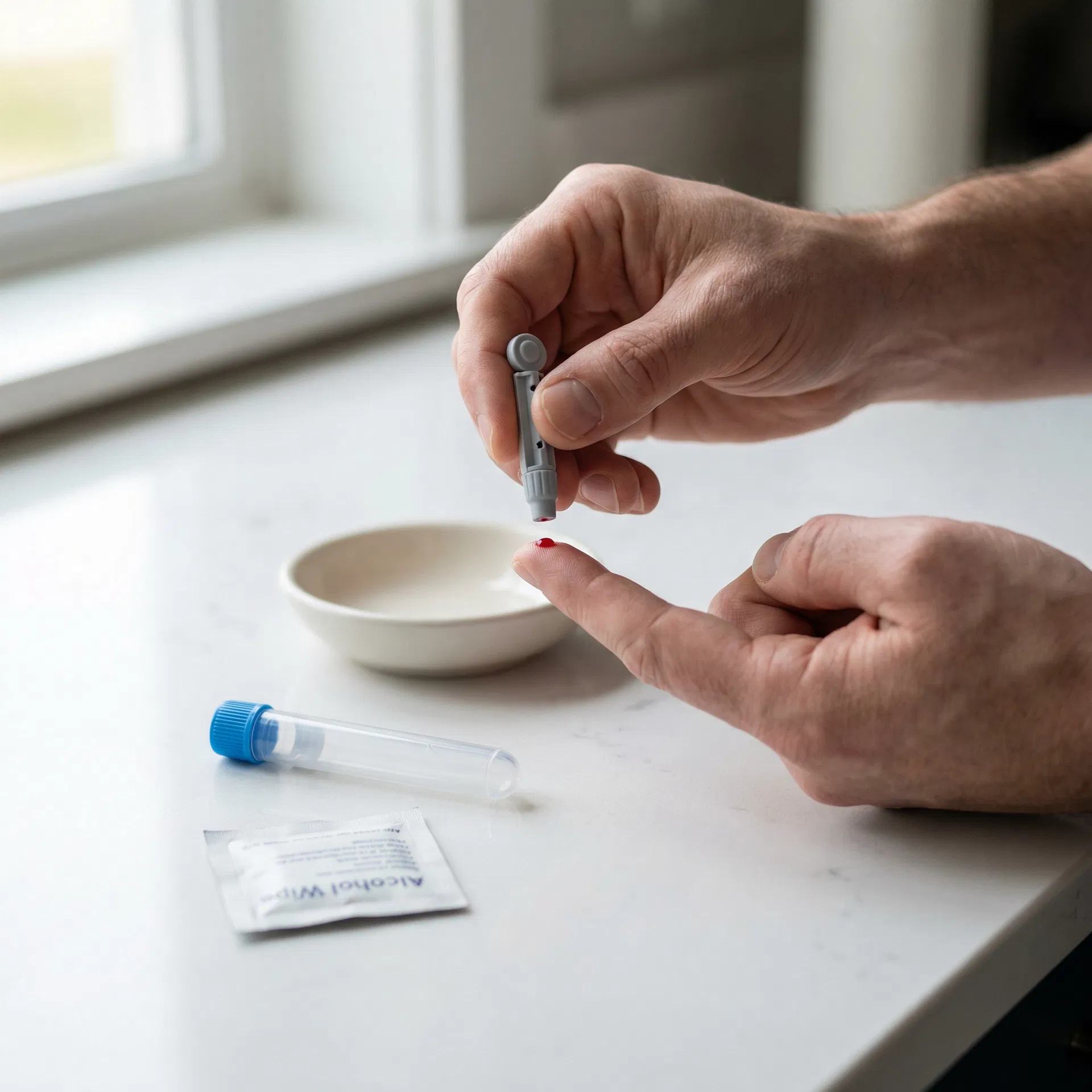
Follow the simple instructions in your kit — whether it's a finger-prick at home or a venous draw at a partner clinic.
 04
04
Insights delivered
Clear, easy-to-understand results sent to you online with actionable health guidance.
Frequently asked questions
This test measures Total Cholesterol, LDL Cholesterol, Non-HDL Cholesterol, HDL Cholesterol, Total Cholesterol : HDL Ratio. Check the full biomarker list on this page for details.
Check Special Instructions on this page. General rule: fast 8-12 hours if cholesterol/glucose/insulin included. Most hormone, vitamin, and antibody tests do not require fasting. Morning collection (7-10am) preferred.
Follow kit instructions. Finger-prick: warm hands, use lancet as directed, fill tube to marked line. Venous: attend phlebotomy with lab form. Post same day, avoid Fridays/bank holidays.
Within the timeframe shown on this page. Notification sent when ready to view online.
You may also be interested in

Advanced Vitamins Blood Test
A 10-biomarker venous blood panel covering fat-soluble vitamins and b vitamins — ideal for investigating relevant symptoms or monitoring health.
Results estimated in 3 working days
10 biomarkers
Venous collection
Ultimate Performance Blood Test Kit
A 56-biomarker venous blood panel covering cholesterol status, diabetes, liver function and other key health markers — ideal for athletes and active people tracking training adaptation, recovery, and performance.
Results estimated in 3 working days
56 biomarkers

Driver's Tiredness Blood Test
A 6-biomarker venous blood panel covering inflammation, iron status, thyroid hormones and vitamins — ideal for investigating ongoing tiredness, low energy, or suspected medical causes.
Results estimated in 5 working days
6 biomarkers