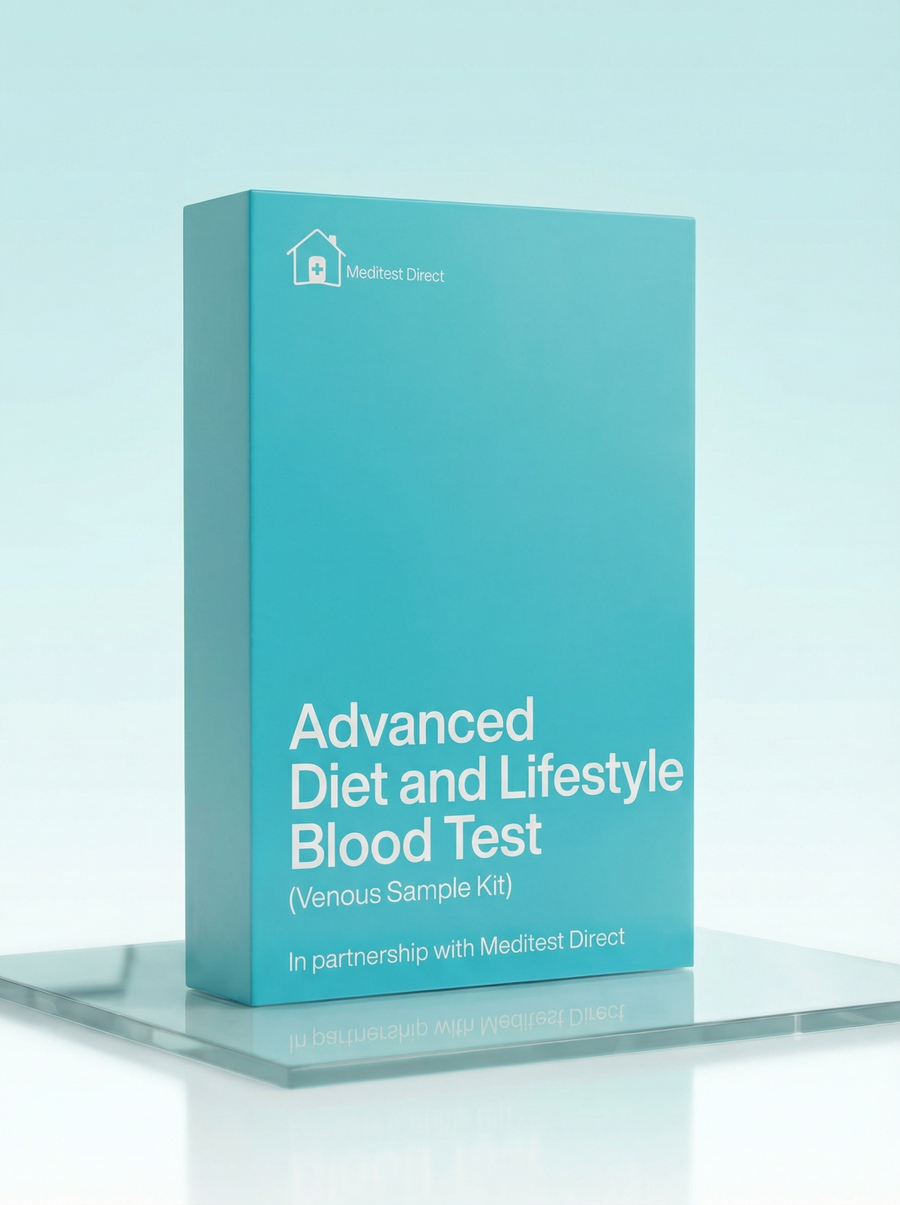
Advanced Diet and Lifestyle Blood Test Kit
£118 ✓ In Stock
Your sample goes to a UKAS accredited laboratory meeting ISO 15189 standards.
After you receive your order confirmation email, please reply with your date of birth.
How it works
Your testing journey
From order to results in four simple steps. Full transparency on where each step happens and what it costs.

Receive your kit by post
Dispatched same working day if ordered before 3pm. Royal Mail Tracked delivery, typically 1–3 working days. 90% of kits arrive within 24 hours.

Visit a partner clinic
Book a phlebotomy appointment at one of our 365+ UK partner clinics. Take your kit with you — the phlebotomist will collect your sample using the materials provided.
Phlebotomy fee applies (paid at clinic)
Venous blood draw at a clinic
A trained phlebotomist takes a small blood sample from a vein in your arm using the vacutainers provided in your kit. The appointment takes around 10 minutes.

Return by prepaid envelope
Seal your sample in the biohazard bag provided and drop it in any Royal Mail postbox using the prepaid Tracked 24 envelope. Post Monday–Thursday for best results.
Venous Blood Collection Kit
This kit is sent to you and taken to your chosen clinic. The phlebotomist will collect your sample using the materials provided.
- 1Vacutainer blood collection tubes
- 2Needle and butterfly needle
- 3Tourniquet
- 4Alcohol swab
- 5Cotton wool and gauze
- 6Adhesive plaster
- 7Biohazard specimen bag
- 8Prepaid return envelope (Royal Mail Tracked 24)
- 9Laboratory request form
- 10Instructions for the phlebotomist
Total protein measures all the protein floating in your blood—mainly albumin and globulins. Albumin is made by your liver and keeps fluid in your blood vessels; globulins are a mixed bag including antibodies from your immune system and proteins that transport things around your body. This test gives a general overview of your nutritional status and can hint at liver, kidney, or immune system issues. Low total protein might suggest malnutrition, liver disease, or protein-losing conditions. High total protein can occur with chronic inflammation, infections, or certain blood disorders. Results outside the normal range may need a follow-up with your GP.
Globulins are a family of proteins with various jobs—some carry hormones and metals around your blood, while others (immunoglobulins) are the antibodies your immune system makes to fight infections. Globulin is usually calculated by subtracting albumin from total protein. High globulins can suggest your immune system is working overtime—chronic infections, inflammation, or autoimmune conditions. Low globulins might indicate immune deficiency or protein loss. Doctors often look at the albumin-to-globulin ratio (A/G ratio) alongside the individual numbers to get more insight into what might be going on. Results outside the normal range may need a follow-up with your GP.
Albumin is the most abundant protein in your blood, made by your liver. It does several important jobs: keeping fluid from leaking out of your blood vessels, carrying hormones and vitamins around your body, and acting as a general marker of your nutritional status. Because your liver makes it, low albumin can signal liver problems—but it can also drop with kidney disease (where it leaks into urine), malnutrition, inflammation, or chronic illness. It's a useful general health marker that tells you something about your liver function, nutrition, and overall protein status. Results outside the normal range may need a follow-up with your GP.
ALP is an enzyme found mainly in your liver and bones, with smaller amounts in your kidneys and gut. In the liver, it's concentrated in the cells lining the bile ducts—the tiny tubes that carry bile to help digest fats. Elevated ALP often points to bile duct problems or bone conditions, rather than liver cell damage specifically. It's naturally higher in children and teenagers (because their bones are still growing) and during pregnancy. In adults, a raised ALP alongside other abnormal liver markers usually prompts further investigation to work out whether the issue is liver, bone, or something else. Results outside the normal range may need a follow-up with your GP.
ALT is an enzyme that lives mainly inside your liver cells. When liver cells are damaged or inflamed, ALT leaks out into your bloodstream—so elevated levels are a fairly specific marker that something's irritating your liver. Common culprits include fatty liver disease (increasingly common with modern diets), alcohol, viral hepatitis, certain medications, and obesity. ALT is often the first liver marker to rise when there's a problem, making it useful for early detection. A one-off mild elevation might not mean much, but persistently raised ALT usually warrants further investigation. Results outside the normal range may need a follow-up with your GP.
AST is another enzyme found in your liver, but unlike ALT, it's also present in your heart, muscles, kidneys, and brain. This means elevated AST isn't as specific to the liver—it could be coming from muscle damage after intense exercise, a heart problem, or various other sources. Doctors usually look at the ratio between AST and ALT to help figure out what's going on. When AST is significantly higher than ALT, it can point to alcohol-related liver damage or more advanced liver disease. When both are raised but ALT is higher, it often suggests fatty liver or viral hepatitis. Results outside the normal range may need a follow-up with your GP.
GGT is an enzyme found throughout your body but concentrated in your liver and bile ducts. It's particularly sensitive to alcohol—even moderate drinking can push it up—which makes it useful for spotting alcohol-related liver stress before other markers budge. GGT also rises with bile duct problems, fatty liver, and certain medications. It's often used alongside ALP to help determine whether a raised ALP is coming from the liver or bones (bone problems don't affect GGT). An isolated raised GGT with everything else normal is often a nudge to look at alcohol intake or check for fatty liver. Results outside the normal range may need a follow-up with your GP.
Creatinine is a waste product that comes from the normal wear and tear of your muscles. Your body produces it at a pretty steady rate, and healthy kidneys filter it out into your urine. Because it's produced consistently and cleared by the kidneys, it's a reliable marker for how well your kidneys are doing their job. Higher levels can suggest your kidneys aren't filtering as efficiently as they should. That said, creatinine can be affected by muscle mass—so bodybuilders and athletes may naturally run a bit higher. Dehydration and certain medications can also bump it up temporarily. Results outside the normal range may need a follow-up with your GP.
eGFR (estimated Glomerular Filtration Rate) calculates how much blood your kidneys filter per minute—essentially measuring their efficiency. It's worked out from your creatinine level along with your age, sex, and ethnicity. A higher number is better: above 90 is generally considered normal, while lower numbers suggest declining kidney function. The beauty of eGFR is that it can pick up kidney problems earlier than creatinine alone, often before you'd notice any symptoms. It's especially important to monitor if you have diabetes, high blood pressure, or a family history of kidney disease. Results outside the normal range may need a follow-up with your GP.
Urea is a waste product formed when your liver breaks down protein. It travels through your blood to your kidneys, which filter it out into your urine. Like creatinine, it's a marker of kidney function—but it's a bit more variable because it's affected by how much protein you eat, dehydration, and even bleeding in your gut. High urea with normal creatinine might suggest dehydration or a high-protein diet rather than kidney problems. Doctors usually look at urea alongside creatinine and eGFR to get the full picture of your kidney health. Results outside the normal range may need a follow-up with your GP.
Total cholesterol is the overall amount of cholesterol circulating in your blood—combining HDL ('good'), LDL ('bad'), and other types. Your body actually needs cholesterol to build healthy cells, make hormones like oestrogen and testosterone, and produce vitamin D. The liver makes most of your cholesterol, with some coming from food. While cholesterol itself isn't bad, the balance matters. This number gives you a starting point, but the breakdown between HDL and LDL tells you much more about your cardiovascular health. Results outside the normal range may need a follow-up with your GP.
LDL (low-density lipoprotein) is often called 'bad' cholesterol because it carries cholesterol to your arteries, where it can build up in the walls and form plaques over time. These plaques can narrow your arteries and make them less flexible—a condition called atherosclerosis. Diet plays a big role here: saturated fats, trans fats, and excess weight can all push LDL higher. The good news? LDL responds well to lifestyle changes like eating more fibre, exercising regularly, and cutting back on processed foods. Lower is generally better for this one. Results outside the normal range may need a follow-up with your GP.
Non-HDL cholesterol is simply your total cholesterol minus your HDL—so it captures all the potentially harmful types in one number. Many doctors now consider this a better predictor of cardiovascular risk than LDL alone because it includes other problematic particles like VLDL (very low-density lipoprotein). It's particularly useful because it doesn't require fasting to be accurate, and it gives a broader picture of the cholesterol that could be building up in your arteries. Think of it as the 'everything except the good stuff' measurement. Results outside the normal range may need a follow-up with your GP.
HDL (high-density lipoprotein) is the 'good' cholesterol—and you want this one higher. It works like a cleanup crew, picking up excess cholesterol from your arteries and ferrying it back to your liver where it gets broken down and removed from your body. Higher HDL levels are linked to lower cardiovascular risk. Exercise is one of the best ways to boost HDL, along with eating healthy fats like olive oil, nuts, and fatty fish. Smoking tanks your HDL, so quitting is one of the quickest ways to improve this number. Results outside the normal range may need a follow-up with your GP.
This ratio divides your total cholesterol by your HDL, giving you a quick snapshot of your cardiovascular risk. It's often more useful than looking at total cholesterol alone because it shows the balance between harmful and protective cholesterol. A lower ratio is better—it means you have more of the good stuff relative to the total. For example, someone with high total cholesterol but very high HDL might have a healthier ratio than someone with lower total cholesterol but rock-bottom HDL. Doctors use this alongside other markers to assess your overall heart health picture. Results outside the normal range may need a follow-up with your GP.
Triglycerides are the most common type of fat in your body. When you eat, your body converts any calories it doesn't need right away into triglycerides, which get stored in fat cells for energy later. They're heavily influenced by what you've eaten recently—especially sugars, refined carbs, and alcohol—which is why fasting before this test matters. Consistently high triglycerides can contribute to hardening of the arteries and increase your risk of heart disease, stroke, and pancreatitis. They often go hand-in-hand with low HDL and high LDL, creating a not-so-great combination. Results outside the normal range may need a follow-up with your GP.
HbA1c (glycated haemoglobin) tells you your average blood sugar levels over the past 2-3 months—much more useful than a single glucose reading which just shows what's happening right now. It works by measuring how much sugar has attached to the haemoglobin in your red blood cells. Since red blood cells live for about three months, this gives you a rolling average. It's the gold standard for monitoring blood sugar control and screening for diabetes and prediabetes. Unlike fasting glucose, you don't need to fast for this test, and it won't be thrown off by what you ate yesterday. Results outside the normal range may need a follow-up with your GP.
Active B12 (holotranscobalamin) measures the form of B12 your body can actually use—it's more accurate than total B12 because it shows what's available to your cells rather than what's just floating around. B12 is essential for making red blood cells, keeping your nervous system healthy, and producing DNA. Deficiency can sneak up slowly, causing fatigue, weakness, pins and needles, memory problems, and mood changes. Vegans and vegetarians are at higher risk since B12 comes mainly from animal foods. Absorption also decreases with age and certain gut conditions. Results outside the normal range may need a follow-up with your GP.
Vitamin D is crucial for absorbing calcium and keeping your bones strong, but it does much more—it supports immune function, muscle health, and mood regulation. Your skin makes it when exposed to sunlight, which is why deficiency is incredibly common in the UK, especially during winter months when there's not enough UV light. Symptoms of low vitamin D include tiredness, muscle weakness, bone pain, and low mood. Food sources like oily fish, eggs, and fortified foods help, but many people need supplements to maintain healthy levels, particularly between October and March. Results outside the normal range may need a follow-up with your GP.
Magnesium is involved in over 300 enzyme reactions in your body—it's essential for muscle and nerve function, blood sugar control, blood pressure regulation, and making protein and bone. Despite being so important, deficiency is surprisingly common because modern diets often fall short and stress depletes it faster. Low magnesium can cause muscle cramps, twitches, fatigue, and poor sleep. The tricky thing is that blood magnesium only shows what's circulating—most of your magnesium is stored in bones and cells, so blood levels can look normal even when stores are low. Results outside the normal range may need a follow-up with your GP.
Haemoglobin is the protein inside red blood cells that carries oxygen from your lungs to every tissue in your body, then brings carbon dioxide back to be breathed out. It's what makes blood red. Low haemoglobin—anaemia—can leave you feeling exhausted, breathless, dizzy, and looking pale because your tissues aren't getting enough oxygen. The causes range from iron deficiency (the most common) to B12 or folate deficiency, chronic disease, or blood loss. High haemoglobin can occur with dehydration, living at altitude, or conditions that cause your body to make too many red blood cells. Results outside the normal range may need a follow-up with your GP.
Haematocrit measures what percentage of your blood volume is made up of red blood cells. If your haematocrit is 45%, that means 45% of your blood is red cells and the rest is plasma (the liquid part) plus white cells and platelets. It tends to track with haemoglobin—low haematocrit usually means anaemia, high haematocrit can mean dehydration or overproduction of red cells. Athletes sometimes have higher haematocrit from training adaptations. It's a useful companion to haemoglobin that helps confirm anaemia and assess hydration status. Results outside the normal range may need a follow-up with your GP.
MCH tells you the average amount of haemoglobin inside each red blood cell. Think of it as how 'full' of haemoglobin your red cells are. Low MCH means your cells are carrying less oxygen-carrying capacity—typically seen with iron deficiency anaemia, where cells are small and pale. High MCH suggests larger-than-normal cells packed with haemoglobin, which happens with B12 or folate deficiency. MCH works together with MCV and MCHC to help pinpoint the cause of anaemia when haemoglobin is low. Results outside the normal range may need a follow-up with your GP.
MCHC measures the concentration of haemoglobin within your red blood cells—essentially how densely packed with haemoglobin they are. While MCH looks at the total amount per cell, MCHC accounts for cell size too. Low MCHC produces 'hypochromic' (pale) cells, typically seen in iron deficiency where cells can't make enough haemoglobin. High MCHC is less common but can occur in conditions where red cells are abnormally shaped or breaking down. It's a useful confirmatory marker alongside MCH and MCV when investigating anaemia. Results outside the normal range may need a follow-up with your GP.
MCV measures the average size of your red blood cells. It's one of the most useful markers for working out what type of anaemia someone has. Small cells (low MCV, 'microcytic') typically point to iron deficiency or thalassaemia. Large cells (high MCV, 'macrocytic') suggest B12 or folate deficiency, or sometimes excess alcohol. Normal-sized cells with low haemoglobin ('normocytic' anaemia) can occur with chronic disease, kidney problems, or recent blood loss. MCV on its own doesn't tell you the cause, but it narrows down the possibilities significantly. Results outside the normal range may need a follow-up with your GP.
Uric acid is a waste product created when your body breaks down purines—substances found naturally in your body and in certain foods like red meat, organ meats, shellfish, and beer. Normally, uric acid dissolves in your blood, passes through your kidneys, and leaves in your urine. But if your body makes too much or your kidneys don't clear enough, it can build up and form sharp crystals in your joints—hello, gout. High uric acid is also linked to kidney stones and may be a marker for cardiovascular risk. Diet, alcohol, and certain medications can all affect levels. Results outside the normal range may need a follow-up with your GP.
Cortisol is your body's main stress hormone, made by the adrenal glands that sit on top of your kidneys. It follows a natural daily rhythm—highest in the morning to help you wake up, then dropping through the day. Cortisol helps regulate your metabolism, controls how your body uses carbs, fats, and proteins for energy, and plays a big role in your immune response and inflammation. It also affects blood pressure, blood sugar levels, and your sleep-wake cycle. This test gives you a snapshot of your cortisol at the time of the blood draw, which is why morning testing is ideal. Results outside the normal range may need a follow-up with your GP.
This test is for screening and information only — it is not a medical diagnosis or professional advice. Please have your results reviewed by a qualified doctor or healthcare provider who can explain what they mean for your personal health situation. If your results show anything outside the normal range, or if you're worried about your health, see your doctor as soon as you can. Don't change any medications or treatments based on these results alone — always talk to your healthcare provider first.
NO CLINICS, NO QUEUES, NO HASSLE
Four steps to clarity
 01
01
Pick your panel
Browse over 200 clinically designed test kits and choose the one that fits your goals.
 02
02
Kit to your door
Everything you need arrives in discreet packaging with step-by-step instructions inside.
 03
03
Collect your sample
Follow the simple instructions in your kit — whether it's a finger-prick at home or a venous draw at a partner clinic.
 04
04
Insights delivered
Clear, easy-to-understand results sent to you online with actionable health guidance.
Frequently asked questions
This panel tests Cortisol, Total Cholesterol, LDL Cholesterol, Non-HDL Cholesterol, HDL Cholesterol and more. Check the full biomarker list on this page. It is designed to give a broad health baseline in a single test.
If the panel includes cholesterol, triglycerides, or glucose, fast for 8-12 hours. For vitamin, thyroid, and hormone markers, fasting is not required. Check kit instructions. Morning collection (7-10am) is preferred.
Annual testing provides a useful baseline to track trends. If previous results showed abnormalities, more frequent monitoring may be recommended.
Normal results confirm that the major markers tested are within expected ranges. This gives you a baseline for future comparison. If symptoms persist despite normal results, discuss with your GP.
You may also be interested in

Advanced Diet and Lifestyle with Omega 3 and 6 Blood Test Kit
A 32-biomarker venous blood panel covering cholesterol status, diabetes, liver function and other key health markers — ideal for optimising omega-3 intake and cardiovascular protection.
Results estimated in 3 working days
32 biomarkers

Nutrition Blood Test Kit
A 11-biomarker venous blood panel covering cholesterol status, inflammation, iron status and other key health markers — ideal for investigating relevant symptoms or monitoring health.
Results estimated in 2 working days
11 biomarkers

Omega-3 and -6 Blood Test Kit
A 2-biomarker venous blood panel covering omega fatty acids — ideal for optimising omega-3 intake and cardiovascular protection.
Results estimated in 16 working days
2 biomarkers

Vitamin D (25-OH) Blood Test Kit
A finger-prick blood test measuring your vitamin D (25-hydroxyvitamin D) level — the essential nutrient for bone health, immune function, and overall wellbeing, commonly deficient in the UK.
Results estimated in 2 working days
1 biomarkers