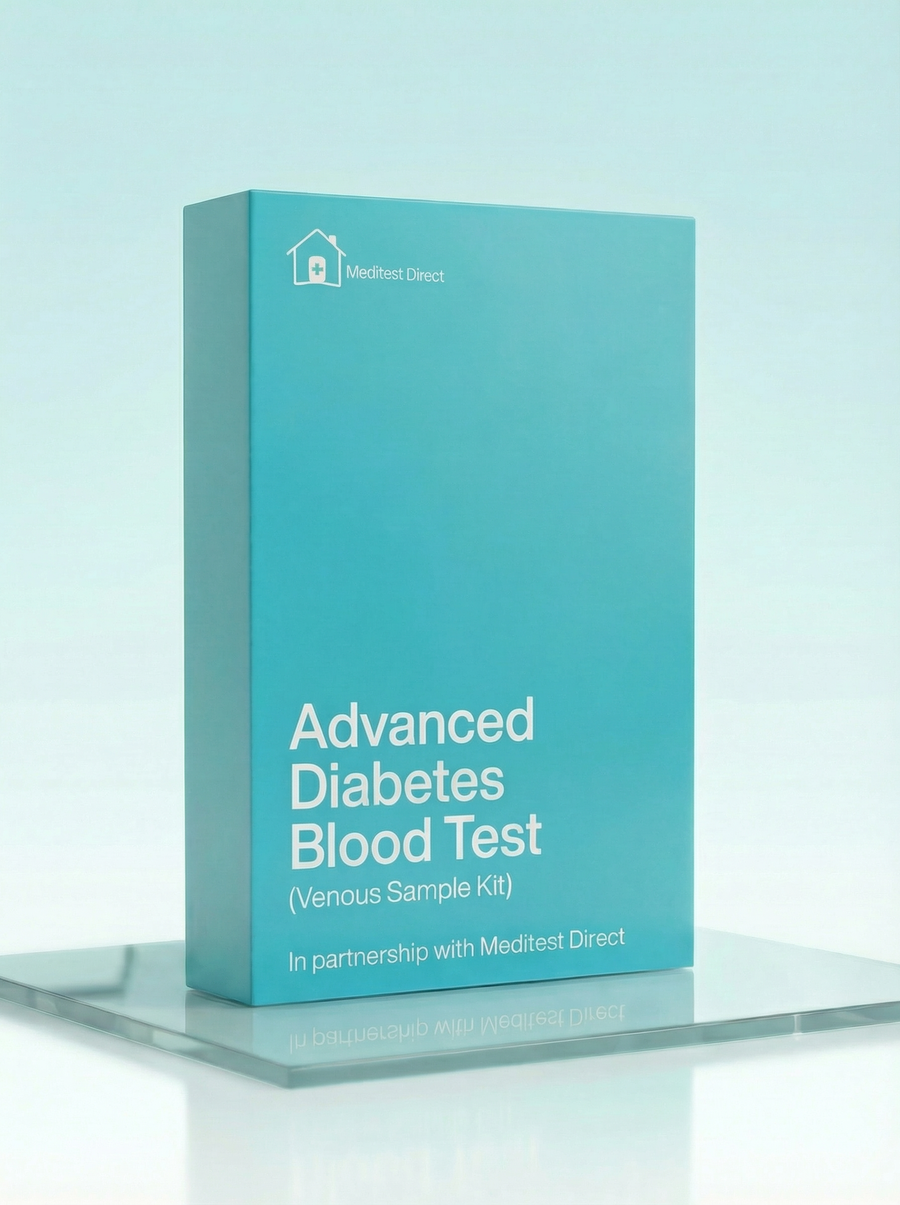
Advanced Diabetes Blood Test
£65 ✓ In Stock
Your sample goes to a UKAS accredited laboratory meeting ISO 15189 standards.
After you receive your order confirmation email, please reply with your date of birth.
How it works
Your testing journey
From order to results in four simple steps. Full transparency on where each step happens and what it costs.

Receive your kit by post
Dispatched same working day if ordered before 3pm. Royal Mail Tracked delivery, typically 1–3 working days. 90% of kits arrive within 24 hours.

Visit a partner clinic
Book a phlebotomy appointment at one of our 365+ UK partner clinics. Take your kit with you — the phlebotomist will collect your sample using the materials provided.
Phlebotomy fee applies (paid at clinic)
Venous blood draw at a clinic
A trained phlebotomist takes a small blood sample from a vein in your arm using the vacutainers provided in your kit. The appointment takes around 10 minutes.

Return by prepaid envelope
Seal your sample in the biohazard bag provided and drop it in any Royal Mail postbox using the prepaid Tracked 24 envelope. Post Monday–Thursday for best results.
Venous Blood Collection Kit
This kit is sent to you and taken to your chosen clinic. The phlebotomist will collect your sample using the materials provided.
- 1Vacutainer blood collection tubes
- 2Needle and butterfly needle
- 3Tourniquet
- 4Alcohol swab
- 5Cotton wool and gauze
- 6Adhesive plaster
- 7Biohazard specimen bag
- 8Prepaid return envelope (Royal Mail Tracked 24)
- 9Laboratory request form
- 10Instructions for the phlebotomist
eGFR (estimated Glomerular Filtration Rate) tells you how well your kidneys are filtering your blood—essentially measuring their efficiency. It's calculated from your creatinine level along with your age, sex, and ethnicity. A higher number is better: above 90 is generally normal, while lower numbers suggest declining kidney function. This marker is especially important for people with diabetes because diabetic kidney disease (nephropathy) is one of the most common complications of long-term high blood sugar. The good news is that kidney damage from diabetes develops slowly and can often be slowed or prevented with good blood sugar and blood pressure control. Regular eGFR monitoring helps catch problems early when intervention works best. Results outside the normal range may need a follow-up with your GP.
Total cholesterol is the overall amount of cholesterol in your blood—combining HDL ('good'), LDL ('bad'), and other types. Your body needs cholesterol to build cells, make hormones, and produce vitamin D, so it's not inherently bad. The issue is balance. For people with diabetes or prediabetes, cholesterol management is especially important because high blood sugar can damage blood vessels, and high cholesterol accelerates that damage. This is why cardiovascular disease is the leading complication of diabetes. Checking your total cholesterol alongside your HbA1c gives you both pieces of the metabolic puzzle. Results outside the normal range may need a follow-up with your GP.
LDL (low-density lipoprotein) is the 'bad' cholesterol that can build up in your artery walls and form plaques over time. For people with diabetes, LDL control is particularly critical—diabetes already increases cardiovascular risk, and high LDL compounds that significantly. Many diabetes guidelines recommend tighter LDL targets than for the general population, and statins are commonly prescribed even when LDL isn't dramatically elevated. Diet helps too: cutting back on saturated fats, eating more fibre, and maintaining a healthy weight can all bring LDL down. Lower is generally better for this marker. Results outside the normal range may need a follow-up with your GP.
HDL (high-density lipoprotein) is the 'good' cholesterol—you want this one higher. It works like a cleanup crew, collecting excess cholesterol from your arteries and transporting it back to your liver for disposal. Higher HDL levels are associated with lower cardiovascular risk. Unfortunately, people with diabetes often have lower HDL and higher triglycerides—a pattern sometimes called 'diabetic dyslipidaemia' that further increases heart disease risk. Exercise is one of the best ways to boost HDL, along with quitting smoking and eating healthy fats like olive oil and nuts. Results outside the normal range may need a follow-up with your GP.
Non-HDL cholesterol is your total cholesterol minus your HDL—so it captures all the potentially harmful types in one number. Many doctors now consider this a better predictor of cardiovascular risk than LDL alone, especially for people with diabetes. It includes LDL plus other problematic particles like VLDL (very low-density lipoprotein), which tends to be elevated when triglycerides are high—common in diabetes. The nice thing about non-HDL is that it's accurate even without fasting, making it a practical marker to track. Target is generally below 4 mmol/L for most people. Results outside the normal range may need a follow-up with your GP.
This ratio divides your total cholesterol by your HDL, giving you a quick snapshot of cardiovascular risk. It's useful because it shows the balance between all your cholesterol and the protective HDL fraction. A lower ratio is better—it means you have proportionally more of the good stuff. Someone with moderately high total cholesterol but excellent HDL might have a healthier ratio than someone with lower total cholesterol but rock-bottom HDL. For people with diabetes, this ratio is often part of the regular monitoring alongside HbA1c to track overall metabolic health. Results outside the normal range may need a follow-up with your GP.
Triglycerides are blood fats that your body uses for energy. When you eat more calories than you need, your body converts the excess into triglycerides and stores them in fat cells. They're particularly relevant in diabetes because high blood sugar and insulin resistance both drive triglycerides up. The classic 'diabetic dyslipidaemia' pattern is high triglycerides combined with low HDL and small, dense LDL particles—a triple threat for cardiovascular disease. Triglycerides respond well to lifestyle changes: cutting back on sugar, refined carbs, and alcohol can bring them down significantly. They're also heavily influenced by recent food intake, which is why avoiding fatty foods before testing helps. Results outside the normal range may need a follow-up with your GP.
HbA1c is the gold standard for measuring long-term blood sugar control. It tells you what your average blood glucose has been over the past 2-3 months by measuring how much sugar has attached to the haemoglobin in your red blood cells. Unlike a finger-prick glucose test that shows what's happening right now, HbA1c gives you the bigger picture—it won't be thrown off by what you ate yesterday or whether you fasted this morning. Doctors use specific thresholds: below 42 mmol/mol is normal, 42-47 indicates prediabetes (higher risk of developing diabetes), and 48 or above is in the diabetic range. If you're already managing diabetes, your target HbA1c will depend on your individual circumstances. Results outside the normal range may need a follow-up with your GP.
This is calculated from your HbA1c result and gives you an estimated average blood glucose in mmol/L—the same units you'd see on a home glucose meter. It helps translate your HbA1c into something more familiar and relatable to day-to-day readings. For example, an HbA1c of 48 mmol/mol roughly corresponds to an average glucose of about 8.6 mmol/L. While it's an estimate rather than a direct measurement, it's useful for understanding what your blood sugar has been doing on average over the past few months. If you monitor your glucose at home, you can compare this average to your own readings. Results outside the normal range may need a follow-up with your GP.
This test is for screening and information only — it is not a medical diagnosis or professional advice. Please have your results reviewed by a qualified doctor or healthcare provider who can explain what they mean for your personal health situation. If your results show anything outside the normal range, or if you're worried about your health, see your doctor as soon as you can. Don't change any medications or treatments based on these results alone — always talk to your healthcare provider first.
NO CLINICS, NO QUEUES, NO HASSLE
Four steps to clarity
 01
01
Pick your panel
Browse over 200 clinically designed test kits and choose the one that fits your goals.
 02
02
Kit to your door
Everything you need arrives in discreet packaging with step-by-step instructions inside.
 03
03
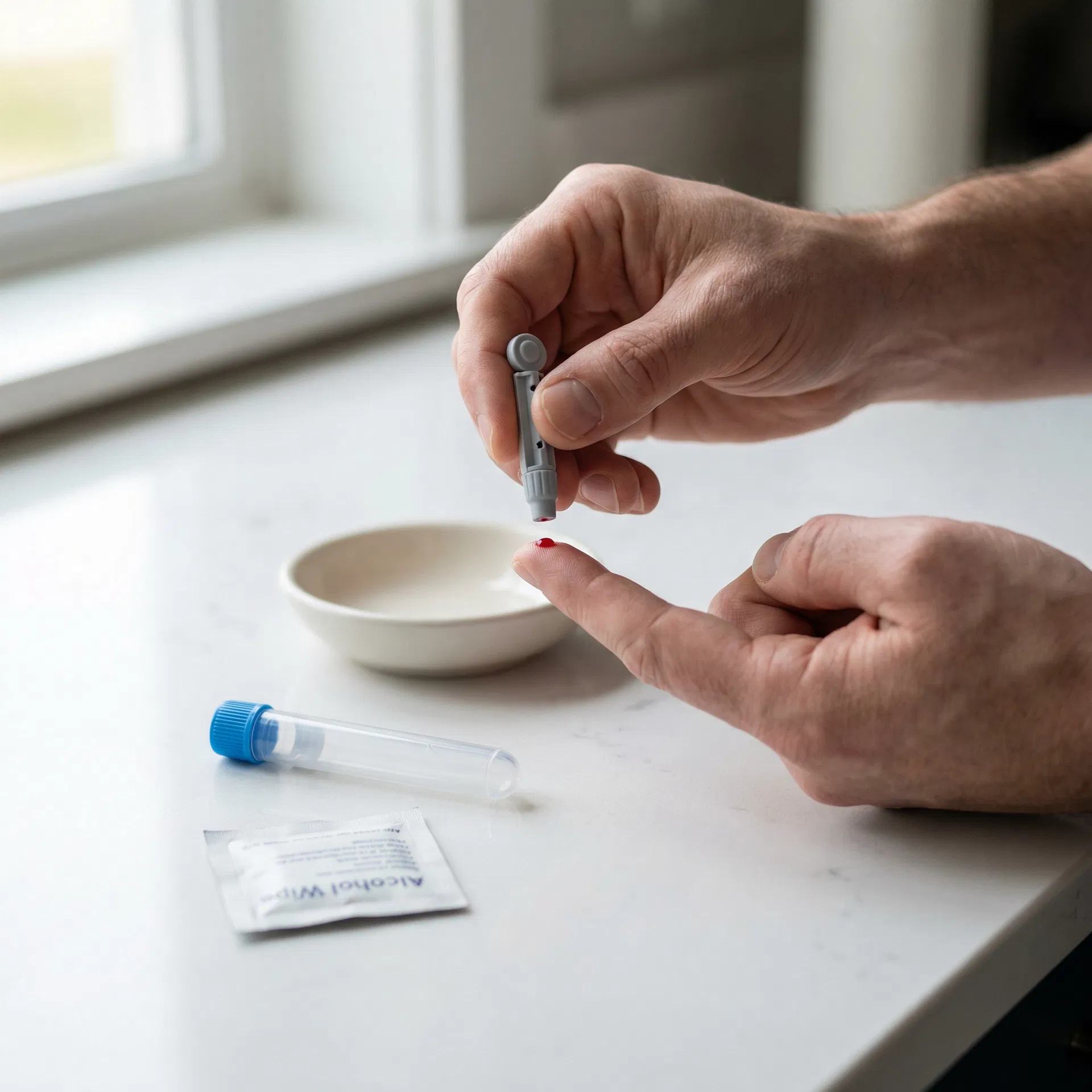
Collect your sample
Follow the simple instructions in your kit — whether it's a finger-prick at home or a venous draw at a partner clinic.
 04
04
Insights delivered
Clear, easy-to-understand results sent to you online with actionable health guidance.
Frequently asked questions
This test measures HbA1c (Glycated Haemoglobin), Average Blood Glucose, Total Cholesterol, LDL Cholesterol, HDL Cholesterol. Check the full biomarker list on this page for detailed descriptions of each marker and what it tells you about your health.
Check the Special Instructions section on this page. As a general rule, if the panel includes cholesterol, triglycerides, glucose, or insulin, fast for 8-12 hours. For most hormone, vitamin, and antibody tests, fasting is not required. Morning collection (7-10am) is preferred.
Follow the instructions in your kit. For finger-prick tests: warm your hands, use the lancet as directed, fill the tube to the marked line. For venous tests: attend a phlebotomy clinic with your laboratory request form. Post your sample the same day — avoid Fridays and bank holidays.
Results are typically available within the timeframe shown on this page. You will receive a notification when ready to view online. Results include reference ranges and guidance.
You may also be interested in

Diabetes (HbA1c) Blood Test Kit
A single-biomarker venous blood test covering diabetes — ideal for diabetes screening or monitoring blood sugar control.
Results estimated in 3 working days
1 biomarkers

Allergy Screen (Essential Foods) Blood Test
An essential food allergy panel testing for the most common food allergens responsible for IgE-mediated reactions — covering the key foods that account for the majority of food allergies in both children and adults.
Results estimated in 2 working days
9 biomarkers

Weight Loss Blood Test
A 23-biomarker venous blood panel covering thyroid hormones, hormones, adrenal hormones and other key health markers — ideal for investigating unexplained weight changes or metabolic imbalance.
Results estimated in 4 working days
23 biomarkers