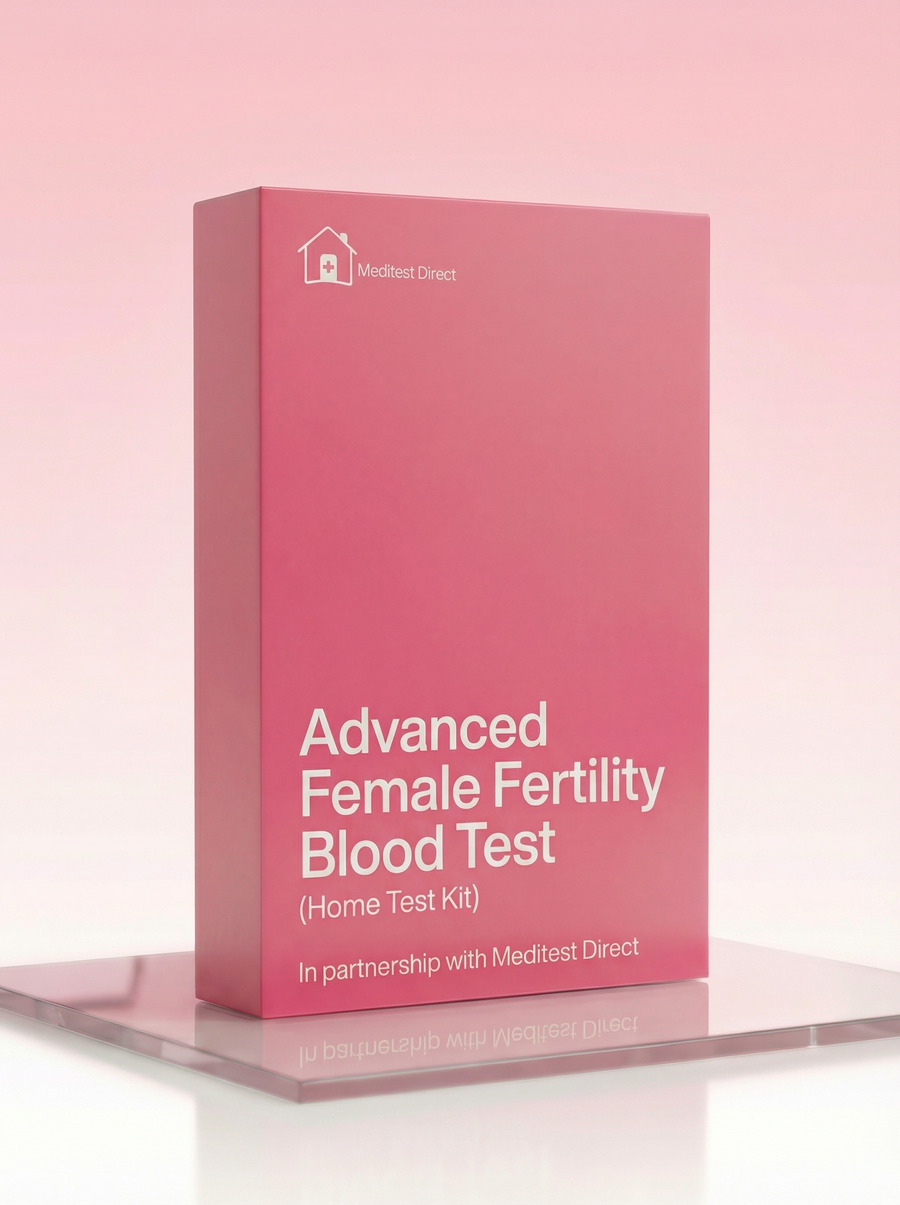
Advanced Female Fertility Blood Test Kit
£158 ✓ In Stock
Your sample goes to a UKAS accredited laboratory meeting ISO 15189 standards.
After you receive your order confirmation email, please reply with your date of birth.
How it works
Your testing journey
From order to results in four simple steps. Full transparency on where each step happens and what it costs.

Receive your kit by post
Dispatched same working day if ordered before 3pm. Royal Mail Tracked delivery, typically 1–3 working days. 90% of kits arrive within 24 hours.

Collect at home
Everything you need is in the kit. Collect your sample in the privacy of your own home — no appointment needed, no clinic visit.
Included in kit price
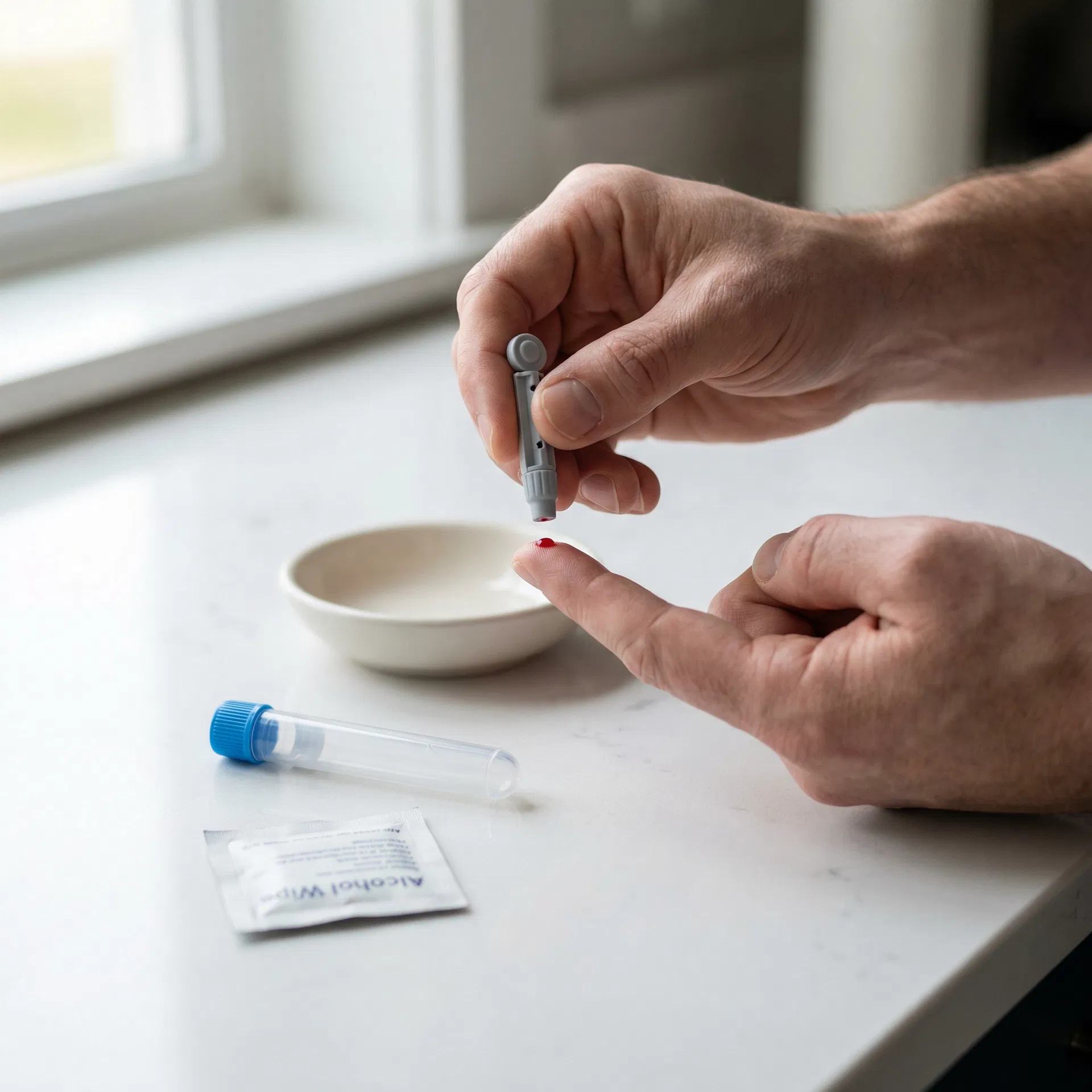
Small finger-prick sample
Use the single-use lancet included in your kit to take a few drops of blood from your fingertip — similar to how diabetics check their blood sugar. Takes about 2 minutes.

Return by prepaid envelope
Seal your sample in the biohazard bag provided and drop it in any Royal Mail postbox using the prepaid Tracked 24 envelope. Post Monday–Thursday for best results.
Home Finger-Prick Blood Collection Kit
- 1Blood collection tube
- 2Single-use lancet device
- 3Sterile gauze pad
- 4Adhesive plaster
- 5Cleansing wipe
- 6Biohazard specimen bag
- 7Prepaid return envelope (Royal Mail Tracked 24)
- 8Step-by-step instructions
Oestradiol is the primary female sex hormone, produced mainly by your ovaries. It's the hormone that drives your menstrual cycle—stimulating the growth of the uterine lining, triggering the release of LH that causes ovulation, and supporting egg development in the follicles. Oestradiol levels fluctuate dramatically throughout your cycle: they're low during your period, rise as follicles develop, peak just before ovulation, then rise again in the luteal phase. When measured on days 2-5 of your cycle (the follicular phase), oestradiol should be relatively low. Higher-than-expected levels at this time might suggest a cyst, early follicle development, or diminishing ovarian reserve where remaining follicles are working harder. Low levels might indicate ovarian dysfunction or perimenopause. Results outside the normal range may need a follow-up with your GP.
FSH is released by your pituitary gland and does exactly what its name suggests—it stimulates the follicles in your ovaries to grow and mature eggs. Early in your cycle, FSH rises to recruit follicles; as the dominant follicle produces oestradiol, this feeds back to reduce FSH. When measured on days 2-5, FSH gives insight into your ovarian reserve. If your ovaries have fewer eggs remaining, they produce less inhibin B (a hormone that suppresses FSH), so FSH levels rise—your pituitary is working harder to stimulate follicle growth. Elevated FSH suggests diminished ovarian reserve or approaching menopause. Very low FSH might indicate pituitary problems or that something is suppressing your hypothalamic-pituitary axis. FSH is most meaningful when interpreted alongside oestradiol and AMH. Results outside the normal range may need a follow-up with your GP.
LH is the hormone that triggers ovulation. Throughout most of your cycle, LH stays relatively low, but when oestradiol from the dominant follicle reaches a threshold, it triggers a massive LH surge—this causes the follicle to rupture and release the egg within 24-36 hours. After ovulation, LH supports the corpus luteum (the remains of the follicle) in producing progesterone. When measured on days 2-5, LH should be similar to or slightly lower than FSH. An elevated LH: FSH ratio (often 2:1 or 3:1) is a characteristic finding in polycystic ovary syndrome (PCOS), where multiple small follicles produce excess LH-stimulating signals. Consistently elevated LH can also indicate primary ovarian insufficiency. Results outside the normal range may need a follow-up with your GP.
While testosterone is primarily known as a male hormone, women produce it too—in the ovaries and adrenal glands—and it plays important roles in libido, energy, muscle mass, and bone density. In women, most testosterone is bound to proteins and inactive; only a small 'free' fraction is biologically active. Elevated testosterone in women is one of the hallmark findings in PCOS and can cause symptoms like acne, excess facial or body hair (hirsutism), and irregular periods. Very high testosterone might indicate an androgen-producing tumour. Low testosterone can contribute to low libido, fatigue, and reduced wellbeing, though it's less commonly tested for in women. Testosterone is best interpreted alongside SHBG, which determines how much is freely available. Results outside the normal range may need a follow-up with your GP.
DHEA sulphate (DHEA-S) is an androgen produced almost exclusively by your adrenal glands. It serves as a precursor hormone—your body can convert it into testosterone and oestrogen as needed. DHEA-S levels are remarkably stable throughout the day and don't fluctuate with your menstrual cycle, making it a reliable marker for adrenal androgen production. Elevated DHEA-S points specifically to adrenal androgen excess rather than ovarian, which helps distinguish between different causes of high testosterone. It can be elevated in PCOS (though ovarian androgens are usually more prominent), congenital adrenal hyperplasia, and adrenal tumours. DHEA-S naturally peaks in your 20s and gradually declines with age. Low levels are generally less concerning but can contribute to fatigue. Results outside the normal range may need a follow-up with your GP.
Prolactin is best known for stimulating breast milk production, but it has important effects on fertility too. Elevated prolactin (hyperprolactinaemia) suppresses the release of GnRH from the hypothalamus, which in turn reduces FSH and LH, disrupting ovulation and causing irregular or absent periods. This is why breastfeeding can act as a natural contraceptive. Outside of pregnancy and breastfeeding, elevated prolactin can be caused by pituitary adenomas (usually benign), certain medications (especially antipsychotics and some antidepressants), hypothyroidism, and stress. Prolactin is highly sensitive to stress, sleep, nipple stimulation, and even the stress of blood collection—which is why it's important to test in the morning, at least an hour after waking, in a relaxed state. A single elevated result often needs repeating to confirm. Results outside the normal range may need a follow-up with your GP.
TSH is produced by your pituitary gland and controls how much thyroid hormone your thyroid produces. It's included in this fertility panel because thyroid function is intimately connected with reproductive health. Both hypothyroidism (underactive thyroid, high TSH) and hyperthyroidism (overactive thyroid, low TSH) can disrupt menstrual cycles, impair ovulation, and affect fertility. Even subclinical hypothyroidism—where TSH is elevated but thyroid hormones are still normal—has been associated with difficulty conceiving and increased miscarriage risk. Most fertility specialists aim for TSH below 2.5 mIU/L when trying to conceive, which is tighter than the general population reference range. TSH works like a thermostat: when thyroid hormones are low, TSH rises to stimulate more production; when they're high, TSH drops. Results outside the normal range may need a follow-up with your GP.
Free T4 is the unbound, active form of thyroxine—the main hormone your thyroid produces. Most T4 in your blood is bound to proteins and inactive; Free T4 is what's actually available to enter cells. T4 is essentially a storage and transport hormone—it gets converted to the more active T3 in your tissues as needed. Measuring Free T4 alongside TSH helps confirm thyroid dysfunction. Low Free T4 with high TSH confirms hypothyroidism; high Free T4 with low TSH confirms hyperthyroidism. Sometimes TSH is abnormal but Free T4 is normal—this 'subclinical' thyroid dysfunction can still affect fertility and is worth monitoring. Adequate T4 is essential for normal follicle development and ovulation. Results outside the normal range may need a follow-up with your GP.
Free T3 is the most active thyroid hormone—the one that actually does the work in your cells, controlling metabolism, energy production, and affecting virtually every organ system including your reproductive system. Most T3 is made by converting T4 in your tissues rather than directly by the thyroid. Some people have normal T4 but don't convert it efficiently to T3, which can cause hypothyroid symptoms despite 'normal' standard thyroid tests. Including Free T3 alongside TSH and Free T4 gives the most complete picture of your thyroid function. T3 is particularly important for detecting hyperthyroidism early, where it often rises before T4 does. For fertility, adequate T3 supports egg maturation, ovulation, and early pregnancy. Results outside the normal range may need a follow-up with your GP.
AMH is produced by the small antral follicles in your ovaries—the pool of follicles waiting to be recruited for ovulation. This makes it the best blood test for estimating ovarian reserve (your remaining egg count). Unlike FSH, LH, and oestradiol, AMH doesn't fluctuate significantly throughout your menstrual cycle, so it can be tested on any day—though we include it in this panel timed with the other hormones for convenience. Higher AMH suggests a larger ovarian reserve; lower AMH indicates fewer remaining eggs. AMH naturally declines with age as your follicle pool diminishes. Very low AMH doesn't mean you can't conceive naturally—it means your window may be shorter and you may have fewer eggs available for IVF if needed. Very high AMH (often with high antral follicle count) can indicate PCOS. It's important to note that AMH reflects quantity, not quality—it can't tell you about egg health or your chances of a healthy pregnancy. Results outside the normal range may need a follow-up with your GP.
Albumin is the most abundant protein in your blood, produced by your liver. In the context of a fertility panel, albumin is included because it's needed to calculate free androgen levels. Hormones like testosterone circulate in your blood in two forms: bound to proteins (mainly SHBG and albumin) and free. Only the free fraction is biologically active. By measuring albumin alongside testosterone and SHBG, the lab can calculate your Free Androgen Index—a more accurate reflection of how much testosterone is actually available to your tissues. Albumin itself also reflects your overall nutritional status and liver function, both of which can affect fertility. Low albumin can occur with malnutrition, liver disease, or chronic illness. Results outside the normal range may need a follow-up with your GP.
SHBG is a protein made by your liver that binds to sex hormones—primarily testosterone and oestradiol—and transports them through your bloodstream. When hormones are bound to SHBG, they're inactive; only the unbound 'free' fraction can enter cells and have effects. This makes SHBG a key regulator of how much sex hormone is actually available to your body. Low SHBG means more free testosterone and oestradiol—this is commonly seen in PCOS, insulin resistance, obesity, and hypothyroidism. It can cause symptoms of androgen excess even when total testosterone is normal. High SHBG means less free hormone is available—this can occur with hyperthyroidism, liver disease, oral contraceptives, and oestrogen therapy. In the context of fertility, SHBG helps interpret testosterone levels and understand your overall hormonal balance. Results outside the normal range may need a follow-up with your GP.
This test is for screening and information only — it is not a medical diagnosis or professional advice. Please have your results reviewed by a qualified doctor or healthcare provider who can explain what they mean for your personal health situation. If your results show anything outside the normal range, or if you're worried about your health, see your doctor as soon as you can. Don't change any medications or treatments based on these results alone — always talk to your healthcare provider first.
NO CLINICS, NO QUEUES, NO HASSLE
Four steps to clarity
 01
01
Pick your panel
Browse over 200 clinically designed test kits and choose the one that fits your goals.
 02
02
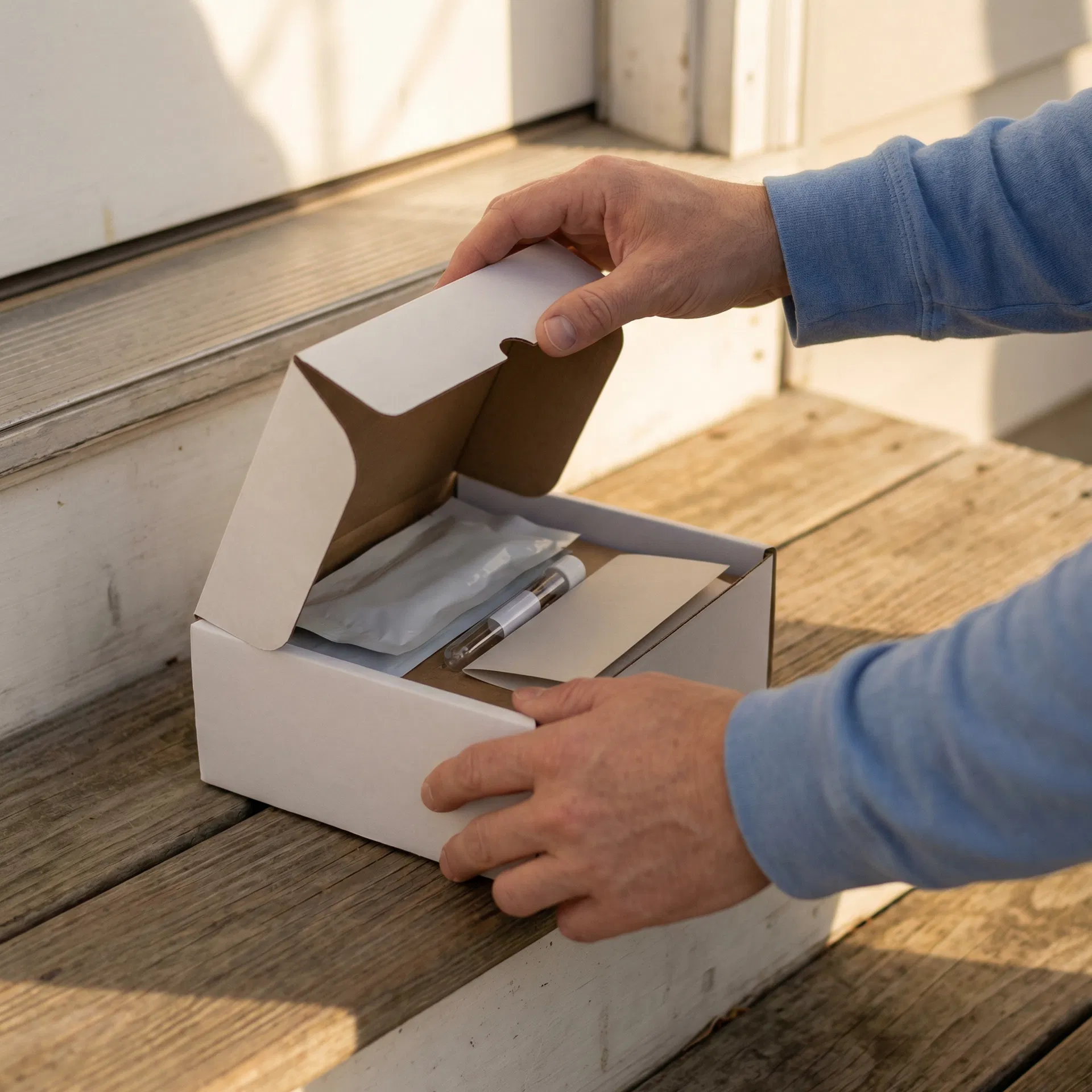
Kit to your door
Everything you need arrives in discreet packaging with step-by-step instructions inside.
 03
03
Collect your sample
Follow the simple instructions in your kit — whether it's a finger-prick at home or a venous draw at a partner clinic.
 04
04
Insights delivered
Clear, easy-to-understand results sent to you online with actionable health guidance.
Frequently asked questions
Collect your sample between days 2 and 5 of your menstrual cycle, ideally on day 3. Day 1 is the first day of full menstrual flow (not spotting). This timing is essential because FSH, LH, oestradiol, and AMH are interpreted against day 2-5 reference ranges. Testing at the wrong time will make the results difficult to interpret accurately.
You can take the test while on hormonal contraception, but your results will reflect your medicated hormone levels, not your natural baseline. Hormonal contraceptives suppress FSH, LH, and oestradiol production. If you want to assess your natural fertility hormone levels, you would need to stop hormonal contraception for at least 3 months — but always discuss this with your GP first.
AMH (Anti-Müllerian Hormone) is produced by cells in your ovarian follicles and reflects your ovarian reserve — the approximate number of eggs remaining. Unlike FSH and LH, AMH is relatively stable throughout your cycle and can be tested on any day. A lower AMH may indicate a reduced egg reserve, which is relevant for family planning timelines and IVF decisions. AMH declines naturally with age.
This advanced panel includes 12 biomarkers: oestradiol, FSH, LH, testosterone, DHEA sulphate, prolactin, TSH, Free T4, Free T3, AMH, plus albumin and SHBG. A basic fertility test typically only checks FSH and LH. The additional markers give a more complete picture, including thyroid function (which directly affects fertility), prolactin (which can suppress ovulation if elevated), and androgen levels (relevant for PCOS assessment).
AMH measured from a finger-prick sample processed by a UKAS-accredited laboratory is clinically validated and used by fertility clinics for assessment. The small sample volume from a finger-prick is sufficient for modern immunoassay techniques. Results are comparable to those from a venous blood draw performed in a clinic.
You may also be interested in

Female Infertility Check Blood test
A 4-biomarker venous blood panel covering female fertility hormones — ideal for investigating female fertility and reproductive health.
Results estimated in 2 working days
4 biomarkers

Testosterone, Free Testosterone and Oestradiol Blood Test
A 5-biomarker venous blood panel covering hormones and proteins — ideal for investigating low testosterone, libido, energy, or hormone replacement monitoring.
Results estimated in 2 working days
5 biomarkers

Ultimate Performance Blood Test Kit
A 56-biomarker venous blood panel covering cholesterol status, diabetes, liver function and other key health markers — ideal for athletes and active people tracking training adaptation, recovery, and performance.
Results estimated in 3 working days
56 biomarkers