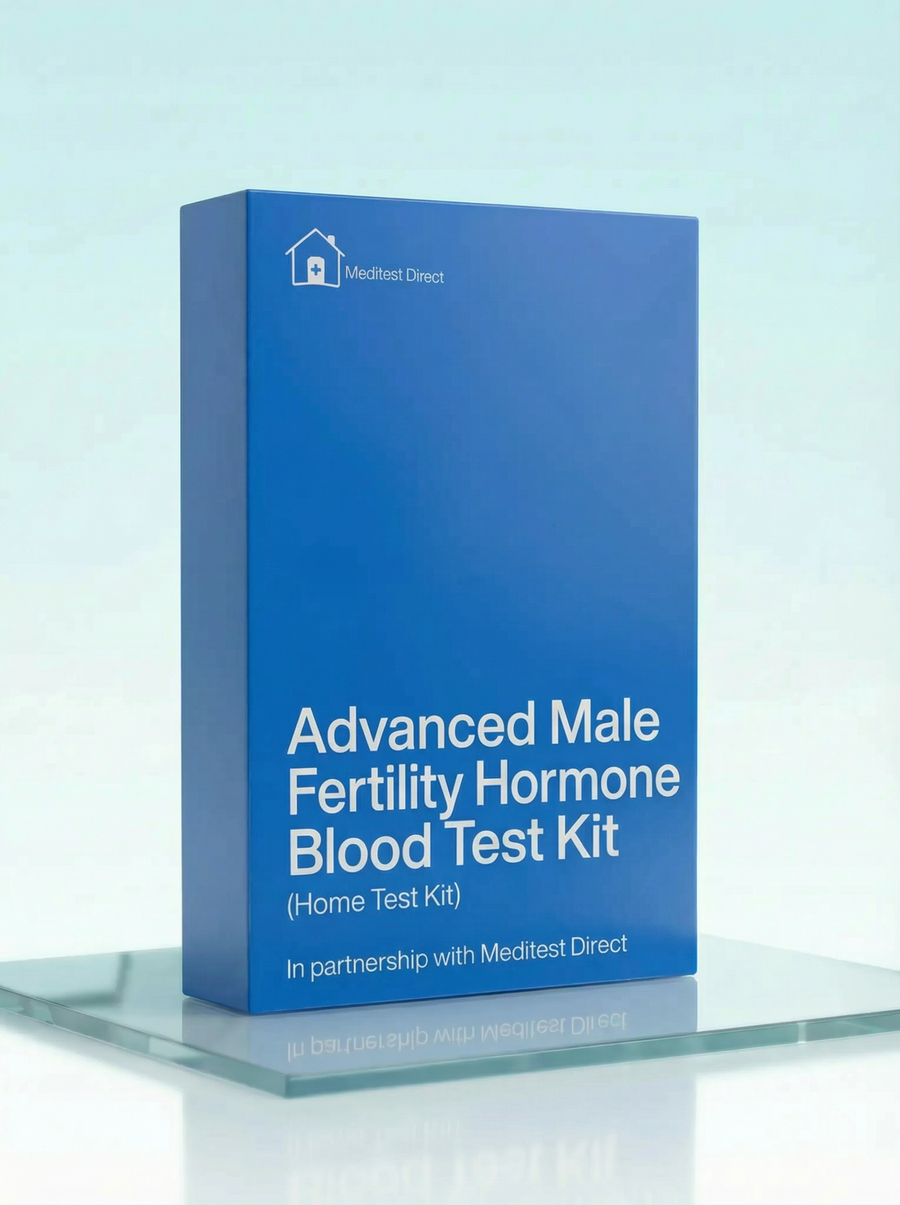
Advanced Male Fertility Hormone Blood Test Kit
£71 ✓ In Stock
Your sample goes to a UKAS accredited laboratory meeting ISO 15189 standards.
After you receive your order confirmation email, please reply with your date of birth.
How it works
Your testing journey
From order to results in four simple steps. Full transparency on where each step happens and what it costs.

Receive your kit by post
Dispatched same working day if ordered before 3pm. Royal Mail Tracked delivery, typically 1–3 working days. 90% of kits arrive within 24 hours.

Visit a partner clinic
Book a phlebotomy appointment at one of our 365+ UK partner clinics. Take your kit with you — the phlebotomist will collect your sample using the materials provided.
Phlebotomy fee applies (paid at clinic)

Multiple samples
This test uses 2 sample types. Instructions for each are included in your kit.

Return by prepaid envelope
Seal your sample in the biohazard bag provided and drop it in any Royal Mail postbox using the prepaid Tracked 24 envelope. Post Monday–Thursday for best results.
Venous Blood Collection Kit
This kit is sent to you and taken to your chosen clinic. The phlebotomist will collect your sample using the materials provided.
- 1Vacutainer blood collection tubes
- 2Needle and butterfly needle
- 3Tourniquet
- 4Alcohol swab
- 5Cotton wool and gauze
- 6Adhesive plaster
- 7Biohazard specimen bag
- 8Prepaid return envelope (Royal Mail Tracked 24)
- 9Laboratory request form
- 10Instructions for the phlebotomist
Semen Collection Kit
- 1Specimen collection cup
- 2Biohazard specimen bag
- 3Prepaid return envelope (Royal Mail Tracked 24)
- 4Step-by-step instructions
FSH is produced by your pituitary gland and is essential for sperm production. In men, FSH acts on the Sertoli cells in the testicles—these are the 'nurse cells' that support and nourish developing sperm throughout the 70+ day process of spermatogenesis. Without adequate FSH signalling, sperm production is impaired. The pituitary gland adjusts FSH output based on feedback from the testicles—if the testicles are struggling to produce sperm, FSH rises as the pituitary tries harder to stimulate them. High FSH in men typically indicates primary testicular failure—the testicles themselves aren't responding properly, often due to damage, genetic factors, or previous treatments like chemotherapy. Low FSH suggests the pituitary isn't sending adequate signals, which can occur with pituitary disorders or when testosterone levels are very high (including from testosterone replacement therapy). Results outside the normal range may need a follow-up with your GP.
LH is produced by your pituitary gland and stimulates the Leydig cells in your testicles to produce testosterone. Think of LH as the messenger that tells your testicles to make testosterone. The pituitary releases LH in pulses throughout the day, with the highest levels typically in the early morning. Your body uses feedback loops to regulate this—when testosterone is low, LH rises to stimulate more production; when testosterone is high, LH drops. High LH with low testosterone suggests primary hypogonadism—your pituitary is shouting at testicles that aren't responding, possibly due to testicular damage, genetic conditions, or age-related decline. Low LH with low testosterone suggests secondary hypogonadism—the problem is with the pituitary or hypothalamus, not the testicles. LH and FSH together help pinpoint where in the hormonal axis the problem lies. Results outside the normal range may need a follow-up with your GP.
Testosterone is the primary male sex hormone, produced mainly by the Leydig cells in your testicles (with small amounts from the adrenal glands). It's essential for male fertility—driving sperm production, maintaining libido, and supporting the function of reproductive organs. Beyond fertility, testosterone affects muscle mass, bone density, fat distribution, red blood cell production, mood, and energy levels. Testosterone naturally declines with age, dropping about 1-2% per year after age 30, though this varies considerably between individuals. Low testosterone (hypogonadism) can cause reduced sperm production, low libido, erectile dysfunction, fatigue, loss of muscle mass, increased body fat, mood changes, and difficulty concentrating. Total testosterone measures all testosterone in your blood—both bound and free. However, only free testosterone is biologically active, which is why this panel also calculates free testosterone. Results outside the normal range may need a follow-up with your GP.
Most testosterone in your blood is bound to proteins—about 60-70% to SHBG (tightly bound and inactive) and about 25-35% to albumin (loosely bound). Only 2-3% circulates as free testosterone, which is the biologically active form that can enter cells and exert effects. This test calculates your free testosterone using your total testosterone, SHBG, and albumin levels—this calculated value closely approximates directly measured free testosterone. Free testosterone is often more clinically meaningful than total testosterone because it reflects what's actually available to your tissues. You can have normal total testosterone but low free testosterone if your SHBG is high—this can happen with ageing, liver disease, hyperthyroidism, and certain medications. Conversely, you can have low-normal total testosterone but adequate free testosterone if SHBG is low (common with obesity, insulin resistance, and hypothyroidism). Results outside the normal range may need a follow-up with your GP.
Prolactin is produced by the pituitary gland and is best known for stimulating milk production in women—but men produce it too, and elevated levels can significantly impact male fertility. High prolactin (hyperprolactinaemia) in men suppresses GnRH from the hypothalamus, which in turn reduces LH and FSH, leading to decreased testosterone production and impaired sperm production. Symptoms of high prolactin in men include low libido, erectile dysfunction, reduced energy, and sometimes breast enlargement or discharge. Causes include pituitary adenomas (usually benign tumours), certain medications (especially antipsychotics, some antidepressants, and anti-nausea drugs), hypothyroidism, and stress. Prolactin is sensitive to many factors—stress, nipple stimulation, heavy meals, and even the stress of blood collection can temporarily raise it. A single elevated result often needs confirming with a repeat test under optimal conditions. Results outside the normal range may need a follow-up with your GP.
Albumin is the most abundant protein in your blood, produced by your liver. In the context of a male fertility hormone panel, albumin is included because it's one of the proteins that binds testosterone in your blood—about 25-35% of your testosterone is loosely bound to albumin. This binding is loose enough that albumin-bound testosterone is sometimes considered 'bioavailable' alongside truly free testosterone, as it can dissociate relatively easily. By measuring albumin alongside total testosterone and SHBG, the lab can accurately calculate your free testosterone—the fraction that's biologically active. Albumin levels also reflect your overall nutritional status and liver function. Low albumin can occur with malnutrition, liver disease, or chronic illness—all of which can independently affect hormone levels and fertility. Very low albumin might affect the free testosterone calculation. Results outside the normal range may need a follow-up with your GP.
SHBG is a protein made by your liver that binds sex hormones—primarily testosterone and oestrogen—and transports them through your bloodstream. Testosterone bound to SHBG is tightly held and inactive; it can't enter cells or exert effects. This makes SHBG a key regulator of how much testosterone is actually available to your body. High SHBG means more testosterone is bound up and unavailable—you might have 'normal' total testosterone but low free testosterone and experience symptoms of deficiency. SHBG increases with age, hyperthyroidism, liver disease, HIV, certain medications, and low body weight. Low SHBG means more testosterone is free and available—this can occur with obesity, insulin resistance, type 2 diabetes, hypothyroidism, and androgen use. Very low SHBG with normal total testosterone means high free testosterone, which is usually fine. Understanding your SHBG is essential for interpreting testosterone results correctly. Results outside the normal range may need a follow-up with your GP.
This test is for screening and information only — it is not a medical diagnosis or professional advice. Please have your results reviewed by a qualified doctor or healthcare provider who can explain what they mean for your personal health situation. If your results show anything outside the normal range, or if you're worried about your health, see your doctor as soon as you can. Don't change any medications or treatments based on these results alone — always talk to your healthcare provider first.
NO CLINICS, NO QUEUES, NO HASSLE
Four steps to clarity
 01
01
Pick your panel
Browse over 200 clinically designed test kits and choose the one that fits your goals.
 02
02
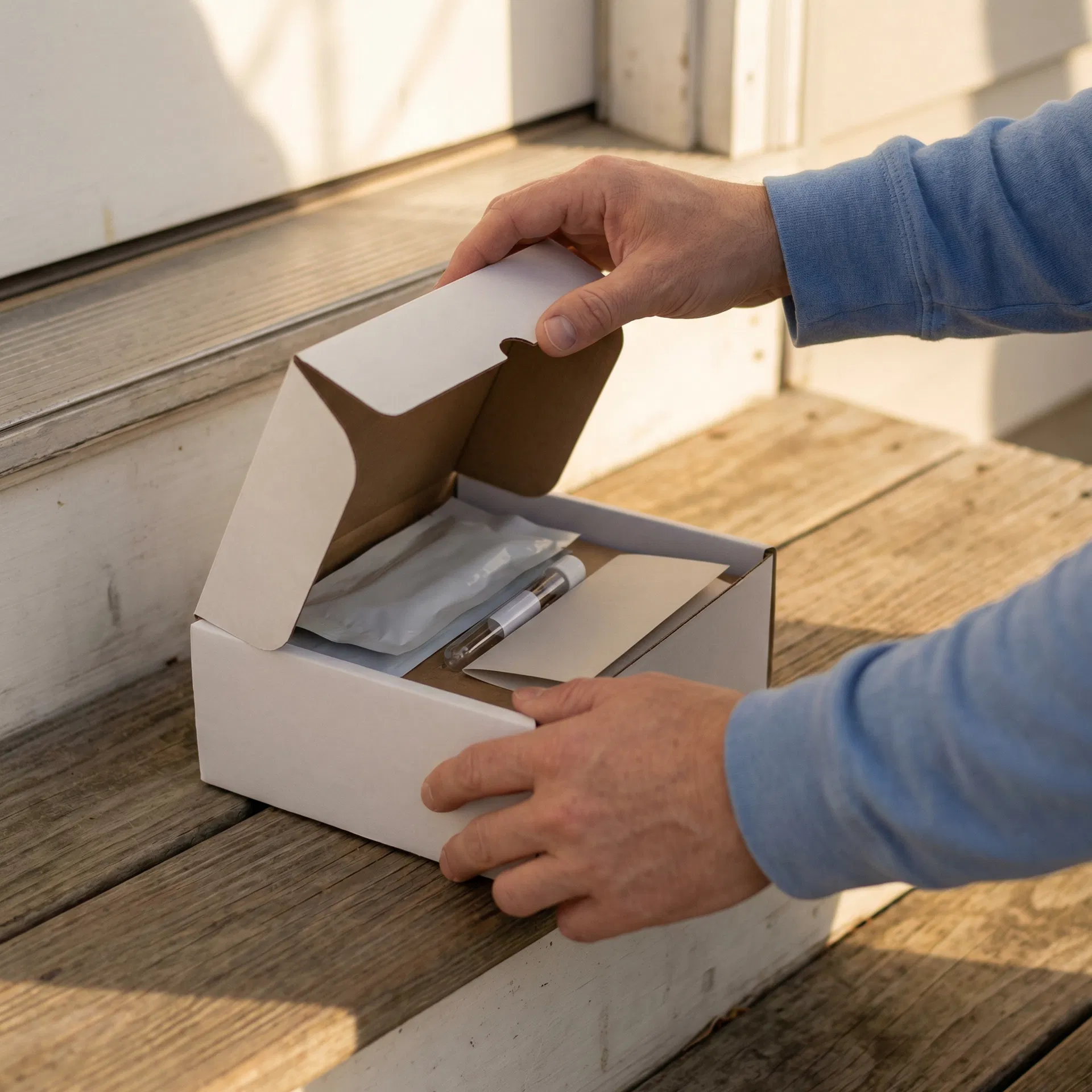
Kit to your door
Everything you need arrives in discreet packaging with step-by-step instructions inside.
 03
03
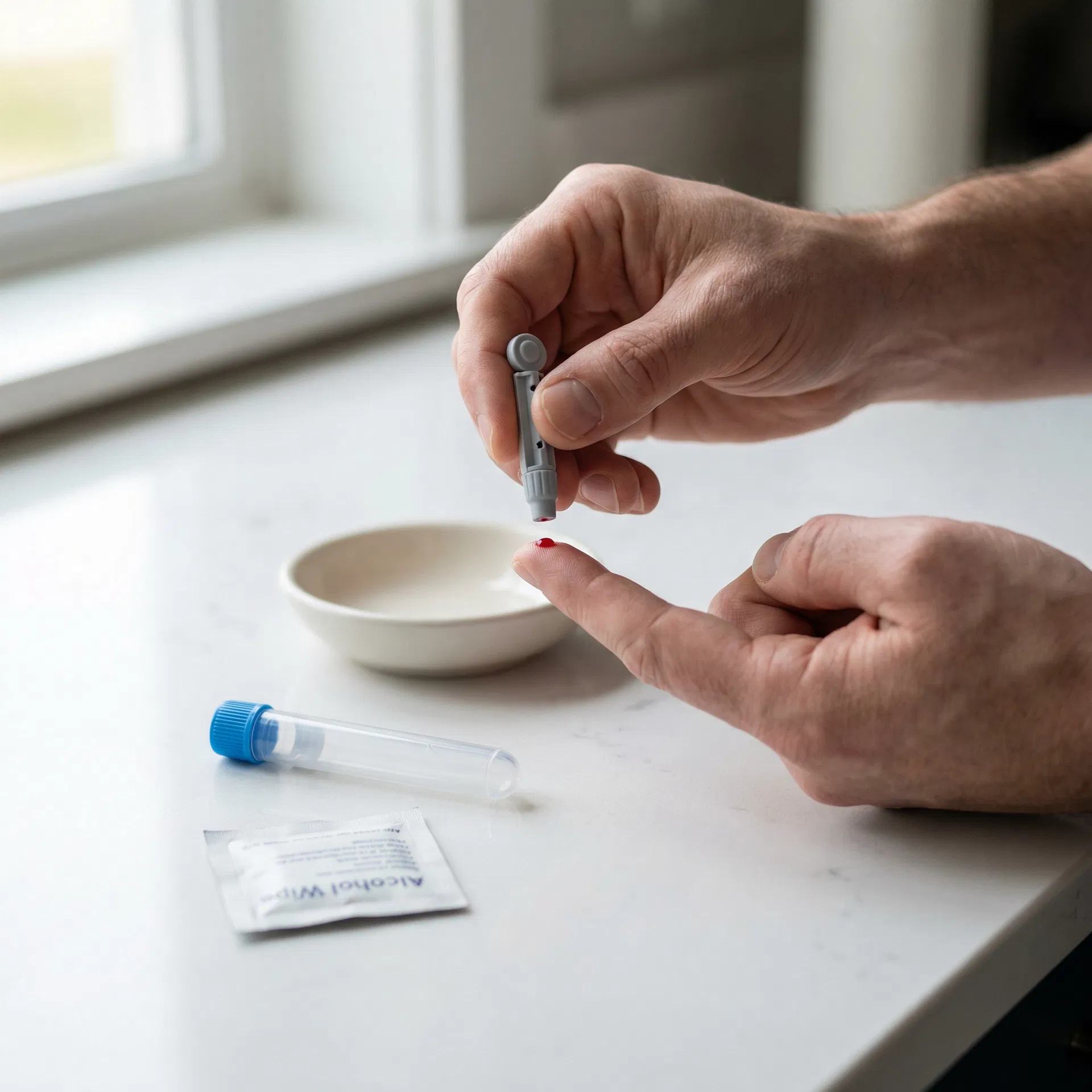
Collect your sample
Follow the simple instructions in your kit — whether it's a finger-prick at home or a venous draw at a partner clinic.
 04
04
Insights delivered
Clear, easy-to-understand results sent to you online with actionable health guidance.
Frequently asked questions
Between 6am and 10am, at least one hour after waking. Testosterone follows a circadian rhythm — it peaks in the early morning and can drop by 30-50% by the afternoon. Testing outside this window may show a falsely low testosterone level that does not reflect your true baseline. Aim for a consistent time if you plan to retest later for comparison.
This advanced panel includes 7 biomarkers: FSH, LH, total testosterone, free testosterone (calculated), prolactin, SHBG, and albumin. A basic testosterone test only measures total testosterone. The additional markers reveal why testosterone might be low (pituitary vs testicular cause via FSH/LH), how much testosterone is actually available to your body (free testosterone via SHBG and albumin), and whether prolactin is suppressing your reproductive axis.
Avoid intense exercise for 24 hours before collecting your sample. Heavy training temporarily affects testosterone, cortisol, and other hormone levels and may not reflect your true baseline. A sample taken on a rest day, after a normal night's sleep, gives the most accurate and clinically useful results.
Yes. Testosterone naturally declines with age, typically by about 1-2% per year after age 30. Reference ranges account for this to some degree, but a result that is 'normal' for a 55-year-old may be low for a 25-year-old. FSH and LH also change with age. Your GP will interpret results in the context of your age, symptoms, and overall health.
A single low testosterone result should be confirmed with a repeat test before any treatment decisions. Many factors can temporarily lower testosterone including poor sleep, stress, illness, obesity, and some medications. If confirmed on a repeat morning sample, your GP may investigate further with additional tests and discuss whether testosterone replacement therapy (TRT) is appropriate for your situation.
You may also be interested in

Female Infertility Check Blood test
A 4-biomarker venous blood panel covering female fertility hormones — ideal for investigating female fertility and reproductive health.
Results estimated in 2 working days
4 biomarkers

Advanced Female Fertility Blood Test Kit
A 12-biomarker venous blood panel covering hormones and proteins — ideal for investigating female fertility and reproductive health.
Results estimated in 2 working days
12 biomarkers

Advanced Well Woman Blood Test
A 47-biomarker venous blood panel covering cholesterol status, clotting status, diabetes and other key health markers — ideal for comprehensive female health screening across multiple body systems.
Results estimated in 3 working days
47 biomarkers