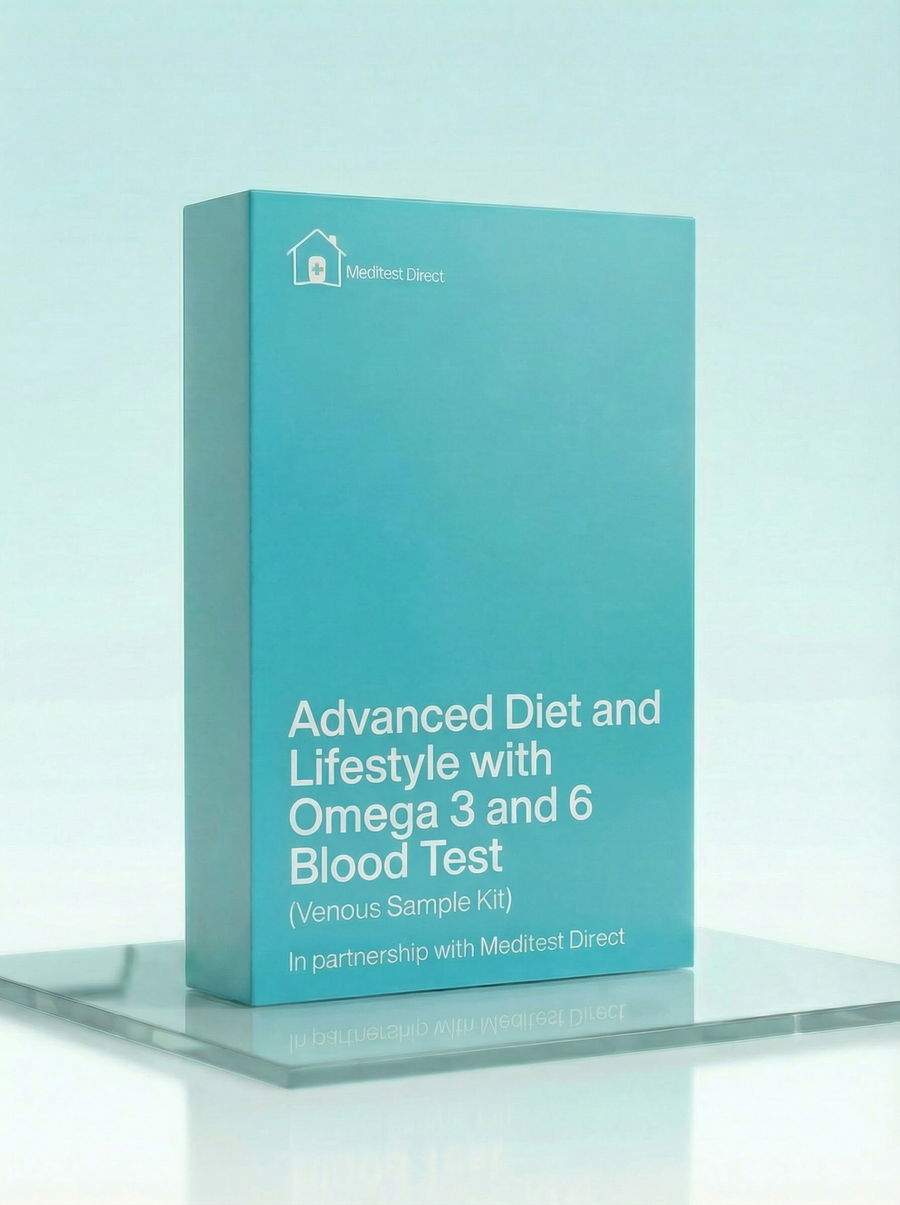
Advanced Diet and Lifestyle with Omega 3 and 6 Blood Test Kit
£175 ✓ In Stock
Your sample goes to a UKAS accredited laboratory meeting ISO 15189 standards.
After you receive your order confirmation email, please reply with your date of birth.
How it works
Your testing journey
From order to results in four simple steps. Full transparency on where each step happens and what it costs.

Receive your kit by post
Dispatched same working day if ordered before 3pm. Royal Mail Tracked delivery, typically 1–3 working days. 90% of kits arrive within 24 hours.

Visit a partner clinic
Book a phlebotomy appointment at one of our 365+ UK partner clinics. Take your kit with you — the phlebotomist will collect your sample using the materials provided.
Phlebotomy fee applies (paid at clinic)
Venous blood draw at a clinic
A trained phlebotomist takes a small blood sample from a vein in your arm using the vacutainers provided in your kit. The appointment takes around 10 minutes.

Return by prepaid envelope
Seal your sample in the biohazard bag provided and drop it in any Royal Mail postbox using the prepaid Tracked 24 envelope. Post Monday–Thursday for best results.
Venous Blood Collection Kit
This kit is sent to you and taken to your chosen clinic. The phlebotomist will collect your sample using the materials provided.
- 1Vacutainer blood collection tubes
- 2Needle and butterfly needle
- 3Tourniquet
- 4Alcohol swab
- 5Cotton wool and gauze
- 6Adhesive plaster
- 7Biohazard specimen bag
- 8Prepaid return envelope (Royal Mail Tracked 24)
- 9Laboratory request form
- 10Instructions for the phlebotomist
Serum iron measures the amount of iron circulating in your blood right now. Your body needs iron to make haemoglobin—the protein in red blood cells that carries oxygen—and it's also essential for energy production, immune function, and brain health. Serum iron fluctuates quite a bit throughout the day and can be affected by recent meals, so it's best interpreted alongside ferritin and transferrin saturation rather than on its own. Low iron is common, especially in women, vegetarians, and people with heavy periods or digestive issues. Very high iron can indicate iron overload conditions. Results outside the normal range may need a follow-up with your GP.
TIBC measures how much transferrin—the protein that carries iron around your blood—is available to bind iron. Think of it as measuring the 'empty seats' on the iron transport system. When iron stores are low, your body makes more transferrin to try to capture every bit of iron it can, so TIBC goes up. When iron stores are high, there's less need for transport capacity, so TIBC goes down. High TIBC with low iron strongly suggests iron deficiency. Low TIBC can occur with iron overload, chronic disease, or liver problems. It helps complete the iron status picture. Results outside the normal range may need a follow-up with your GP.
Transferrin saturation tells you what percentage of your iron-carrying capacity is actually being used—essentially, how full your iron transport system is. It's calculated from your serum iron and TIBC. Low saturation (lots of empty seats) suggests iron deficiency; your body has the capacity to carry iron but not enough iron to fill it. High saturation (nearly all seats full) can indicate iron overload—too much iron relative to carrying capacity. In haemochromatosis (genetic iron overload), transferrin saturation is often one of the first markers to become abnormal. Normal saturation is typically 20-45%. Results outside the normal range may need a follow-up with your GP.
Ferritin is a protein that stores iron in your cells, and blood ferritin reflects those stores—it's the best single marker of your iron reserves. Think of it as your iron savings account. Low ferritin is often the first sign of depleting iron stores, even before you become anaemic. It's common in women with heavy periods, vegetarians, endurance athletes, and people with absorption problems. However, ferritin is also an acute phase reactant, meaning it rises with inflammation, infection, and liver disease—so a 'normal' ferritin doesn't always rule out iron deficiency in these situations. Very high ferritin can indicate iron overload or chronic inflammation. Results outside the normal range may need a follow-up with your GP.
ALT is an enzyme that lives mainly inside your liver cells. When those cells are damaged or inflamed, ALT leaks into your bloodstream—so elevated levels are a fairly specific signal that something's irritating your liver. Common culprits include fatty liver disease (increasingly common with modern diets and obesity), alcohol, viral hepatitis, and certain medications. ALT is often the first liver marker to rise when there's a problem, making it useful for early detection. A one-off mild elevation might not mean much, but persistently raised ALT usually warrants investigation. Results outside the normal range may need a follow-up with your GP.
AST is another liver enzyme, but unlike ALT, it's also found in your heart, muscles, kidneys, and brain. This means raised AST isn't as specific to the liver—it could come from muscle damage after intense exercise, a heart issue, or other sources. Doctors usually look at the ratio between AST and ALT to help narrow things down. When AST is significantly higher than ALT, it can point to alcohol-related liver damage or more advanced liver disease. When both are raised but ALT leads, it often suggests fatty liver or viral hepatitis. Results outside the normal range may need a follow-up with your GP.
GGT is an enzyme concentrated in your liver and bile ducts, and it's particularly sensitive to alcohol—even moderate regular drinking can push it up. This makes it useful for spotting alcohol-related liver stress before other markers budge. GGT also rises with bile duct problems, fatty liver, and certain medications. It's often used alongside ALP to determine whether a raised ALP is coming from the liver or bones (bone issues don't affect GGT). An isolated raised GGT with everything else normal is often a nudge to look at alcohol intake or check for fatty liver. Results outside the normal range may need a follow-up with your GP.
ALP is an enzyme found mainly in your liver and bones, with smaller amounts in kidneys and gut. In the liver, it's concentrated in cells lining the bile ducts—the tiny tubes that carry bile to help digest fats. Elevated ALP often points to bile duct issues or bone conditions, rather than liver cell damage specifically. It's naturally higher in children and teenagers (growing bones) and during pregnancy. In adults, a raised ALP alongside other abnormal liver markers usually prompts further investigation. When ALP is raised but GGT is normal, the source is more likely bone than liver. Results outside the normal range may need a follow-up with your GP.
Total protein measures all the protein floating in your blood—mainly albumin (made by your liver) and globulins (including antibodies from your immune system). This gives a general overview of your nutritional status and can hint at liver, kidney, or immune system issues. Low total protein might suggest malnutrition, liver disease that's affecting protein production, or conditions where you're losing protein (like kidney disease). High total protein can occur with chronic inflammation, infections, or certain blood disorders. It's a useful general health marker. Results outside the normal range may need a follow-up with your GP.
Albumin is the most abundant protein in your blood, manufactured by your liver. It does several important jobs: keeping fluid from leaking out of your blood vessels (maintaining blood pressure), carrying hormones, vitamins, and medications around your body, and serving as a marker of your nutritional status. Because your liver makes it, low albumin can signal liver problems—but it also drops with kidney disease (where it leaks into urine), malnutrition, chronic inflammation, or serious illness. It's a useful general indicator of liver function and overall protein nutrition. Results outside the normal range may need a follow-up with your GP.
Globulins are a diverse family of blood proteins with various jobs—some transport hormones and metals, while others (immunoglobulins) are the antibodies your immune system makes to fight infections. Globulin is usually calculated by subtracting albumin from total protein. High globulins can suggest your immune system is working overtime—chronic infections, inflammation, or autoimmune conditions. Low globulins might indicate immune deficiency or protein loss. The albumin-to-globulin ratio (A/G ratio) helps provide additional context for interpreting these results. Results outside the normal range may need a follow-up with your GP.
This ratio compares your albumin to your globulin levels, helping doctors interpret your protein results. A normal ratio suggests balanced protein production and turnover. A low ratio (relatively more globulin) might indicate liver disease affecting albumin production, kidney disease causing albumin loss, or immune conditions driving up globulin production. A high ratio (relatively more albumin) is less common but can occur with certain immune deficiencies. The ratio helps narrow down whether abnormal protein levels are coming from the liver side (albumin) or immune side (globulin) of things. Results outside the normal range may need a follow-up with your GP.
Creatinine is a waste product from the normal wear and tear of your muscles. Your body produces it at a fairly steady rate, and healthy kidneys filter it out into your urine. Because production is consistent and clearance depends on kidney function, creatinine is a reliable marker for how well your kidneys are working. Higher levels suggest your kidneys aren't filtering as efficiently as they should. That said, creatinine is affected by muscle mass—muscular people and athletes may naturally run higher. Dehydration and certain medications can also temporarily bump it up. Results outside the normal range may need a follow-up with your GP.
eGFR (estimated Glomerular Filtration Rate) calculates how much blood your kidneys filter per minute—essentially measuring their efficiency. It's worked out from your creatinine level along with your age, sex, and ethnicity. A higher number is better: above 90 is generally normal, while lower numbers suggest declining kidney function. The beauty of eGFR is that it can pick up kidney problems earlier than creatinine alone, often before you'd notice any symptoms. It's especially important to monitor if you have diabetes, high blood pressure, or take medications that can affect the kidneys. Results outside the normal range may need a follow-up with your GP.
Urea is a waste product formed when your liver breaks down protein. It travels through your blood to your kidneys, which filter it out into your urine. Like creatinine, it's a marker of kidney function—but it's more variable because it's influenced by how much protein you eat, your hydration status, and even gut bleeding. High urea with normal creatinine often suggests dehydration or a very high-protein diet rather than kidney disease. Doctors usually look at urea alongside creatinine and eGFR to get the complete picture of your kidney health. Results outside the normal range may need a follow-up with your GP.
This ratio compares your urea to your creatinine, which helps doctors work out why these markers might be abnormal. Because urea is affected by diet and hydration while creatinine isn't, the ratio can distinguish different causes. A high ratio (proportionally more urea) often points to dehydration, high protein intake, or bleeding in the gut—all of which raise urea but not creatinine. A low ratio might suggest liver problems (less urea being made) or low protein intake. It's a helpful diagnostic tool that adds context to the individual kidney markers. Results outside the normal range may need a follow-up with your GP.
Total cholesterol is the sum of all cholesterol in your blood—HDL ('good'), LDL ('bad'), and other types combined. Your body needs cholesterol to build cell membranes, make hormones, and produce vitamin D, so it's not inherently bad. The key is balance. This number gives you a starting point, but looking at the breakdown between HDL and LDL tells you much more about your actual cardiovascular risk. Diet, exercise, genetics, and lifestyle all influence your total cholesterol. Results outside the normal range may need a follow-up with your GP.
LDL (low-density lipoprotein) is the 'bad' cholesterol because it deposits cholesterol into your artery walls, where it can build up into plaques over time. This process—atherosclerosis—narrows your arteries and increases heart attack and stroke risk. The good news is that LDL responds well to lifestyle changes: eating more fibre, reducing saturated fat, exercising regularly, and maintaining a healthy weight can all bring it down. Some people also have genetic factors that keep LDL high despite a healthy lifestyle. Lower is generally better for this marker. Results outside the normal range may need a follow-up with your GP.
HDL (high-density lipoprotein) is the 'good' cholesterol—you want this one higher. It acts like a cleanup crew, scooping up excess cholesterol from your arteries and ferrying it back to your liver for disposal. Higher HDL levels are linked to lower cardiovascular risk. Exercise is one of the best ways to raise HDL, along with eating healthy fats like olive oil, avocados, and nuts. Smoking tanks your HDL, so quitting is one of the fastest ways to improve this number. Moderate alcohol can raise HDL, but the risks outweigh the benefits. Results outside the normal range may need a follow-up with your GP.
Non-HDL cholesterol is your total cholesterol minus your HDL—capturing all the potentially harmful types in one convenient number. Many doctors now prefer this to LDL alone because it includes other problematic particles like VLDL that can also contribute to artery damage. It's particularly useful because it stays accurate even if you haven't fasted perfectly. The target for most people is below 4 mmol/L, though your ideal target may vary depending on other risk factors. Think of it as the 'everything except the good stuff' measurement. Results outside the normal range may need a follow-up with your GP.
This ratio divides your total cholesterol by your HDL, giving you a quick cardiovascular risk snapshot. It's useful because it shows the balance between all your cholesterol and the protective HDL fraction. A lower ratio is better—it means more of your cholesterol is the helpful kind. Someone with moderately high total cholesterol but excellent HDL might actually have a healthier ratio than someone with lower total cholesterol but poor HDL. Most guidelines suggest aiming for a ratio below 4, with below 3.5 being ideal. Results outside the normal range may need a follow-up with your GP.
Triglycerides are the most common type of fat in your blood. When you eat more calories than you need, your body converts the excess into triglycerides and stores them in fat cells for later energy. They're heavily influenced by what you've eaten recently—especially sugar, refined carbs, and alcohol—which is why fasting before this test is important. Consistently high triglycerides increase your risk of heart disease and can contribute to fatty liver. They often travel with low HDL and high LDL, creating a problematic pattern. Cutting back on sugar and alcohol usually brings them down quite effectively. Results outside the normal range may need a follow-up with your GP.
HbA1c (glycated haemoglobin) measures your average blood sugar over the past 2-3 months by looking at how much glucose has attached to the haemoglobin in your red blood cells. Unlike a finger-prick glucose test that shows what's happening right now, HbA1c gives you the bigger picture—it won't be thrown off by what you ate yesterday. It's the gold standard for screening for diabetes and prediabetes: below 42 mmol/mol is normal, 42-47 indicates prediabetes, and 48 or above is in the diabetic range. Even without diabetes, knowing your HbA1c helps you understand how your diet is affecting your blood sugar. Results outside the normal range may need a follow-up with your GP.
Vitamin D is crucial for calcium absorption and bone health, but it also plays important roles in immune function, muscle strength, and mood regulation. Your skin makes it when exposed to sunlight, which is why deficiency is incredibly common in the UK, especially from October to March when there's not enough UV light. Symptoms of low vitamin D include tiredness, muscle weakness, bone pain, and low mood—often vague enough to be blamed on other things. Food sources like oily fish, eggs, and fortified foods help, but many people need supplements to maintain healthy levels. This test measures 25-OH vitamin D, the main circulating form. Results outside the normal range may need a follow-up with your GP.
Vitamin B12 is essential for making red blood cells, keeping your nervous system healthy, and producing DNA. Deficiency can sneak up slowly over years, causing fatigue, weakness, pins and needles, memory problems, and mood changes. Vegans and vegetarians are at higher risk since B12 comes almost exclusively from animal foods. Absorption also decreases with age, certain gut conditions (like Crohn's or coeliac), and medications that reduce stomach acid (like PPIs). Some people lack intrinsic factor—a protein needed to absorb B12—leading to pernicious anaemia. Because the body can store years' worth of B12, deficiency develops gradually. Results outside the normal range may need a follow-up with your GP.
Folate (vitamin B9) is essential for DNA synthesis, cell division, and red blood cell formation—making it particularly important during pregnancy for preventing neural tube defects. It works closely with vitamin B12; the two need each other to function properly. Deficiency can cause anaemia with symptoms like tiredness, weakness, and shortness of breath. Good dietary sources include leafy greens, legumes, and fortified cereals. Unlike B12, your body doesn't store much folate, so you need regular intake. Low folate can be caused by poor diet, excessive alcohol, certain medications, or malabsorption conditions. Results outside the normal range may need a follow-up with your GP.
Haemoglobin is the protein inside red blood cells that carries oxygen from your lungs to every tissue in your body, then brings carbon dioxide back to be breathed out. It's what makes blood red. Low haemoglobin—anaemia—can leave you feeling exhausted, breathless, dizzy, and looking pale because your tissues aren't getting enough oxygen. Causes range from iron deficiency (the most common) to B12 or folate deficiency, chronic disease, or blood loss. High haemoglobin can occur with dehydration, living at high altitude, or conditions where your body makes too many red blood cells. It's one of the most important markers for energy and oxygen delivery. Results outside the normal range may need a follow-up with your GP.
White blood cells are your immune system's soldiers, defending you against infections, viruses, and other invaders. A raised white cell count often signals that your immune system is fighting something—an infection, inflammation, or even stress. Very high counts can occasionally indicate more serious blood conditions. A low white cell count might suggest viral infections, bone marrow problems, or immune deficiencies—it can leave you more vulnerable to infections. Some medications and autoimmune conditions also affect white cell numbers. It's a useful overall indicator of immune system activity. Results outside the normal range may need a follow-up with your GP.
Platelets are tiny cell fragments that clump together to form clots and stop bleeding when you cut yourself. Too few platelets (thrombocytopenia) can mean bruising easily and bleeding that's hard to stop. This can happen with viral infections, certain medications, autoimmune conditions, or bone marrow problems. Too many platelets (thrombocytosis) can increase clotting risk—sometimes it's reactive (responding to inflammation, infection, or iron deficiency) and sometimes it indicates a bone marrow condition. Platelet count is a basic but important marker of your clotting system's raw materials. Results outside the normal range may need a follow-up with your GP.
Omega-3 fatty acids are essential fats your body can't make—you have to get them from food. The main ones are EPA and DHA (found in oily fish like salmon, mackerel, and sardines) and ALA (found in flaxseeds, chia seeds, and walnuts). Omega-3s are well-known for supporting heart health by reducing triglycerides and inflammation, but they're also crucial for brain function, eye health, and may help with joint pain and mood. Most Western diets are low in omega-3, particularly if you don't eat much fish. This test measures your omega-3 levels to see if you're getting enough—whether from diet or supplements. Results outside the normal range may need a follow-up with your GP.
Omega-6 fatty acids are also essential fats, and they're important for brain function, growth, and maintaining healthy skin and hair. The most common omega-6 is linoleic acid, found abundantly in vegetable oils (sunflower, corn, soybean), nuts, and seeds. The issue isn't omega-6 itself—it's essential—but modern diets tend to be flooded with it. Vegetable oils are in almost everything processed. While omega-6 isn't inherently bad, too much relative to omega-3 can promote inflammation. The goal isn't necessarily to reduce omega-6, but to increase omega-3 to improve the balance. This test shows where your omega-6 levels sit. Results outside the normal range may need a follow-up with your GP.
This ratio compares your omega-3 to omega-6 levels and is arguably the most important number in this section. Historically, humans ate roughly equal amounts of omega-3 and omega-6 (around 1:1 to 1:4). Modern Western diets have shifted this dramatically—many people have ratios of 1:15 or even 1:25, heavily skewed toward omega-6. This imbalance is associated with increased inflammation and may contribute to cardiovascular disease, obesity, and inflammatory conditions. Improving your ratio doesn't necessarily mean cutting omega-6; often it's easier to increase omega-3 by eating more oily fish or taking supplements. A ratio closer to 1:4 or lower is generally considered healthier. Results outside the normal range may need a follow-up with your GP.
This test is for screening and information only — it is not a medical diagnosis or professional advice. Please have your results reviewed by a qualified doctor or healthcare provider who can explain what they mean for your personal health situation. If your results show anything outside the normal range, or if you're worried about your health, see your doctor as soon as you can. Don't change any medications or treatments based on these results alone — always talk to your healthcare provider first.
NO CLINICS, NO QUEUES, NO HASSLE
Four steps to clarity
 01
01
Pick your panel
Browse over 200 clinically designed test kits and choose the one that fits your goals.
 02
02
Kit to your door
Everything you need arrives in discreet packaging with step-by-step instructions inside.
 03
03
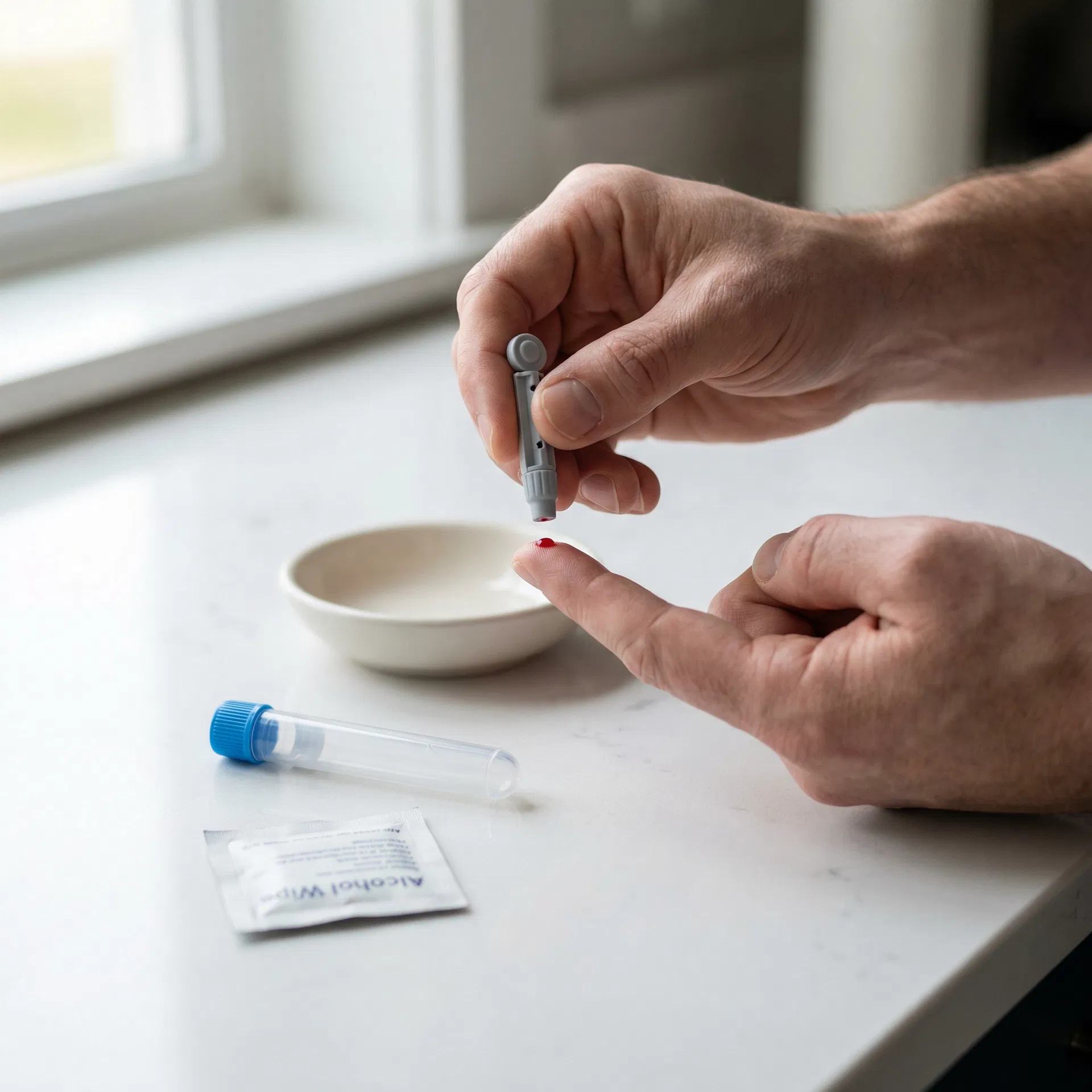
Collect your sample
Follow the simple instructions in your kit — whether it's a finger-prick at home or a venous draw at a partner clinic.
 04
04
Insights delivered
Clear, easy-to-understand results sent to you online with actionable health guidance.
Frequently asked questions
This panel tests Total Cholesterol, LDL Cholesterol, HDL Cholesterol, Non-HDL Cholesterol, Total Cholesterol : HDL Ratio and more. Check the full biomarker list on this page. It is designed to give a broad health baseline in a single test.
If the panel includes cholesterol, triglycerides, or glucose, fast for 8-12 hours. For vitamin, thyroid, and hormone markers, fasting is not required. Check kit instructions. Morning collection (7-10am) is preferred.
Annual testing provides a useful baseline to track trends. If previous results showed abnormalities, more frequent monitoring may be recommended.
Normal results confirm that the major markers tested are within expected ranges. This gives you a baseline for future comparison. If symptoms persist despite normal results, discuss with your GP.
You may also be interested in

NAD+ Blood Test
A 2-biomarker venous blood panel covering cellular energy & longevity — ideal for optimising cellular energy production and longevity.
Results estimated in 7–10 working days
2 biomarkers

Vitamin B2 (riboflavin) Blood Test
A single-biomarker venous blood test covering vitamins — ideal for investigating B vitamin deficiency or nervous system symptoms.
Results estimated in 9 working days
1 biomarkers

Vitamin B9 (folic acid) Blood Test Kit
A single-biomarker venous blood test covering vitamins — ideal for investigating folate deficiency, fatigue, or pre-conception health.
Results estimated in 2 working days
1 biomarkers

Driver's Tiredness Blood Test
A 6-biomarker venous blood panel covering inflammation, iron status, thyroid hormones and vitamins — ideal for investigating ongoing tiredness, low energy, or suspected medical causes.
Results estimated in 5 working days
6 biomarkers