
Iron Blood Test Kit
£49 ✓ In Stock
Your sample goes to a UKAS accredited laboratory meeting ISO 15189 standards.
After you receive your order confirmation email, please reply with your date of birth.
How it works
Your testing journey
From order to results in four simple steps. Full transparency on where each step happens and what it costs.

Receive your kit by post
Dispatched same working day if ordered before 3pm. Royal Mail Tracked delivery, typically 1–3 working days. 90% of kits arrive within 24 hours.

Visit a partner clinic
Book a phlebotomy appointment at one of our 365+ UK partner clinics. Take your kit with you — the phlebotomist will collect your sample using the materials provided.
Phlebotomy fee applies (paid at clinic)
Venous blood draw at a clinic
A trained phlebotomist takes a small blood sample from a vein in your arm using the vacutainers provided in your kit. The appointment takes around 10 minutes.

Return by prepaid envelope
Seal your sample in the biohazard bag provided and drop it in any Royal Mail postbox using the prepaid Tracked 24 envelope. Post Monday–Thursday for best results.
Venous Blood Collection Kit
This kit is sent to you and taken to your chosen clinic. The phlebotomist will collect your sample using the materials provided.
- 1Vacutainer blood collection tubes
- 2Needle and butterfly needle
- 3Tourniquet
- 4Alcohol swab
- 5Cotton wool and gauze
- 6Adhesive plaster
- 7Biohazard specimen bag
- 8Prepaid return envelope (Royal Mail Tracked 24)
- 9Laboratory request form
- 10Instructions for the phlebotomist
Iron is an essential mineral that plays a critical role in oxygen transport throughout the body. It's a key component of haemoglobin (the protein in red blood cells that carries oxygen from the lungs to tissues) and myoglobin (which stores oxygen in muscle cells). Iron is also involved in energy production, DNA synthesis, and immune function. The body cannot make iron, so it must be obtained from food—either as haem iron from animal sources (readily absorbed) or non-haem iron from plant sources (less readily absorbed). Serum iron measures the amount of iron circulating in your blood, bound to the transport protein transferrin. It's important to understand that serum iron is just a snapshot of iron in transit—it fluctuates significantly throughout the day and is heavily influenced by recent dietary intake, making it the least reliable marker when viewed in isolation. A single serum iron reading can vary by 30-40% within the same person on the same day. Low serum iron can indicate iron deficiency, but it can also occur in chronic disease and inflammation (where iron is redistributed into storage rather than circulation). High serum iron may indicate iron overload conditions such as haemochromatosis, or can occur after recent iron supplementation or iron-rich meals. Because of its variability, serum iron should always be interpreted alongside ferritin, TIBC, and transferrin saturation for a complete picture. Results outside the normal range may need a follow-up with your GP.
Ferritin is a protein that stores iron within cells, particularly in the liver, spleen, and bone marrow. When your body has more iron than it immediately needs, it stores the excess in ferritin for future use. When iron is needed (for example, to make new red blood cells), it's released from ferritin stores. A small amount of ferritin is released into the blood, and measuring this serum ferritin gives a reliable indication of your total body iron stores—it's the single most useful marker for assessing iron status in most situations. Low ferritin is the earliest and most sensitive indicator of iron depletion. Ferritin falls before serum iron drops and before anaemia develops, making it valuable for detecting iron deficiency at an early stage when it's easiest to correct. A ferritin level below 30 µg/L is widely considered to indicate depleted iron stores, even if haemoglobin is still normal. Some experts consider levels below 50 µg/L as suboptimal, particularly for certain groups like athletes or those with symptoms of iron deficiency. However, ferritin is also an "acute phase reactant," meaning it rises in response to inflammation, infection, liver disease, chronic alcohol consumption, and some malignancies—even when actual iron stores are low. This can mask true iron deficiency. If ferritin appears normal or elevated but you have symptoms of iron deficiency and other markers (like transferrin saturation) suggest deficiency, inflammation may be masking the picture. This is why hs-CRP is included in this panel—if both ferritin and hs-CRP are elevated, inflammation is likely contributing to the ferritin result. Very high ferritin (above 300-500 µg/L in the absence of inflammation) may indicate iron overload and warrants further investigation. Results outside the normal range may need a follow-up with your GP.
Total Iron-Binding Capacity (TIBC) measures the maximum amount of iron that could be bound by proteins in your blood—primarily transferrin, the main iron transport protein. Think of transferrin as a delivery truck and TIBC as measuring the total carrying capacity of all the trucks. TIBC essentially reflects how much transferrin is available in your blood and thus your body's capacity to transport iron. TIBC responds inversely to iron status: when iron stores are low, your body compensates by producing more transferrin to capture and transport whatever iron is available—so TIBC increases. When iron stores are adequate or excessive, less transferrin is needed, and TIBC decreases. This makes TIBC a useful marker for distinguishing different types of iron problems. In iron deficiency, TIBC is typically elevated (above 70 µmol/L)—your body is producing more transferrin to try to capture more iron. In iron overload conditions like haemochromatosis, TIBC is typically low or normal because less transport capacity is needed. In the anaemia of chronic disease (where iron is "trapped" in storage by inflammation), TIBC is typically low or normal, which helps distinguish it from true iron deficiency anaemia where TIBC would be high. TIBC is less affected by day-to-day variation than serum iron, making it a more stable marker. Results outside the normal range may need a follow-up with your GP.
Transferrin saturation (TSAT) is a calculated percentage that shows how much of your transferrin (iron transport protein) is actually carrying iron. It's calculated by dividing serum iron by TIBC and multiplying by 100. If TIBC represents the total carrying capacity of your iron "delivery trucks," transferrin saturation tells you what percentage of that capacity is currently being used. Normal transferrin saturation is typically between 20-45%. In iron deficiency, transferrin saturation falls below 20%—there's plenty of transport capacity available (high TIBC) but not enough iron to fill it. A transferrin saturation below 16-20% is a strong indicator of iron deficiency, and even if ferritin is normal (perhaps due to concurrent inflammation), a low transferrin saturation suggests that iron delivery to tissues is inadequate. Conversely, transferrin saturation above 45% suggests iron overload—more iron is being transported than normal. Persistently elevated transferrin saturation (especially above 45-50%) is often the first abnormality detected in hereditary haemochromatosis, sometimes before ferritin becomes elevated. If your transferrin saturation is consistently high, testing for haemochromatosis (HFE gene mutation) may be recommended. Transferrin saturation combines information from serum iron and TIBC, making it a more informative single number than either alone. Results outside the normal range may need a follow-up with your GP.
High-sensitivity C-reactive protein (hs-CRP) is included in this iron panel specifically to help interpret your ferritin result. CRP is a protein produced by the liver in response to inflammation anywhere in the body. The "high-sensitivity" assay can detect the low levels of chronic, smouldering inflammation that standard CRP tests would miss. The reason hs-CRP is included here relates to ferritin's dual nature: ferritin is both an iron storage protein AND an acute phase reactant that rises with inflammation. This creates a diagnostic challenge—a person with true iron deficiency but concurrent inflammation (from infection, autoimmune disease, chronic illness, or even obesity) might have a "normal" or even elevated ferritin, masking their iron-depleted state. By measuring hs-CRP alongside ferritin, we can identify when inflammation might be artificially elevating ferritin. If ferritin appears normal but hs-CRP is elevated, this suggests inflammation is present and ferritin may not accurately reflect iron stores—true iron deficiency could still exist. In this situation, transferrin saturation becomes particularly important: a low transferrin saturation (below 16-20%) in the presence of normal ferritin and elevated CRP strongly suggests iron deficiency masked by inflammation. If both ferritin and hs-CRP are low/normal, the ferritin is likely a reliable reflection of iron stores. Your doctor can help interpret the pattern of results. Results outside the normal range may need a follow-up with your GP.
This test is for screening and information only — it is not a medical diagnosis or professional advice. Please have your results reviewed by a qualified doctor or healthcare provider who can explain what they mean for your personal health situation. If your results show anything outside the normal range, or if you're worried about your health, see your doctor as soon as you can. Don't change any medications or treatments based on these results alone — always talk to your healthcare provider first.
NO CLINICS, NO QUEUES, NO HASSLE
Four steps to clarity
 01
01
Pick your panel
Browse over 200 clinically designed test kits and choose the one that fits your goals.
 02
02
Kit to your door
Everything you need arrives in discreet packaging with step-by-step instructions inside.
 03
03
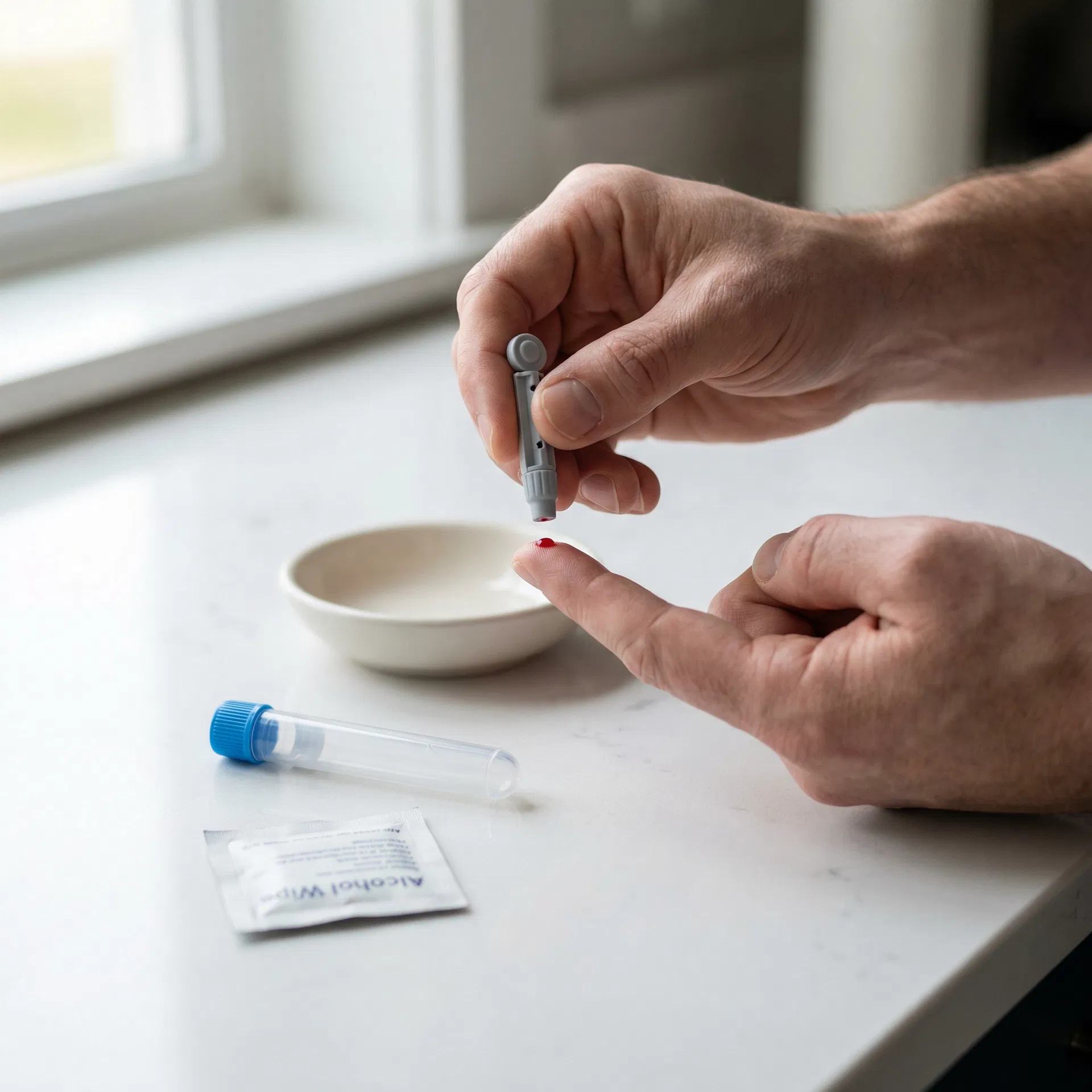
Collect your sample
Follow the simple instructions in your kit — whether it's a finger-prick at home or a venous draw at a partner clinic.
 04
04
Insights delivered
Clear, easy-to-understand results sent to you online with actionable health guidance.
Frequently asked questions
Serum iron fluctuates throughout the day. Ferritin measures iron stores — a more stable and clinically useful marker. Low ferritin indicates depleted stores even if serum iron appears normal.
Morning sample before food preferred. Iron levels can rise after iron-rich meals.
For baseline: stop 24-48 hours before. To monitor supplementation: continue as normal.
Reference ranges start at 15-30 µg/L. Many clinicians consider below 50 µg/L suboptimal. For hair loss, some dermatologists recommend above 70 µg/L.
You may also be interested in

Advanced Vitamins Blood Test
A 10-biomarker venous blood panel covering fat-soluble vitamins and b vitamins — ideal for investigating relevant symptoms or monitoring health.
Results estimated in 3 working days
10 biomarkers
Venous collection
Ultimate Performance Blood Test Kit
A 56-biomarker venous blood panel covering cholesterol status, diabetes, liver function and other key health markers — ideal for athletes and active people tracking training adaptation, recovery, and performance.
Results estimated in 3 working days
56 biomarkers

Driver's Tiredness Blood Test
A 6-biomarker venous blood panel covering inflammation, iron status, thyroid hormones and vitamins — ideal for investigating ongoing tiredness, low energy, or suspected medical causes.
Results estimated in 5 working days
6 biomarkers