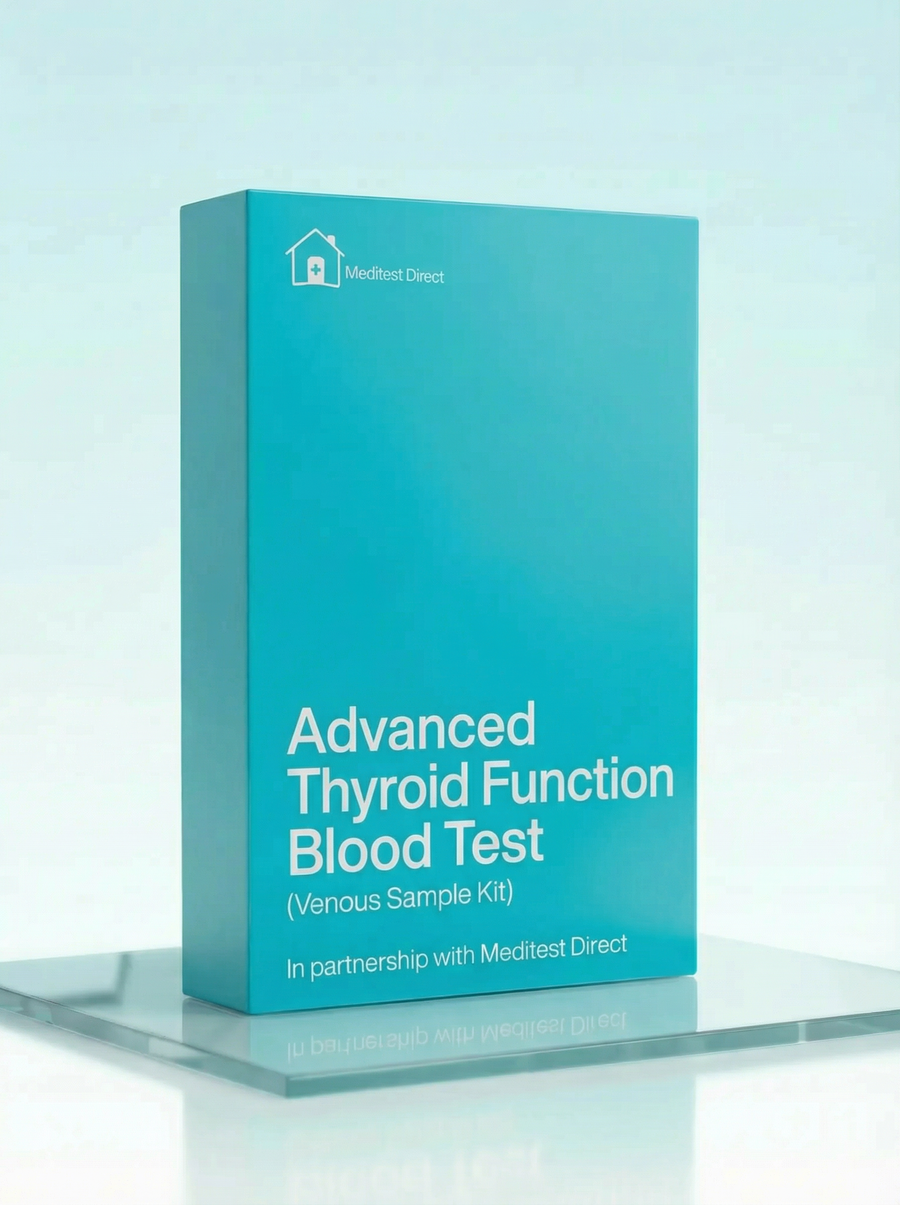
Advanced Thyroid Function Blood Test Kit
£88 ✓ In Stock
Your sample goes to a UKAS accredited laboratory meeting ISO 15189 standards.
After you receive your order confirmation email, please reply with your date of birth.
How it works
Your testing journey
From order to results in four simple steps. Full transparency on where each step happens and what it costs.

Receive your kit by post
Dispatched same working day if ordered before 3pm. Royal Mail Tracked delivery, typically 1–3 working days. 90% of kits arrive within 24 hours.

Visit a partner clinic
Book a phlebotomy appointment at one of our 365+ UK partner clinics. Take your kit with you — the phlebotomist will collect your sample using the materials provided.
Phlebotomy fee applies (paid at clinic)
Venous blood draw at a clinic
A trained phlebotomist takes a small blood sample from a vein in your arm using the vacutainers provided in your kit. The appointment takes around 10 minutes.

Return by prepaid envelope
Seal your sample in the biohazard bag provided and drop it in any Royal Mail postbox using the prepaid Tracked 24 envelope. Post Monday–Thursday for best results.
Venous Blood Collection Kit
This kit is sent to you and taken to your chosen clinic. The phlebotomist will collect your sample using the materials provided.
- 1Vacutainer blood collection tubes
- 2Needle and butterfly needle
- 3Tourniquet
- 4Alcohol swab
- 5Cotton wool and gauze
- 6Adhesive plaster
- 7Biohazard specimen bag
- 8Prepaid return envelope (Royal Mail Tracked 24)
- 9Laboratory request form
- 10Instructions for the phlebotomist
TSH is produced by your pituitary gland and acts as the master controller of your thyroid. It tells your thyroid how much hormone to produce. The clever thing about TSH is that it works in reverse—when thyroid hormones are low, TSH rises to stimulate more production; when thyroid hormones are high, TSH drops because the pituitary senses there's already enough. This makes TSH the most sensitive single marker for thyroid dysfunction. High TSH (typically above 4-4.5 mIU/L) indicates hypothyroidism—your pituitary is calling for more hormone because levels are low. Low TSH (below 0.4-0.5 mIU/L) indicates hyperthyroidism—there's so much thyroid hormone that the pituitary has stopped asking for more. TSH can be abnormal while T4 and T3 are still in the normal range (subclinical thyroid disease), making it an early warning sign. Results outside the normal range may need a follow-up with your GP.
Free T3 is the active form of thyroid hormone—it's what actually enters your cells and affects your metabolism. 'Free' means it's not bound to proteins and is available to your tissues. Most T3 isn't made directly by your thyroid; instead, your body converts the more abundant T4 into T3 as needed in tissues throughout your body. This conversion happens via deiodinase enzymes and requires adequate selenium, zinc, and iron. Low Free T3 can occur with hypothyroidism, but also with 'low T3 syndrome' where conversion is impaired—this happens with calorie restriction, chronic illness, stress, and certain nutrient deficiencies. Some people on levothyroxine have normal T4 but low-normal T3 and still feel unwell, suggesting a conversion issue. Free T3 gives insight into what's actually happening at the cellular level. Results outside the normal range may need a follow-up with your GP.
Free T4 is the unbound, active portion of thyroxine—the main hormone your thyroid gland produces. T4 acts as a reservoir or prohormone that circulates in your blood and gets converted to the more active T3 when your body needs it. 'Free' T4 is more clinically useful than total T4 because it's not affected by changes in binding proteins (which can fluctuate with pregnancy, oestrogen, liver disease, and certain medications). In hypothyroidism, Free T4 is low; in hyperthyroidism, it's high. If you're taking levothyroxine treatment, Free T4 shows how well your replacement therapy is working. Measuring both Free T4 and Free T3 together gives a fuller picture than either alone—especially for identifying conversion problems where T4 is adequate but T3 is low. Results outside the normal range may need a follow-up with your GP.
TPO antibodies are produced when your immune system mistakenly attacks thyroid peroxidase—an enzyme essential for making thyroid hormones. Elevated TPO antibodies are the hallmark of autoimmune thyroid disease, present in about 90% of people with Hashimoto's thyroiditis (the most common cause of hypothyroidism) and many with Graves' disease. However, positive antibodies don't always mean you have or will develop thyroid disease—about 10-15% of the general population have elevated TPO antibodies with normal thyroid function. What elevated antibodies do tell you is that there's autoimmune activity against your thyroid, and you're at increased risk of developing thyroid dysfunction in the future. TPO antibodies are also associated with higher miscarriage rates in early pregnancy and may warrant monitoring during pregnancy even if thyroid function is normal. Results outside the normal range may need a follow-up with your GP.
Thyroglobulin antibodies target thyroglobulin—a protein made exclusively by the thyroid gland that serves as the scaffold for thyroid hormone production. Like TPO antibodies, elevated thyroglobulin antibodies indicate autoimmune thyroid disease. They're found in about 70-80% of Hashimoto's patients and about 50-70% of Graves' disease patients. Some people have elevated thyroglobulin antibodies but negative TPO antibodies, so testing both gives a more complete picture of autoimmune involvement. In thyroid cancer follow-up, thyroglobulin antibodies are important because they can interfere with thyroglobulin measurements used to monitor for recurrence. In the general population, positive thyroglobulin antibodies (like TPO antibodies) indicate increased risk of developing thyroid dysfunction over time, even if current thyroid function is normal. Results outside the normal range may need a follow-up with your GP.
Ferritin is the storage form of iron, and blood ferritin levels reflect how much iron your body has in reserve. Iron is directly involved in thyroid hormone production—thyroid peroxidase (the enzyme that makes thyroid hormones) requires iron to function. Low ferritin is associated with impaired thyroid function and can worsen hypothyroid symptoms even when thyroid hormones are technically in range. Symptoms of low ferritin—fatigue, weakness, cold intolerance, hair loss, difficulty concentrating—overlap substantially with hypothyroidism, so it's important to check both. Women of reproductive age are particularly prone to low ferritin due to menstrual blood loss. Many thyroid specialists suggest optimal ferritin is 70-90 µg/L for people with thyroid conditions, though the standard reference range starts much lower. However, ferritin is also an acute phase reactant—it rises with inflammation—so hs-CRP is included in this panel to help interpret ferritin accurately. Results outside the normal range may need a follow-up with your GP.
Vitamin D is measured as 25-hydroxyvitamin D (25-OH D), which reflects your body's vitamin D status from both sun exposure and dietary/supplement intake. Vitamin D is increasingly recognised as important for thyroid health—not just for symptoms that overlap with hypothyroidism (fatigue, muscle weakness, mood changes) but for thyroid function itself. Low vitamin D is associated with higher rates of autoimmune thyroid disease, and people with Hashimoto's thyroiditis are more likely to be vitamin D deficient than the general population. Vitamin D plays a role in immune regulation, and adequate levels may help modulate autoimmune activity. In the UK, vitamin D deficiency is common, especially in winter. Levels above 50 nmol/L are generally considered adequate; above 75 nmol/L may be optimal, particularly if you have autoimmune thyroid disease. Results outside the normal range may need a follow-up with your GP.
Active B12 (holotranscobalamin) measures the portion of vitamin B12 that's actually available to your cells—a more accurate marker than total B12. B12 is essential for red blood cell formation, neurological function, and DNA synthesis. B12 deficiency causes symptoms that closely mimic hypothyroidism—fatigue, brain fog, depression, weakness, and tingling in hands and feet—which is why it's important to check alongside thyroid function. There's also a specific connection: autoimmune thyroid disease (Hashimoto's) often coexists with pernicious anaemia (autoimmune destruction of cells needed to absorb B12). People with one autoimmune condition are more likely to develop others. Low B12 can also occur with metformin use, vegetarian/vegan diets, and age-related absorption decline. Results outside the normal range may need a follow-up with your GP.
Folate (vitamin B9) is essential for DNA synthesis, red blood cell formation, and cellular division. It works closely with vitamin B12—deficiency in either causes similar symptoms including fatigue, weakness, and anaemia. Low folate causes macrocytic anaemia (large, immature red blood cells) and can contribute to elevated homocysteine, which is associated with cardiovascular risk. Folate deficiency can occur with poor dietary intake (it's found in leafy greens, legumes, and fortified foods), malabsorption conditions, alcohol excess, and certain medications. In the context of thyroid health, folate deficiency can worsen fatigue and cognitive symptoms, and optimal folate status supports overall wellbeing. Serum folate reflects recent intake (days to weeks) rather than long-term stores. Note that folate testing from finger-prick samples can be unreliable, which is why this test uses venous collection. Results outside the normal range may need a follow-up with your GP.
High-sensitivity CRP measures low-level inflammation in your body. CRP is produced by your liver in response to inflammatory signals from anywhere in the body. The 'high-sensitivity' test detects the subtle elevations relevant to chronic inflammation and cardiovascular risk, not just the dramatic elevations seen with acute infection. In the context of thyroid health, hs-CRP serves several purposes. First, it helps interpret ferritin—if CRP is elevated, ferritin may be artificially raised by inflammation rather than reflecting true iron stores. Second, autoimmune thyroid conditions can be associated with chronic low-grade inflammation. Third, both hypo- and hyperthyroidism can affect inflammatory markers. Finally, hs-CRP is a useful general health marker—persistent elevation is associated with increased cardiovascular risk and warrants investigation into the cause. Results outside the normal range may need a follow-up with your GP.
This test is for screening and information only — it is not a medical diagnosis or professional advice. Please have your results reviewed by a qualified doctor or healthcare provider who can explain what they mean for your personal health situation. If your results show anything outside the normal range, or if you're worried about your health, see your doctor as soon as you can. Don't change any medications or treatments based on these results alone — always talk to your healthcare provider first.
NO CLINICS, NO QUEUES, NO HASSLE
Four steps to clarity
 01
01
Pick your panel
Browse over 200 clinically designed test kits and choose the one that fits your goals.
 02
02
Kit to your door
Everything you need arrives in discreet packaging with step-by-step instructions inside.
 03
03
Collect your sample
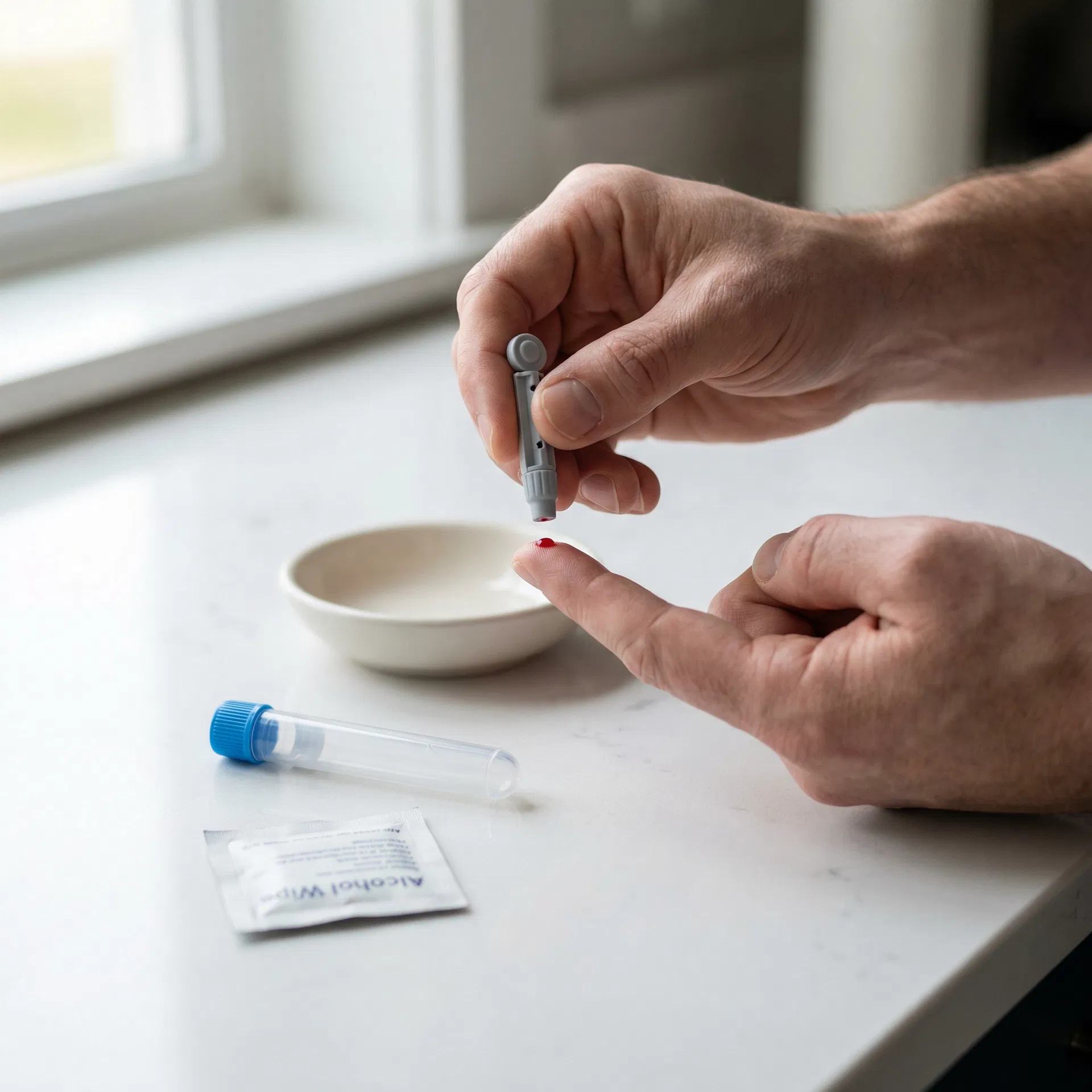
Follow the simple instructions in your kit — whether it's a finger-prick at home or a venous draw at a partner clinic.
 04
04
Insights delivered
Clear, easy-to-understand results sent to you online with actionable health guidance.
Frequently asked questions
7-10am, before eating. If on levothyroxine, collect BEFORE your morning dose. TSH is highest in early morning.
Yes. Stop biotin for at least 48 hours before testing. Biotin can cause falsely abnormal results.
Basic: TSH and Free T4. Advanced adds Free T3 (active hormone) and thyroid antibodies (TPO, TG) for autoimmune thyroid disease detection.
No, but morning before food is preferred for consistent results.
You may also be interested in

Underactive Thyroid (Levothyroxine Monitoring) Blood Test
A 2-biomarker finger-prick blood panel covering thyroid hormones — ideal for investigating tiredness, weight changes, or suspected thyroid dysfunction.
Results estimated in 2 working days
2 biomarkers

Thyroid Function with Antibodies Blood Test Kit
A 5-biomarker venous blood panel covering thyroid hormones and thyroid antibodies — ideal for investigating tiredness, weight changes, or suspected thyroid dysfunction.
Results estimated in 2 working days
5 biomarkers

Thyroid Function Blood Test Kit
A 3-biomarker venous blood panel covering thyroid hormones — ideal for investigating tiredness, weight changes, or suspected thyroid dysfunction.
Results estimated in 2 working days
3 biomarkers

Advanced Well Woman Blood Test
A 47-biomarker venous blood panel covering cholesterol status, clotting status, diabetes and other key health markers — ideal for comprehensive female health screening across multiple body systems.
Results estimated in 3 working days
47 biomarkers