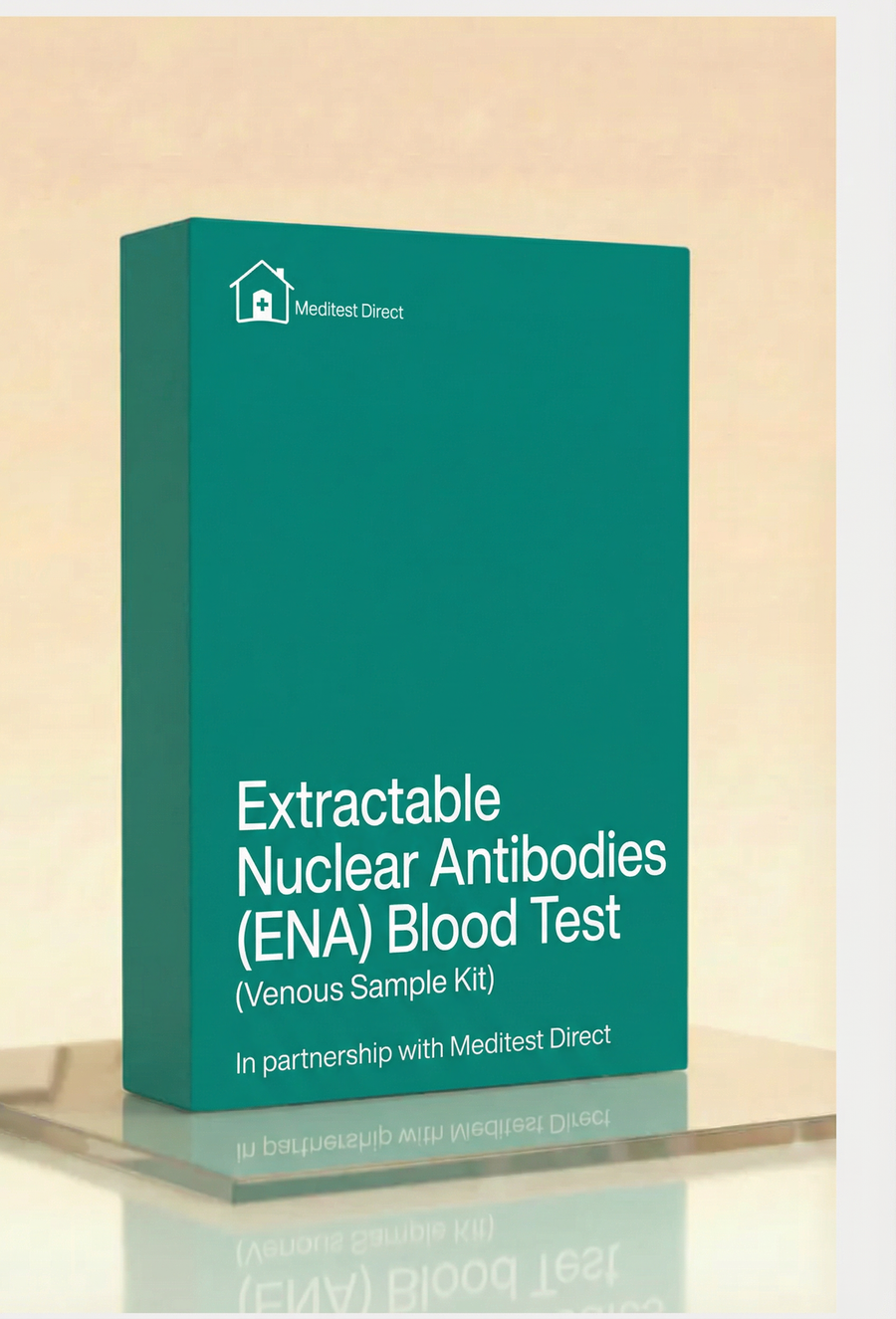
Extractable Nuclear Antibodies (ENA) Blood Test
£85 ✓ In Stock
Your sample goes to a UKAS accredited laboratory meeting ISO 15189 standards.
After you receive your order confirmation email, please reply with your date of birth.
How it works
Your testing journey
From order to results in four simple steps. Full transparency on where each step happens and what it costs.

Receive your kit by post
Dispatched same working day if ordered before 3pm. Royal Mail Tracked delivery, typically 1–3 working days. 90% of kits arrive within 24 hours.

Visit a partner clinic
Book a phlebotomy appointment at one of our 365+ UK partner clinics. Take your kit with you — the phlebotomist will collect your sample using the materials provided.
Phlebotomy fee applies (paid at clinic)
Venous blood draw at a clinic
A trained phlebotomist takes a small blood sample from a vein in your arm using the vacutainers provided in your kit. The appointment takes around 10 minutes.

Return by prepaid envelope
Seal your sample in the biohazard bag provided and drop it in any Royal Mail postbox using the prepaid Tracked 24 envelope. Post Monday–Thursday for best results.
Venous Blood Collection Kit
This kit is sent to you and taken to your chosen clinic. The phlebotomist will collect your sample using the materials provided.
- 1Vacutainer blood collection tubes
- 2Needle and butterfly needle
- 3Tourniquet
- 4Alcohol swab
- 5Cotton wool and gauze
- 6Adhesive plaster
- 7Biohazard specimen bag
- 8Prepaid return envelope (Royal Mail Tracked 24)
- 9Laboratory request form
- 10Instructions for the phlebotomist
The ENA (Extractable Nuclear Antigen) screen is a comprehensive test that detects the presence of any extractable nuclear antibodies in the blood. This screening test identifies whether autoantibodies are present before specific antibody types are identified. A positive ENA screen indicates the presence of one or more of the specific ENA antibodies, prompting further investigation to determine which specific antibodies are present and their clinical significance.
Anti-ribonucleoprotein (anti-nRNP) antibodies target U1 small nuclear ribonucleoprotein. These antibodies are found in various connective tissue diseases, including systemic lupus erythematosus (SLE), systemic sclerosis, and polymyositis. High levels of anti-RNP antibodies are the defining feature of mixed connective tissue disease (MCTD), a condition that shares features of multiple autoimmune disorders. The presence of these antibodies is associated with Raynaud's phenomenon, arthritis, and muscle inflammation.
Anti-Smith (anti-Sm) antibodies target Smith proteins, which are components of small nuclear ribonucleoproteins. These antibodies are highly specific for systemic lupus erythematosus (SLE), though they are only present in about 20–30% of SLE patients. The presence of anti-Sm antibodies is one of the diagnostic criteria for SLE and is associated with more severe disease manifestations, including kidney involvement and central nervous system complications.
Anti-Ro antibodies, also called anti-SS-A antibodies, target Ro/SS-A proteins. These antibodies are found in approximately 40–60% of people with Sjögren's syndrome and 30–40% of those with systemic lupus erythematosus (SLE). Anti-Ro antibodies can cross the placenta during pregnancy and are associated with neonatal lupus and congenital heart block in babies born to mothers with these antibodies. Results outside the normal range may need a follow-up with your GP.
Anti-La antibodies, also known as anti-SS-B antibodies, target the La/SS-B protein. These antibodies are commonly found in Sjögren's syndrome, often appearing alongside anti-Ro antibodies. Anti-La antibodies are also associated with systemic lupus erythematosus (SLE) and neonatal lupus. Their presence in pregnant women with SLE is linked to a lower risk of congenital heart block in the baby compared to anti-Ro antibodies alone.
Anti-Jo-1 antibodies target histidyl-tRNA synthetase, an enzyme involved in protein synthesis. These antibodies are the most common type of anti-synthetase antibodies and are strongly associated with polymyositis and dermatomyositis. Patients with anti-Jo-1 antibodies often develop antisynthetase syndrome, characterised by muscle inflammation, interstitial lung disease, arthritis, Raynaud's phenomenon, and mechanic's hands (rough, cracked skin on the fingers).
Anti-Scl 70 antibodies, also known as anti-topoisomerase I antibodies, target the DNA topoisomerase I enzyme. These antibodies are highly specific for systemic sclerosis (scleroderma), particularly the diffuse cutaneous form. Their presence is associated with more severe disease, including widespread skin thickening, interstitial lung disease, and pulmonary fibrosis. Anti-Scl 70 antibodies are found in approximately 20–30% of people with systemic sclerosis.
Anti-centromere protein B (anti-CENP-B) antibodies target proteins in the centromere region of chromosomes. These antibodies are highly specific for limited cutaneous systemic sclerosis (lcSSc), also known as CREST syndrome. Their presence is associated with Raynaud's phenomenon, skin thickening limited to hands and face, and a generally better prognosis compared to diffuse scleroderma. Results outside the normal range may need a follow-up with your GP.
This test is for screening and information only — it is not a medical diagnosis or professional advice. Please have your results reviewed by a qualified doctor or healthcare provider who can explain what they mean for your personal health situation. If your results show anything outside the normal range, or if you're worried about your health, see your doctor as soon as you can. Don't change any medications or treatments based on these results alone — always talk to your healthcare provider first.
NO CLINICS, NO QUEUES, NO HASSLE
Four steps to clarity
 01
01
Pick your panel
Browse over 200 clinically designed test kits and choose the one that fits your goals.
 02
02
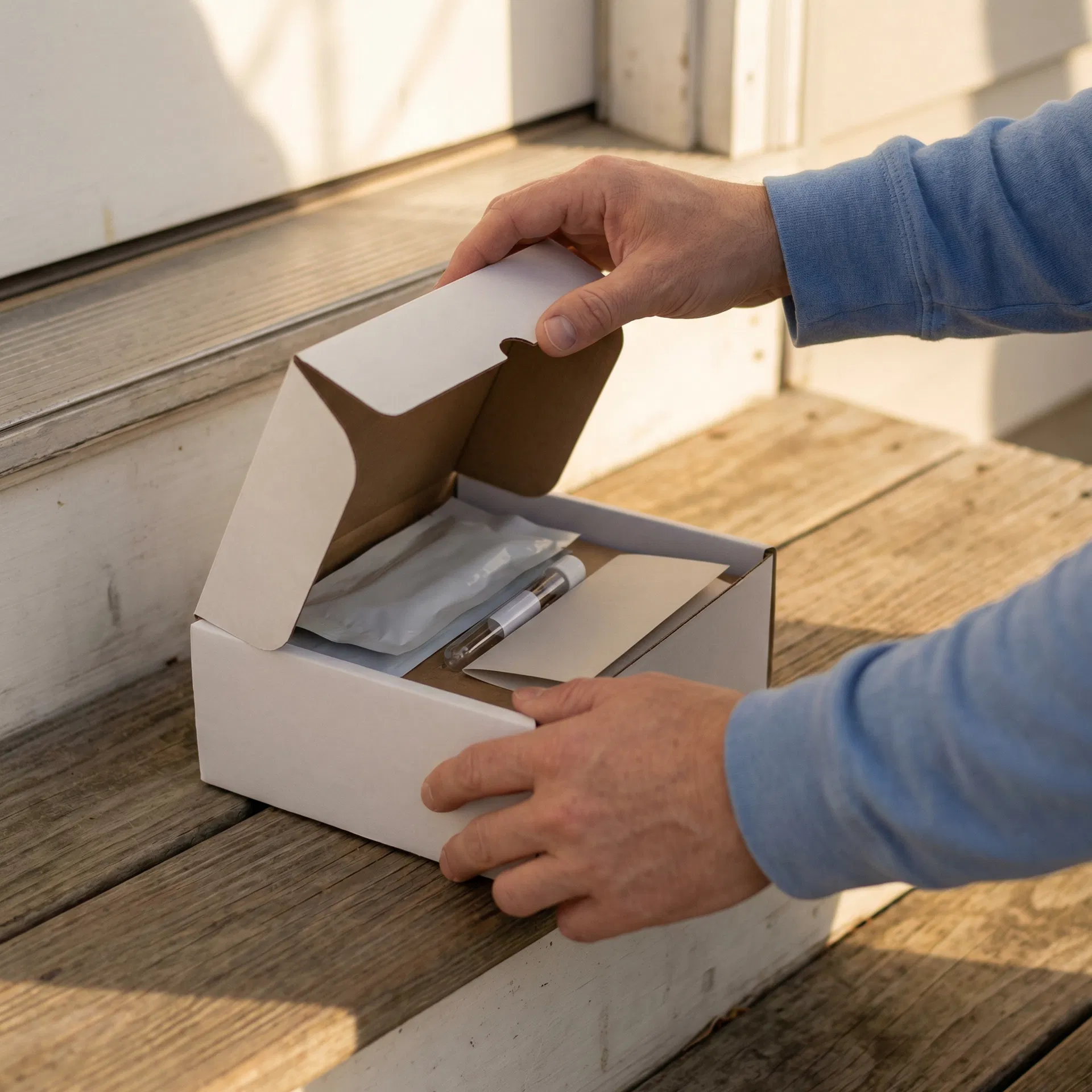
Kit to your door
Everything you need arrives in discreet packaging with step-by-step instructions inside.
 03
03
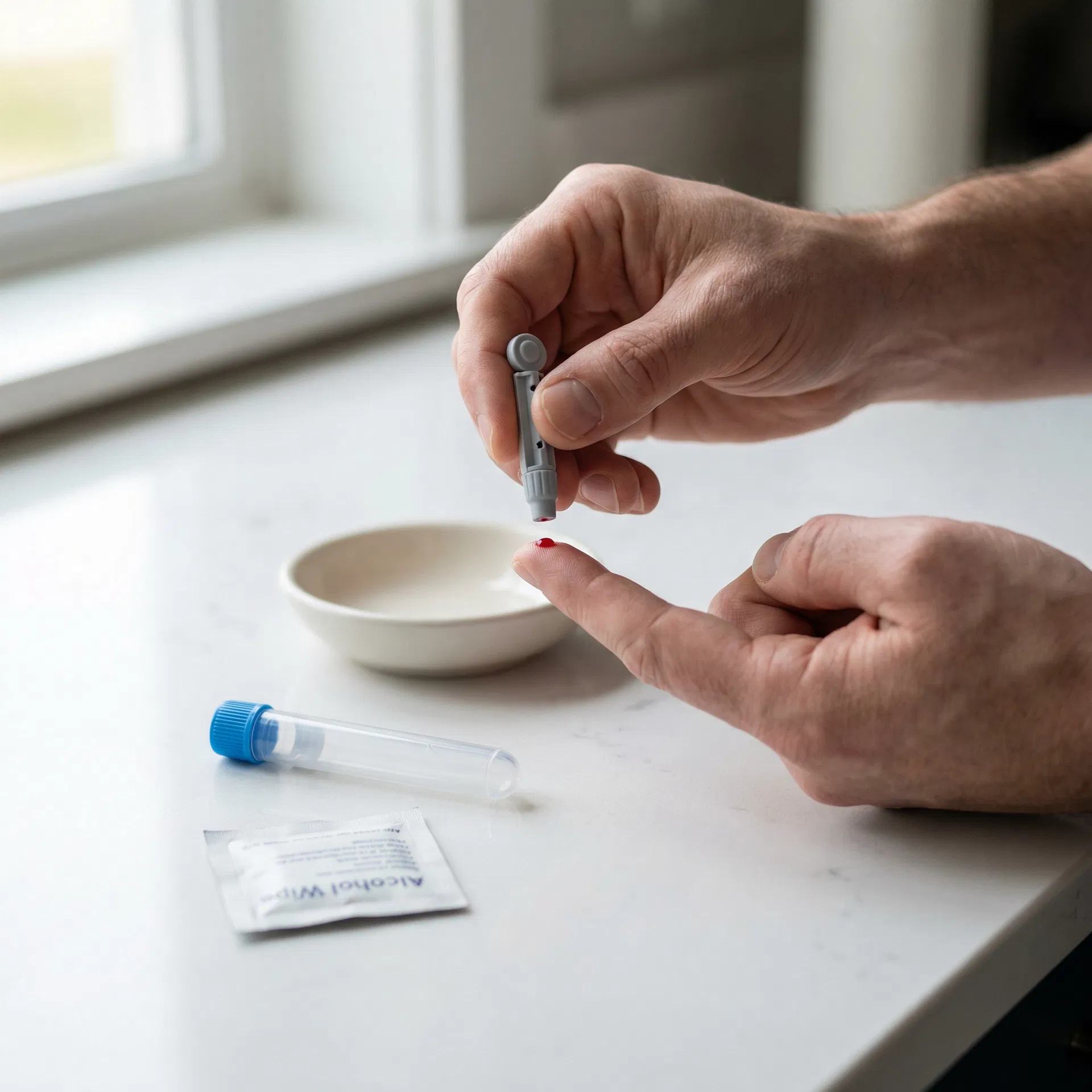
Collect your sample
Follow the simple instructions in your kit — whether it's a finger-prick at home or a venous draw at a partner clinic.
 04
04
Insights delivered
Clear, easy-to-understand results sent to you online with actionable health guidance.
Frequently asked questions
This test measures ENA Screen, Anti-nRNP Antibodies, Anti-Sm Antibodies, Anti-Ro (SS-A) Antibodies, Anti-La (SS-B) Antibodies. Check the full biomarker list on this page for detailed descriptions.
Check the Special Instructions on this page. General rule: fast 8-12 hours if cholesterol/glucose/insulin included. Most hormone, vitamin, and antibody tests do not require fasting. Morning collection (7-10am) is preferred.
Follow the instructions in your kit. For finger-prick: warm hands, use lancet as directed, fill tube to marked line. For venous: attend a phlebotomy clinic with your lab form. Post same day, avoid Fridays/bank holidays.
Results are typically available within the timeframe shown on this page. You will receive a notification when ready to view online.
You may also be interested in

Ultra Advanced Multisite STI Screen with Hepatitis B & C
A 13-biomarker venous blood,urine,swab panel covering blood tests (serology), 7 sti pcr panel and additional multisite testing — ideal for screening for current or past infection, vaccine response, or pre-treatment monitoring.
Results estimated in 3 working days
13 biomarkers

Hepatitis B Profile Blood Test
A 3-biomarker venous blood panel covering hepatitis b serology — ideal for screening for current or past infection, vaccine response, or pre-treatment monitoring.
Results estimated in 3 working days
3 biomarkers

Autoantibodies Profile 2 Blood Test
A 5-biomarker venous blood panel covering autoimmunity — ideal for investigating suspected autoimmune conditions.
Results estimated in 10 working days
5 biomarkers

Allergy Screen (Essential Foods) Blood Test
An essential food allergy panel testing for the most common food allergens responsible for IgE-mediated reactions — covering the key foods that account for the majority of food allergies in both children and adults.
Results estimated in 2 working days
9 biomarkers