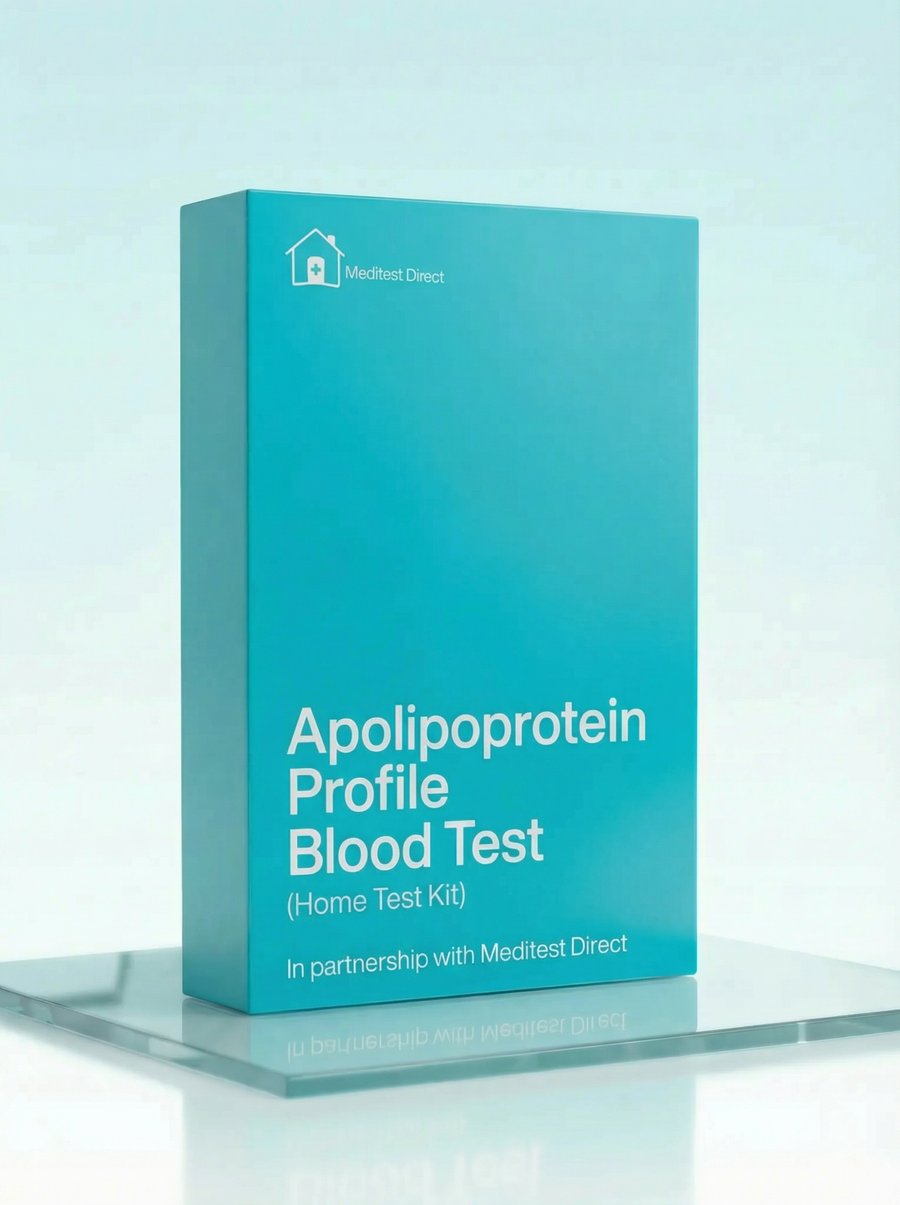
Apolipoprotein Profile Blood Test Kit
£87 ✓ In Stock
Your sample goes to a UKAS accredited laboratory meeting ISO 15189 standards.
After you receive your order confirmation email, please reply with your date of birth.
How it works
Your testing journey
From order to results in four simple steps. Full transparency on where each step happens and what it costs.

Receive your kit by post
Dispatched same working day if ordered before 3pm. Royal Mail Tracked delivery, typically 1–3 working days. 90% of kits arrive within 24 hours.

Visit a partner clinic
Book a phlebotomy appointment at one of our 365+ UK partner clinics. Take your kit with you — the phlebotomist will collect your sample using the materials provided.
Phlebotomy fee applies (paid at clinic)
Venous blood draw at a clinic
A trained phlebotomist takes a small blood sample from a vein in your arm using the vacutainers provided in your kit. The appointment takes around 10 minutes.

Return by prepaid envelope
Seal your sample in the biohazard bag provided and drop it in any Royal Mail postbox using the prepaid Tracked 24 envelope. Post Monday–Thursday for best results.
Venous Blood Collection Kit
This kit is sent to you and taken to your chosen clinic. The phlebotomist will collect your sample using the materials provided.
- 1Vacutainer blood collection tubes
- 2Needle and butterfly needle
- 3Tourniquet
- 4Alcohol swab
- 5Cotton wool and gauze
- 6Adhesive plaster
- 7Biohazard specimen bag
- 8Prepaid return envelope (Royal Mail Tracked 24)
- 9Laboratory request form
- 10Instructions for the phlebotomist
Total cholesterol measures all cholesterol in your blood—both the protective HDL and the potentially harmful LDL and other fractions combined. Despite its negative reputation, cholesterol is essential for life: it forms cell membranes, produces steroid hormones (including testosterone, oestrogen, and cortisol), synthesises vitamin D, and makes bile acids for fat digestion. Your liver manufactures most of your cholesterol, with dietary cholesterol contributing a smaller proportion. Total cholesterol alone has limited value for assessing cardiovascular risk because it doesn't distinguish between protective HDL and harmful LDL—you could have high total cholesterol due to high protective HDL (which is actually good) or high harmful LDL (which is concerning). The detailed breakdown in this panel provides much more useful information than total cholesterol alone. Results outside the normal range may need a follow-up with your GP.
LDL (low-density lipoprotein) cholesterol is often called 'bad cholesterol' because elevated levels are associated with atherosclerosis—the build-up of fatty plaques inside artery walls. LDL particles transport cholesterol from the liver to tissues throughout your body. While this is necessary, excessive LDL can deposit cholesterol in artery walls, where it triggers inflammation and plaque formation, narrowing arteries and increasing risk of heart attack and stroke. LDL cholesterol is the traditional primary target for cardiovascular risk reduction. However, standard LDL cholesterol testing measures the amount of cholesterol carried by LDL particles, not the number of particles—and particle number may be more important for predicting risk. This is where ApoB (measured in this panel) adds value, as it directly reflects LDL particle number. Results outside the normal range may need a follow-up with your GP.
Non-HDL cholesterol is calculated by subtracting protective HDL cholesterol from total cholesterol. It represents all the potentially harmful cholesterol fractions combined—not just LDL, but also VLDL, IDL, and lipoprotein remnants, all of which can contribute to atherosclerosis. Because it captures all atherogenic cholesterol particles (not just LDL), non-HDL is considered a better cardiovascular risk marker than LDL alone. This is particularly relevant for people with elevated triglycerides, who often have significant cholesterol in VLDL particles that isn't captured by LDL testing. Non-HDL cholesterol also has the advantage of not requiring fasting—it remains accurate even after eating. The recommended target for non-HDL is below 4.0 mmol/L for most people, with lower targets for those at higher cardiovascular risk. Results outside the normal range may need a follow-up with your GP.
HDL (high-density lipoprotein) cholesterol is often called 'good cholesterol' because it helps protect against cardiovascular disease. HDL particles perform 'reverse cholesterol transport'—they collect excess cholesterol from tissues and artery walls and carry it back to the liver for disposal or recycling. Higher HDL levels are generally associated with lower cardiovascular risk. HDL above 1.0 mmol/L in men and 1.2 mmol/L in women is generally considered desirable—the higher the better. Low HDL is an independent cardiovascular risk factor even when LDL is normal. Factors that increase HDL include regular aerobic exercise, moderate alcohol consumption, weight loss, and not smoking. Factors that decrease HDL include smoking, obesity, sedentary lifestyle, and very high carbohydrate diets. The main protein in HDL particles is ApoA1 (also measured in this panel). Results outside the normal range may need a follow-up with your GP.
The total cholesterol to HDL ratio is calculated by dividing your total cholesterol by your HDL cholesterol. A lower ratio is better—it indicates that a higher proportion of your total cholesterol is the protective HDL type. This ratio is more informative than total cholesterol alone because it reflects the balance between harmful and protective cholesterol. A ratio below 4 is generally considered optimal for cardiovascular health; above 6 indicates increased risk. This ratio is used in cardiovascular risk calculators (like QRISK) to estimate your 10-year risk of heart attack or stroke. However, many experts now consider the ApoB: ApoA1 ratio (also included in this panel) to be an even better predictor of cardiovascular risk. Results outside the normal range may need a follow-up with your GP.
Triglycerides are fats that circulate in your blood, providing energy for your cells. After eating, your body converts excess calories (whether from fats, carbohydrates, or protein) into triglycerides, which are transported to fat cells for storage. Between meals, triglycerides are released to provide energy. Elevated fasting triglycerides indicate that your body is storing more fat than it's burning—often related to excessive calorie intake (particularly from refined carbohydrates and alcohol), obesity, insulin resistance, or metabolic syndrome. Very high triglycerides (above 10 mmol/L) can cause pancreatitis. Moderately elevated triglycerides are associated with increased cardiovascular risk, partly because they're associated with small, dense LDL particles (which are more atherogenic) and low HDL. Fasting triglycerides below 1.7 mmol/L are generally desirable. Triglycerides are the lipid marker most affected by recent food intake, which is why fasting is recommended for accurate measurement. Results outside the normal range may need a follow-up with your GP.
Apolipoprotein A1 (ApoA1) is the main structural protein of HDL (good cholesterol) particles. ApoA1 is essential for HDL formation and function—it helps activate the enzyme that allows HDL to pick up cholesterol from tissues (LCAT), enabling the reverse cholesterol transport that makes HDL protective. Higher ApoA1 levels generally indicate more HDL particles and are associated with lower cardiovascular risk. ApoA1 provides complementary information to HDL cholesterol—while HDL-C measures the cholesterol content of HDL particles, ApoA1 reflects the number and functionality of those particles. Low ApoA1, especially when combined with elevated ApoB, is associated with increased cardiovascular disease risk. Factors that increase ApoA1 include regular exercise, moderate alcohol consumption, healthy diet (particularly Mediterranean-style eating), maintaining healthy weight, and not smoking. Results outside the normal range may need a follow-up with your GP.
Apolipoprotein B (ApoB) is the main structural protein found in all atherogenic (artery-clogging) lipoprotein particles—including LDL, VLDL, IDL, and lipoprotein(a). Crucially, each of these particles contains exactly one ApoB molecule, regardless of size or cholesterol content. This makes ApoB a direct count of the total number of atherogenic particles in your blood—and cardiovascular risk is driven more by particle number than by cholesterol concentration. This is why many experts now consider ApoB a superior marker of cardiovascular risk compared to LDL cholesterol. ApoB is particularly valuable in people with metabolic syndrome, diabetes, or high triglycerides, where LDL particles tend to be small and dense—these people may have 'normal' LDL cholesterol but high ApoB (many small particles), indicating significant cardiovascular risk that standard testing would miss. Over 90% of ApoB in blood is found on LDL particles. ApoB is relatively stable and less affected by recent food intake than triglycerides. Results outside the normal range may need a follow-up with your GP.
The ApoB: ApoA1 ratio is calculated by dividing your ApoB level by your ApoA1 level. This ratio represents the balance between atherogenic (artery-clogging) lipoprotein particles (reflected by ApoB) and protective lipoprotein particles (reflected by ApoA1). A lower ratio is better—it indicates a more favourable balance with more protective particles relative to harmful ones. Multiple large studies, including the INTERHEART study involving over 25,000 participants across 52 countries, have found the ApoB: ApoA1 ratio to be one of the strongest predictors of myocardial infarction (heart attack), often outperforming traditional cholesterol ratios. A ratio below 0.6 is generally considered optimal; above 0.9 indicates significantly elevated cardiovascular risk. The ratio is particularly useful because it captures both sides of the equation—having high ApoB, low ApoA1, or both will elevate your ratio and risk. Lifestyle interventions including Mediterranean diet, regular exercise, weight loss, and smoking cessation can improve this ratio. Results outside the normal range may need a follow-up with your GP.
This test is for screening and information only — it is not a medical diagnosis or professional advice. Please have your results reviewed by a qualified doctor or healthcare provider who can explain what they mean for your personal health situation. If your results show anything outside the normal range, or if you're worried about your health, see your doctor as soon as you can. Don't change any medications or treatments based on these results alone — always talk to your healthcare provider first.
NO CLINICS, NO QUEUES, NO HASSLE
Four steps to clarity
 01
01
Pick your panel
Browse over 200 clinically designed test kits and choose the one that fits your goals.
 02
02
Kit to your door
Everything you need arrives in discreet packaging with step-by-step instructions inside.
 03
03
Collect your sample
Follow the simple instructions in your kit — whether it's a finger-prick at home or a venous draw at a partner clinic.
 04
04
Insights delivered
Clear, easy-to-understand results sent to you online with actionable health guidance.
Frequently asked questions
If triglycerides included, fast 8-12 hours. For cardiac markers like BNP or Lp(a), fasting is not required. Drink water normally.
This test measures advanced cardiovascular risk markers beyond standard cholesterol. Lp(a) and apolipoprotein B provide additional risk information, particularly useful for people with family history of early heart disease or those on statins wanting a more complete picture.
Lp(a) is genetically determined. Diet, exercise, and statins have little effect. It only needs measuring once. A high Lp(a) means managing other risk factors more aggressively.
Normal results: every 3-5 years. On statins or with risk factors: every 6-12 months.
You may also be interested in

VLDL Cholesterol Blood Test
A single-biomarker venous blood test covering cholesterol status — ideal for cardiovascular risk assessment and heart health monitoring.
Results estimated in 3 working days
1 biomarkers

Lipoprotein (a) Blood Test Kit
A single-biomarker venous blood test covering cardiovascular risk — ideal for investigating relevant symptoms or monitoring health.
Results estimated in 3 working days
1 biomarkers

Allergy Screen (Essential Foods) Blood Test
An essential food allergy panel testing for the most common food allergens responsible for IgE-mediated reactions — covering the key foods that account for the majority of food allergies in both children and adults.
Results estimated in 2 working days
9 biomarkers