

Pernicious Anaemia Blood Test Kit
£279 ✓ In Stock
Your sample goes to a UKAS accredited laboratory meeting ISO 15189 standards.
After you receive your order confirmation email, please reply with your date of birth.
How it works
Your testing journey
From order to results in four simple steps. Full transparency on where each step happens and what it costs.

Receive your kit by post
Dispatched same working day if ordered before 3pm. Royal Mail Tracked delivery, typically 1–3 working days. 90% of kits arrive within 24 hours.

Visit a partner clinic
Book a phlebotomy appointment at one of our 365+ UK partner clinics. Take your kit with you — the phlebotomist will collect your sample using the materials provided.
Phlebotomy fee applies (paid at clinic)
Venous blood draw at a clinic
A trained phlebotomist takes a small blood sample from a vein in your arm using the vacutainers provided in your kit. The appointment takes around 10 minutes.

Return by prepaid envelope
Seal your sample in the biohazard bag provided and drop it in any Royal Mail postbox using the prepaid Tracked 24 envelope. Post Monday–Thursday for best results.
Venous Blood Collection Kit
This kit is sent to you and taken to your chosen clinic. The phlebotomist will collect your sample using the materials provided.
- 1Vacutainer blood collection tubes
- 2Needle and butterfly needle
- 3Tourniquet
- 4Alcohol swab
- 5Cotton wool and gauze
- 6Adhesive plaster
- 7Biohazard specimen bag
- 8Prepaid return envelope (Royal Mail Tracked 24)
- 9Laboratory request form
- 10Instructions for the phlebotomist
Haemoglobin is the iron-containing protein in red blood cells that carries oxygen from the lungs to tissues throughout the body. It gives blood its red colour and is the primary measure used to diagnose anaemia. Normal haemoglobin is typically 130-170 g/L in men and 120-150 g/L in women. In pernicious anaemia, haemoglobin is reduced because the body cannot produce adequate numbers of healthy red blood cells without sufficient vitamin B12. B12 is essential for DNA synthesis in all rapidly dividing cells, including the red blood cell precursors in the bone marrow. Without enough B12, these cells cannot divide properly—they become abnormally large (macrocytes) and are often defective. The bone marrow compensates by producing fewer cells overall, leading to reduced haemoglobin and the symptoms of anaemia: fatigue, weakness, shortness of breath, pallor, and reduced exercise tolerance. Importantly, pernicious anaemia can cause neurological symptoms even before haemoglobin becomes significantly low. B12 is also crucial for nerve function, and nerve damage can begin while the blood count is still borderline. This is why B12 testing is important alongside haemoglobin—waiting for severe anaemia to develop before testing risks irreversible neurological damage. Results outside the normal range may need a follow-up with your GP.
Haematocrit (also called packed cell volume) measures the proportion of blood volume occupied by red blood cells, expressed as a percentage. When blood is centrifuged, red cells settle at the bottom—haematocrit is this packed cell layer as a proportion of total blood volume. Normal haematocrit is typically 40-52% in men and 36-48% in women. In pernicious anaemia, haematocrit is reduced along with haemoglobin because there are fewer red blood cells. Haematocrit provides complementary information to haemoglobin. While haemoglobin measures the total oxygen-carrying capacity of blood, haematocrit reflects the proportion of blood that consists of red cells. Both are reduced in anaemia, but the relationship between them can provide additional diagnostic clues. In pernicious anaemia with its characteristically large red cells, the haematocrit may not drop proportionally as much as haemoglobin because each cell, though fewer in number, takes up more space. Haematocrit also helps assess the severity of anaemia and monitor response to treatment. Once B12 replacement therapy begins, haematocrit typically begins to improve within 1-2 weeks and normalises over 6-8 weeks as the bone marrow starts producing healthy red cells again. Results outside the normal range may need a follow-up with your GP.
Mean Corpuscular Volume measures the average size of red blood cells in femtolitres (fL). Normal MCV ranges from 80-100 fL. MCV is one of the most important markers for classifying anaemia and is particularly valuable for detecting B12 deficiency because it causes characteristically large red cells—macrocytosis (MCV above 100 fL). In pernicious anaemia, MCV is typically elevated, often significantly so (commonly 100-130 fL or higher). The reason B12 deficiency causes large red cells relates to how cells divide. Vitamin B12 is a cofactor for DNA synthesis—without it, cells cannot replicate their DNA normally. In the bone marrow, red blood cell precursors continue to grow and accumulate cytoplasm (the cell contents), but they cannot divide at the normal rate. The result is fewer cells that are larger than normal—macrocytes. This is called megaloblastic anaemia, referring to the large, abnormal precursor cells (megaloblasts) seen in the bone marrow. High MCV is an important screening finding that often leads to B12 testing. However, MCV can also be elevated by other causes: folate deficiency (which causes similar megaloblastic changes), alcohol excess (which affects red cell membrane composition), liver disease, hypothyroidism, certain medications (methotrexate, anticonvulsants), and bone marrow disorders. This is why elevated MCV requires further investigation to identify the cause. If B12 deficiency is confirmed, the next question is why—and intrinsic factor antibodies help answer whether pernicious anaemia is responsible. Results outside the normal range may need a follow-up with your GP.
Vitamin B12 (cobalamin) is an essential water-soluble vitamin required for DNA synthesis, red blood cell production, and maintenance of the nervous system (particularly the myelin sheath that protects nerve fibres). The body cannot make B12—it must come from the diet, primarily from animal products including meat, fish, eggs, and dairy. The liver stores several years' worth of B12, so deficiency develops slowly unless there's a complete failure of absorption (as in pernicious anaemia) or total absence of dietary intake (strict veganism without supplementation). B12 absorption is a complex process requiring several steps: dietary B12 is bound to food proteins, which must be released by stomach acid; free B12 then binds to intrinsic factor (produced by stomach parietal cells); and the B12-intrinsic factor complex is absorbed in the terminal ileum (the end of the small intestine). Failure at any step causes B12 deficiency. In pernicious anaemia, the immune system attacks the parietal cells, destroying them and eliminating intrinsic factor production. Without intrinsic factor, B12 cannot be absorbed regardless of how much is consumed. Normal B12 levels are typically above 200 ng/L (or 150 pmol/L, depending on units used). Levels below 150 ng/L strongly suggest deficiency; 150-200 ng/L is borderline and may require further testing (such as methylmalonic acid). Symptoms of B12 deficiency include fatigue, weakness, anaemia, numbness and tingling (particularly in hands and feet), difficulty walking, memory problems, confusion, depression, and in severe cases, irreversible neurological damage including subacute combined degeneration of the spinal cord. Early diagnosis and treatment with B12 injections prevents these complications. Results outside the normal range may need a follow-up with your GP.
Intrinsic factor antibodies are autoantibodies that target intrinsic factor—the protein produced by stomach parietal cells that's essential for vitamin B12 absorption. These antibodies either block intrinsic factor from binding to B12 (type 1 antibodies) or prevent the B12-intrinsic factor complex from binding to its receptor in the ileum (type 2 antibodies). Either way, they prevent B12 absorption. The presence of intrinsic factor antibodies is highly specific for pernicious anaemia and confirms the autoimmune nature of the condition. Intrinsic factor antibodies are present in approximately 50-70% of people with pernicious anaemia—so a negative result does not rule out the diagnosis, but a positive result essentially confirms it. The specificity is very high (approximately 95-100%)—false positives are rare. This makes intrinsic factor antibodies the most useful confirmatory test for pernicious anaemia. Some laboratories also test for parietal cell antibodies, which are more sensitive (present in about 90% of pernicious anaemia cases) but less specific (they can be positive in other conditions and even in some healthy people, particularly elderly individuals). If you have low B12 with positive intrinsic factor antibodies, the diagnosis of pernicious anaemia is confirmed. You will need lifelong B12 replacement—typically by injection (intramuscular) because oral B12 cannot be absorbed without intrinsic factor. Standard treatment is usually loading doses initially (often 1000mcg every other day for 2 weeks), followed by maintenance injections every 2-3 months. Some patients require more frequent injections if symptoms recur between doses. People with pernicious anaemia also have a slightly increased risk of stomach cancer and should be monitored accordingly. Results should be discussed with your GP.
This test is for screening and information only — it is not a medical diagnosis or professional advice. Please have your results reviewed by a qualified doctor or healthcare provider who can explain what they mean for your personal health situation. If your results show anything outside the normal range, or if you're worried about your health, see your doctor as soon as you can. Don't change any medications or treatments based on these results alone — always talk to your healthcare provider first.
NO CLINICS, NO QUEUES, NO HASSLE
Four steps to clarity
 01
01
Pick your panel
Browse over 200 clinically designed test kits and choose the one that fits your goals.
 02
02
Kit to your door
Everything you need arrives in discreet packaging with step-by-step instructions inside.
 03
03
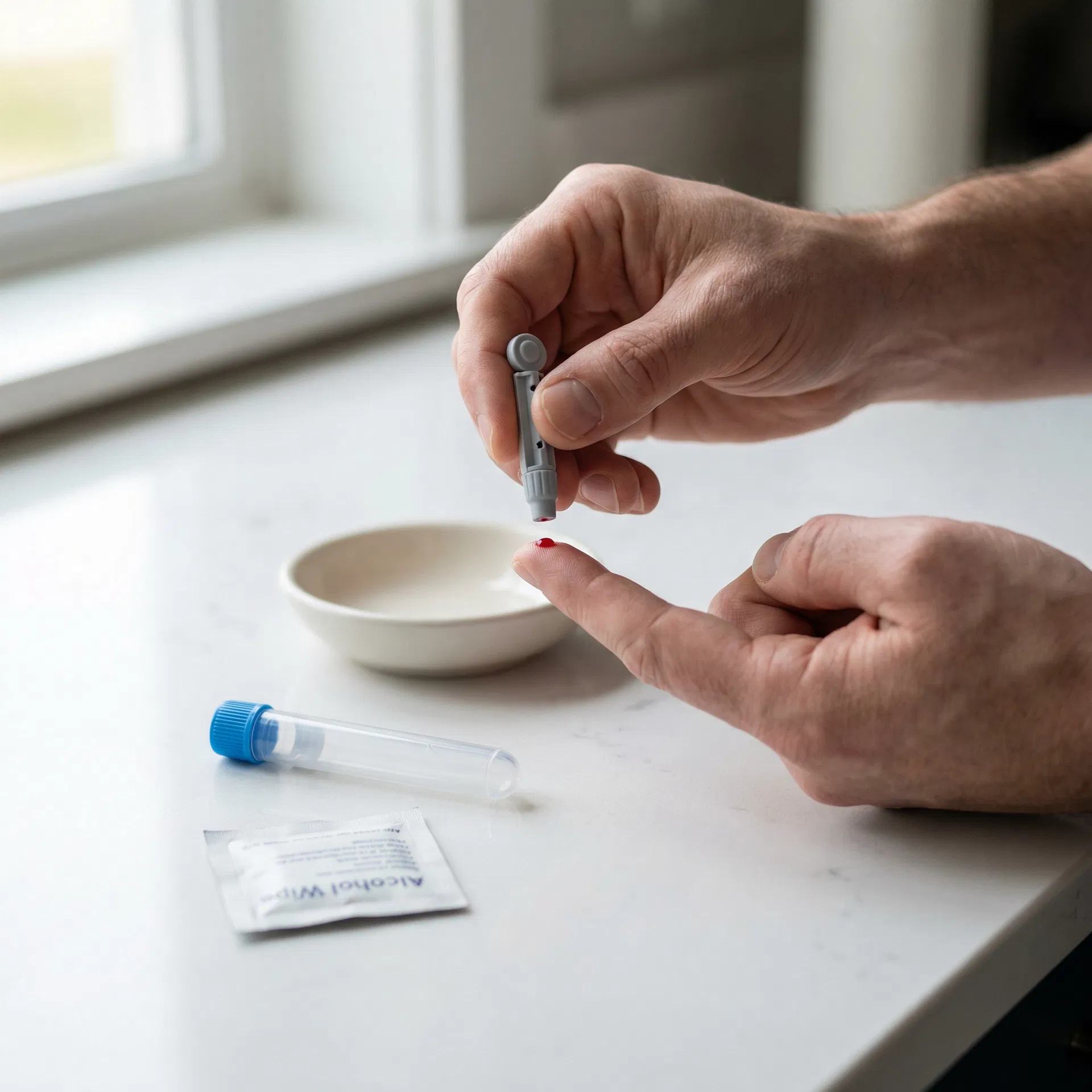
Collect your sample
Follow the simple instructions in your kit — whether it's a finger-prick at home or a venous draw at a partner clinic.
 04
04
Insights delivered
Clear, easy-to-understand results sent to you online with actionable health guidance.
Frequently asked questions
This test measures Haemoglobin, Haematocrit, MCV (Mean Corpuscular Volume), Vitamin B12, Intrinsic Factor Antibodies. Check the full biomarker list on this page for detailed descriptions.
Check the Special Instructions on this page. General rule: fast 8-12 hours if cholesterol/glucose/insulin included. Most hormone, vitamin, and antibody tests do not require fasting. Morning collection (7-10am) is preferred.
Follow the instructions in your kit. For finger-prick: warm hands, use lancet as directed, fill tube to marked line. For venous: attend a phlebotomy clinic with your lab form. Post same day, avoid Fridays/bank holidays.
Results are typically available within the timeframe shown on this page. You will receive a notification when ready to view online.
You may also be interested in

Anaemia Profile Blood Test
A 21-biomarker venous blood panel covering red blood cells, white blood cells, clotting status and other key health markers — ideal for investigating fatigue, brain fog, tingling, or pernicious anaemia.
Results estimated in 2 working days
21 biomarkers

Advanced Vitamins Blood Test
A 10-biomarker venous blood panel covering fat-soluble vitamins and b vitamins — ideal for investigating relevant symptoms or monitoring health.
Results estimated in 3 working days
10 biomarkers
Venous collection
Allergy Screen (Essential Foods) Blood Test
An essential food allergy panel testing for the most common food allergens responsible for IgE-mediated reactions — covering the key foods that account for the majority of food allergies in both children and adults.
Results estimated in 2 working days
9 biomarkers