
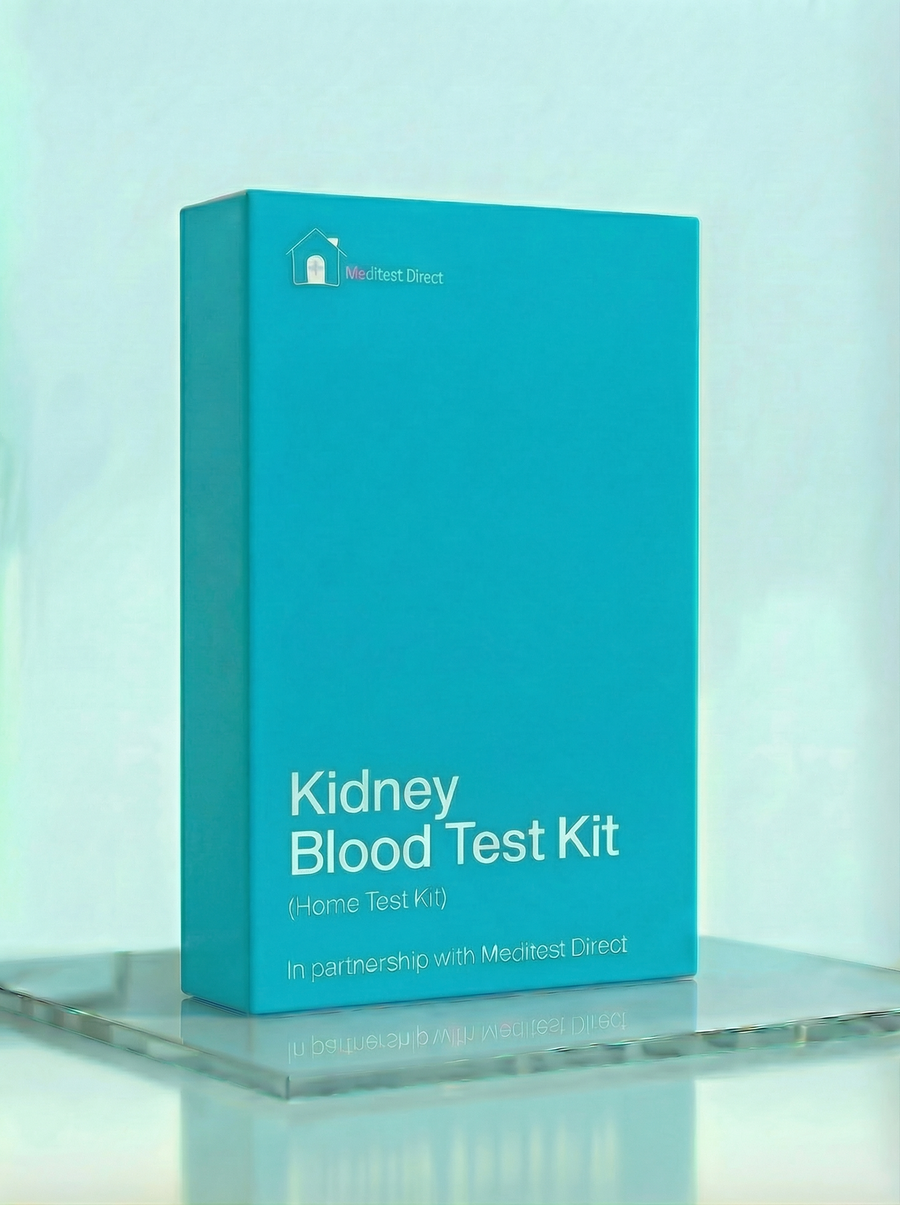
Kidney Blood Test Kit
£38 ✓ In Stock
Your sample goes to a UKAS accredited laboratory meeting ISO 15189 standards.
After you receive your order confirmation email, please reply with your date of birth.
How it works
Your testing journey
From order to results in four simple steps. Full transparency on where each step happens and what it costs.

Receive your kit by post
Dispatched same working day if ordered before 3pm. Royal Mail Tracked delivery, typically 1–3 working days. 90% of kits arrive within 24 hours.

Visit a partner clinic
Book a phlebotomy appointment at one of our 365+ UK partner clinics. Take your kit with you — the phlebotomist will collect your sample using the materials provided.
Phlebotomy fee applies (paid at clinic)
Venous blood draw at a clinic
A trained phlebotomist takes a small blood sample from a vein in your arm using the vacutainers provided in your kit. The appointment takes around 10 minutes.

Return by prepaid envelope
Seal your sample in the biohazard bag provided and drop it in any Royal Mail postbox using the prepaid Tracked 24 envelope. Post Monday–Thursday for best results.
Venous Blood Collection Kit
This kit is sent to you and taken to your chosen clinic. The phlebotomist will collect your sample using the materials provided.
- 1Vacutainer blood collection tubes
- 2Needle and butterfly needle
- 3Tourniquet
- 4Alcohol swab
- 5Cotton wool and gauze
- 6Adhesive plaster
- 7Biohazard specimen bag
- 8Prepaid return envelope (Royal Mail Tracked 24)
- 9Laboratory request form
- 10Instructions for the phlebotomist
Creatinine is a waste product generated from the normal breakdown of creatine phosphate in muscle tissue. It's produced at a fairly constant rate (depending on your muscle mass) and is filtered out of the blood exclusively by the kidneys, making it one of the most useful markers of kidney function. Unlike some other waste products, creatinine isn't significantly reabsorbed by the kidneys or secreted by other routes—virtually all of it ends up in urine. Because the kidneys are responsible for clearing creatinine from the blood, when kidney function declines, creatinine accumulates and blood levels rise. This makes serum creatinine a reliable indicator of how well the kidneys are filtering. However, creatinine levels are also influenced by muscle mass—people with more muscle naturally produce more creatinine, so a muscular person may have higher creatinine levels that are completely normal for them. This is why creatinine is used alongside eGFR (which accounts for age and sex) and other markers rather than interpreted alone. Normal creatinine levels vary by age, sex, and muscle mass, but are typically 60-110 µmol/L for men and 45-90 µmol/L for women. Elevated creatinine may indicate reduced kidney function, but can also be caused by dehydration, recent intense exercise, high protein intake, or certain medications. Persistently elevated creatinine warrants further investigation. Very low creatinine is less common but can occur with reduced muscle mass, severe liver disease, or pregnancy. Results outside the normal range may need a follow-up with your GP.
The estimated Glomerular Filtration Rate (eGFR) is calculated from your creatinine level, age, and sex to provide an estimate of how much blood your kidneys are filtering per minute. The glomeruli are tiny filtering units within the kidneys (about a million in each kidney) where blood is filtered and urine formation begins. GFR is considered the best overall measure of kidney function. eGFR is reported in mL/min/1.73m² (millilitres per minute, normalised to body surface area). The calculation accounts for factors that affect creatinine levels independent of kidney function—for example, men typically have higher creatinine than women due to greater muscle mass, and creatinine naturally rises with age as kidney function gradually declines. The most commonly used formula is the CKD-EPI equation, which gives a more accurate estimate than older formulas, particularly at higher (more normal) GFR values. Normal eGFR is above 90 mL/min/1.73m². An eGFR between 60-89 is mildly reduced and may be normal for older adults, but should be monitored. Sustained eGFR below 60 for more than 3 months defines chronic kidney disease (CKD). CKD is staged by eGFR: Stage 3a (45-59), Stage 3b (30-44), Stage 4 (15-29), and Stage 5 (<15, which may require dialysis or transplant). Importantly, a single eGFR reading should not be used to diagnose CKD—results should be confirmed with repeat testing, as eGFR can fluctuate day to day. Kidney function naturally declines with age (roughly 1 mL/min/year after age 30-40), so an eGFR of 70 in a healthy 75-year-old may be entirely appropriate. Results outside the normal range may need a follow-up with your GP.
Urea (also called blood urea nitrogen or BUN in some countries) is a waste product formed in the liver when protein is broken down into amino acids and then metabolised. The nitrogen released during this process is converted to urea, which travels through the bloodstream to the kidneys, where it's filtered out and excreted in urine. Urea reflects both protein metabolism (how much protein you're breaking down) and kidney function (how well the kidneys are eliminating waste). Unlike creatinine, which is produced at a relatively constant rate, urea levels are influenced by dietary protein intake and the body's metabolic state. Eating a high-protein meal can temporarily raise urea levels, while a low-protein diet or liver disease can lower them. This makes urea somewhat less specific for kidney function than creatinine, but it provides complementary information—looking at the ratio of urea to creatinine can help distinguish between different causes of elevated results. Normal urea levels are typically 2.5-7.8 mmol/L. Elevated urea can indicate reduced kidney function, but is also commonly caused by dehydration (a very common cause), gastrointestinal bleeding (digested blood provides a protein load), high-protein diet, certain medications (steroids, tetracyclines), or conditions causing increased protein breakdown (burns, trauma, fever). A disproportionately elevated urea compared to creatinine often suggests dehydration or gastrointestinal bleeding rather than kidney disease. Low urea can occur with liver disease (impaired urea production), low-protein diet, or pregnancy. Results outside the normal range may need a follow-up with your GP.
Sodium is both an essential electrolyte and a mineral that plays crucial roles in maintaining fluid balance, blood pressure regulation, nerve impulse transmission, and muscle contraction. The body tightly regulates sodium levels within a narrow range through a complex system involving the kidneys, hormones (particularly aldosterone and antidiuretic hormone), and thirst mechanisms. The kidneys are central to this regulation—they adjust how much sodium is excreted or retained based on the body's needs. In the context of kidney function testing, sodium provides information about the kidney's ability to maintain electrolyte balance and regulate fluid status. Healthy kidneys can adjust sodium excretion over a wide range to match intake and maintain balance. When kidney function is impaired, this regulatory capacity may be diminished, potentially leading to sodium imbalances. Sodium levels can also be affected by many other factors including fluid intake, hormonal conditions, medications (especially diuretics), and various medical conditions. Normal sodium levels are 136-145 mmol/L. Low sodium (hyponatraemia, below 136 mmol/L) can cause symptoms ranging from mild (headache, nausea, confusion) to severe (seizures, coma) depending on how low and how quickly it falls. Common causes include excess fluid intake, certain medications (especially diuretics, antidepressants), heart failure, liver cirrhosis, and syndrome of inappropriate ADH (SIADH). High sodium (hypernatraemia, above 145 mmol/L) is most commonly caused by dehydration, but can also occur with diabetes insipidus or excessive salt intake. Sodium imbalances often reflect problems with water balance rather than actual sodium excess or deficiency. Results outside the normal range may need a follow-up with your GP.
This test is for screening and information only — it is not a medical diagnosis or professional advice. Please have your results reviewed by a qualified doctor or healthcare provider who can explain what they mean for your personal health situation. If your results show anything outside the normal range, or if you're worried about your health, see your doctor as soon as you can. Don't change any medications or treatments based on these results alone — always talk to your healthcare provider first.
NO CLINICS, NO QUEUES, NO HASSLE
Four steps to clarity
 01
01
Pick your panel
Browse over 200 clinically designed test kits and choose the one that fits your goals.
 02
02
Kit to your door
Everything you need arrives in discreet packaging with step-by-step instructions inside.
 03
03
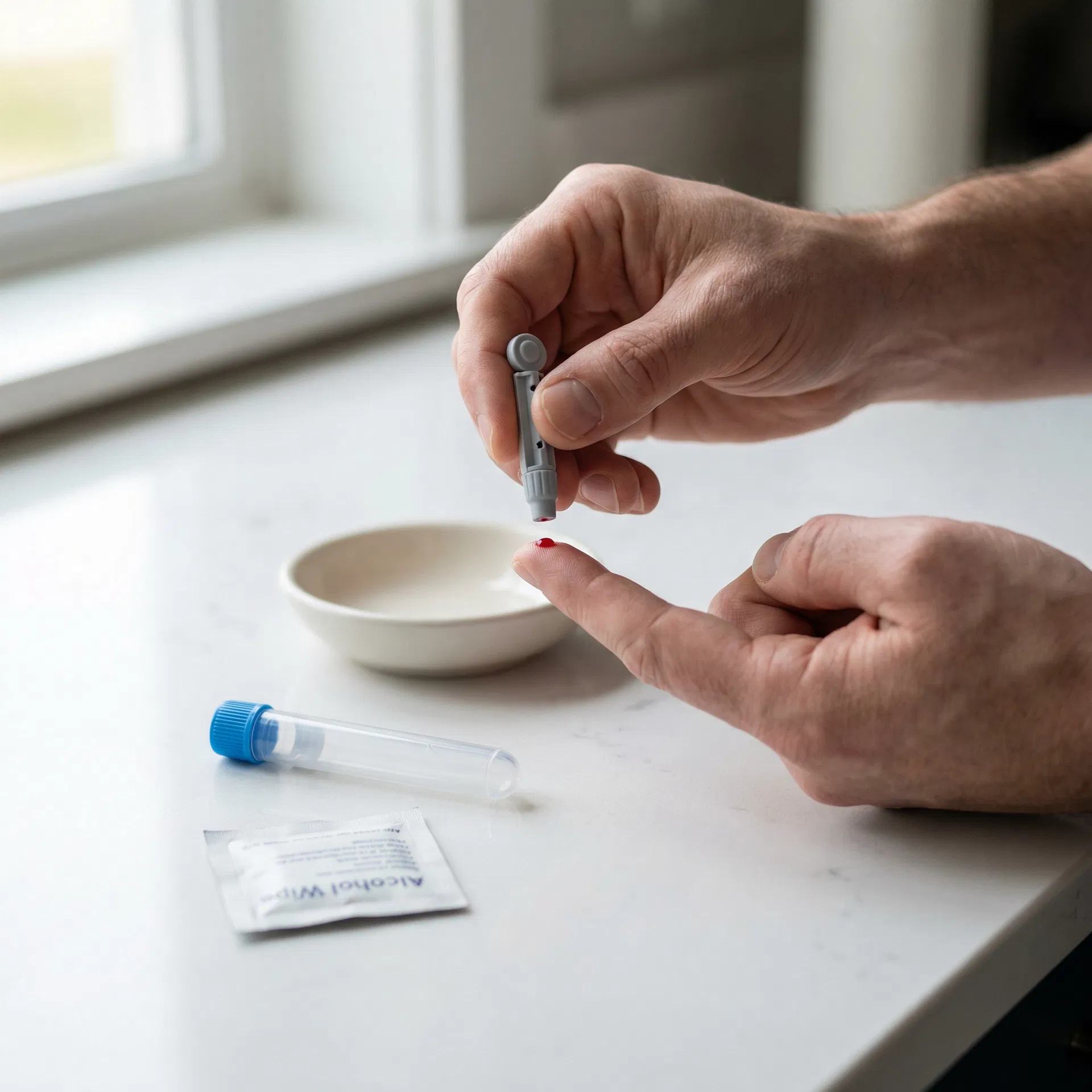
Collect your sample
Follow the simple instructions in your kit — whether it's a finger-prick at home or a venous draw at a partner clinic.
 04
04
Insights delivered
Clear, easy-to-understand results sent to you online with actionable health guidance.
Frequently asked questions
Typically creatinine, urea, eGFR, and electrolytes. eGFR is the key marker — above 90 is normal, below 60 sustained over 3 months indicates chronic kidney disease.
Yes. Dehydration can temporarily elevate creatinine and urea. Drink water normally before testing.
No. Avoid unusually high-protein meals and intense exercise for 24 hours before testing.
You may also be interested in

Blood Urea Nitrogen (BUN) Blood Test
A 2-biomarker venous blood panel covering kidney health — ideal for investigating relevant symptoms or monitoring health.
Results estimated in 2 working days
2 biomarkers

Allergy Screen (Essential Foods) Blood Test
An essential food allergy panel testing for the most common food allergens responsible for IgE-mediated reactions — covering the key foods that account for the majority of food allergies in both children and adults.
Results estimated in 2 working days
9 biomarkers

Bile Acids (Total) Blood Test
A single-biomarker venous blood test covering liver health — ideal for investigating relevant symptoms or monitoring health.
Results estimated in 9 working days
1 biomarkers