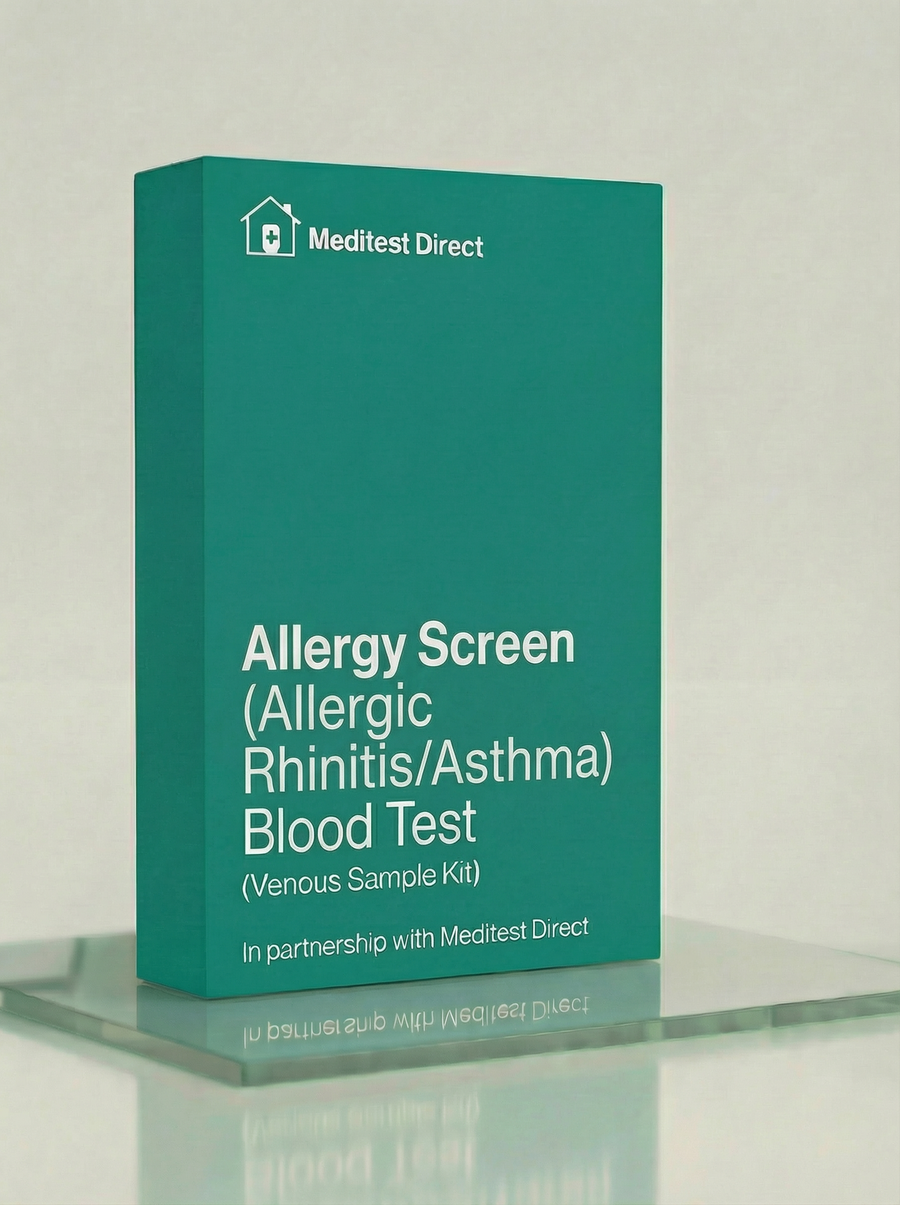
Allergy Screen (Allergic Rhinitis/Asthma) Blood Test
£290 ✓ In Stock
Your sample goes to a UKAS accredited laboratory meeting ISO 15189 standards.
After you receive your order confirmation email, please reply with your date of birth.
How it works
Your testing journey
From order to results in four simple steps. Full transparency on where each step happens and what it costs.

Receive your kit by post
Dispatched same working day if ordered before 3pm. Royal Mail Tracked delivery, typically 1–3 working days. 90% of kits arrive within 24 hours.

Visit a partner clinic
Book a phlebotomy appointment at one of our 365+ UK partner clinics. Take your kit with you — the phlebotomist will collect your sample using the materials provided.
Phlebotomy fee applies (paid at clinic)
Venous blood draw at a clinic
A trained phlebotomist takes a small blood sample from a vein in your arm using the vacutainers provided in your kit. The appointment takes around 10 minutes.

Return by prepaid envelope
Seal your sample in the biohazard bag provided and drop it in any Royal Mail postbox using the prepaid Tracked 24 envelope. Post Monday–Thursday for best results.
Venous Blood Collection Kit
This kit is sent to you and taken to your chosen clinic. The phlebotomist will collect your sample using the materials provided.
- 1Vacutainer blood collection tubes
- 2Needle and butterfly needle
- 3Tourniquet
- 4Alcohol swab
- 5Cotton wool and gauze
- 6Adhesive plaster
- 7Biohazard specimen bag
- 8Prepaid return envelope (Royal Mail Tracked 24)
- 9Laboratory request form
- 10Instructions for the phlebotomist
Cat dander contains the major allergen Fel d 1, produced in saliva and sebaceous glands and shed on skin flakes. It is small, sticky, and persistent in the environment — making it a common trigger of allergic rhinitis and asthma even in homes without cats.
Dog dander allergy is driven mainly by Can f 1 and other proteins found in saliva, urine, and skin. Dog allergens tend to be more variable between breeds than cat allergens but can still trigger significant respiratory and skin symptoms.
Silver birch pollen is the dominant tree pollen allergen in northern Europe. It causes spring hay fever and is the main driver of pollen-food syndrome (oral itching from raw apples, hazelnuts, stone fruits, and some vegetables).
Timothy grass is a major source of grass pollen allergy and a common cause of seasonal allergic rhinitis (hay fever) in the UK during late spring and summer. It is also the basis for many grass pollen immunotherapy preparations.
London Plane is included in this allergy panel to detect specific IgE antibodies. A positive result indicates sensitisation, which — combined with a clinical history of symptoms on exposure — supports the diagnosis of allergy. Testing helps identify trigger allergens so that informed avoidance and management decisions can be made.
Mugwort is included in this allergy panel to detect specific IgE antibodies. A positive result indicates sensitisation, which — combined with a clinical history of symptoms on exposure — supports the diagnosis of allergy. Testing helps identify trigger allergens so that informed avoidance and management decisions can be made.
Aspergillus fumigatus is included in this allergy panel to detect specific IgE antibodies. A positive result indicates sensitisation, which — combined with a clinical history of symptoms on exposure — supports the diagnosis of allergy. Testing helps identify trigger allergens so that informed avoidance and management decisions can be made.
Cladosporium herbarum is included in this allergy panel to detect specific IgE antibodies. A positive result indicates sensitisation, which — combined with a clinical history of symptoms on exposure — supports the diagnosis of allergy. Testing helps identify trigger allergens so that informed avoidance and management decisions can be made.
Alternaria alternata is included in this allergy panel to detect specific IgE antibodies. A positive result indicates sensitisation, which — combined with a clinical history of symptoms on exposure — supports the diagnosis of allergy. Testing helps identify trigger allergens so that informed avoidance and management decisions can be made.
Dermatophagoides pteronyssinus is the most common house dust mite worldwide and a major trigger of perennial allergic rhinitis, asthma, and atopic dermatitis. Dust mites live in bedding, carpets, and soft furnishings; their faecal pellets contain the main allergenic proteins.
Peanut is one of the most clinically significant food allergens because reactions tend to be severe and lifelong. Even tiny amounts can trigger anaphylaxis in sensitised individuals, making accurate testing essential.
Egg white contains the most allergenic egg proteins (ovomucoid, ovalbumin, ovotransferrin, lysozyme). Egg allergy is most common in young children and can trigger eczema flare-ups, urticaria, gastrointestinal symptoms, and anaphylaxis in sensitised individuals.
Cow's milk allergy is one of the most common food allergies in childhood and may also persist into adulthood. Reactions are driven by IgE antibodies to milk proteins (mainly casein, alpha-lactalbumin, and beta-lactoglobulin) and can range from mild skin rashes to severe systemic reactions.
This test is for screening and information only — it is not a medical diagnosis or professional advice. Please have your results reviewed by a qualified doctor or healthcare provider who can explain what they mean for your personal health situation. If your results show anything outside the normal range, or if you're worried about your health, see your doctor as soon as you can. Don't change any medications or treatments based on these results alone — always talk to your healthcare provider first.
NO CLINICS, NO QUEUES, NO HASSLE
Four steps to clarity
 01
01
Pick your panel
Browse over 200 clinically designed test kits and choose the one that fits your goals.
 02
02
Kit to your door
Everything you need arrives in discreet packaging with step-by-step instructions inside.
 03
03
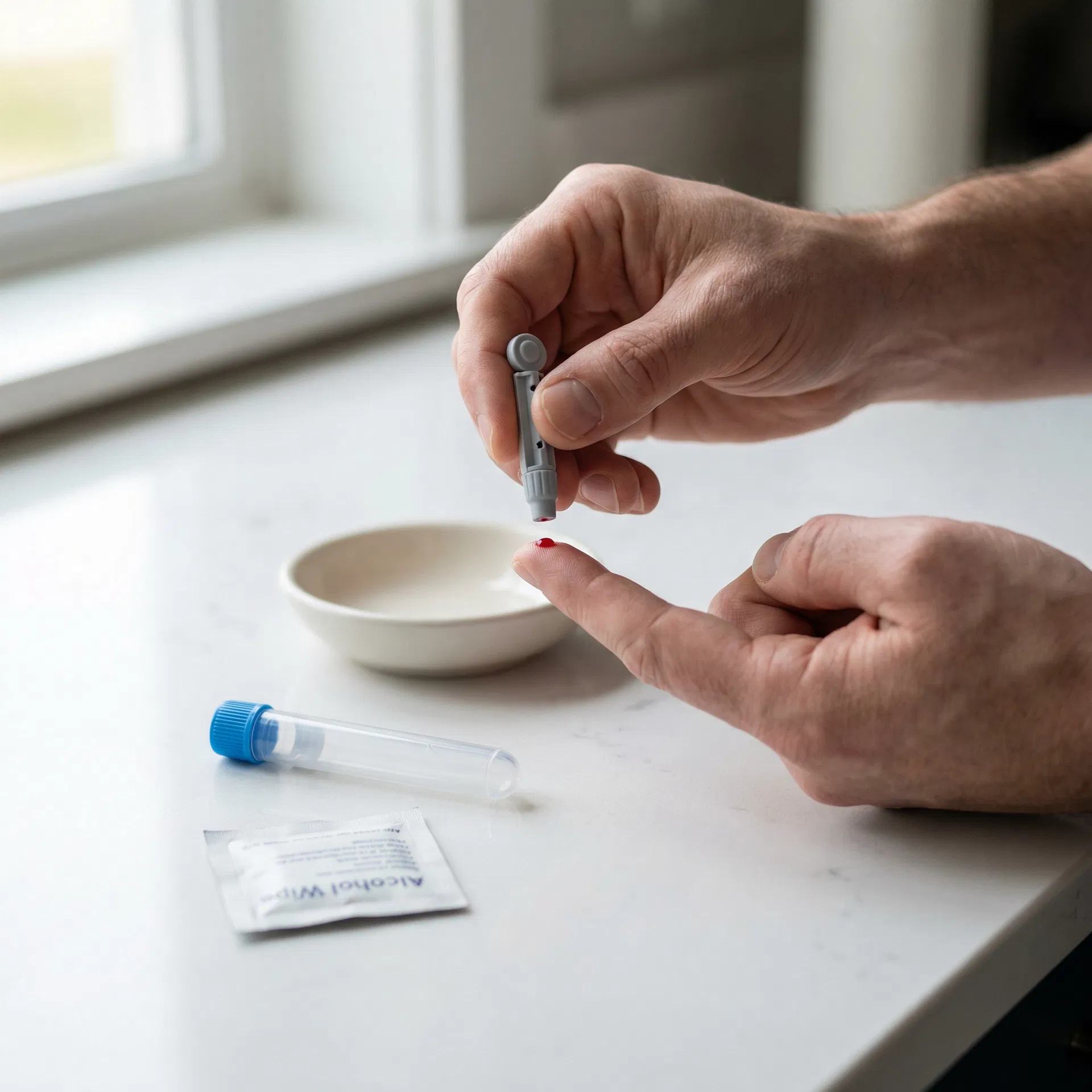
Collect your sample
Follow the simple instructions in your kit — whether it's a finger-prick at home or a venous draw at a partner clinic.
 04
04
Insights delivered
Clear, easy-to-understand results sent to you online with actionable health guidance.
Frequently asked questions
Yes. Unlike skin prick tests, blood-based IgE allergy tests are not affected by antihistamines, steroids, or inhalers. You can continue all your regular medications and still get accurate results.
A positive IgE result means your immune system has produced antibodies to that allergen (sensitisation). However, sensitisation does not always cause clinical symptoms. Results should be interpreted alongside your symptom history, ideally with a GP or allergy specialist.
No. Allergy blood tests are not affected by recent food intake.
Yes. This panel tests for common environmental allergens including grass and tree pollens, house dust mites, mould spores, and animal dander. Identifying your specific triggers allows more targeted treatment and avoidance strategies.
Yes. Identifying specific allergen triggers helps your doctor optimise your asthma treatment plan and consider allergen-specific immunotherapy if appropriate.
You may also be interested in

Allergy Screen (Atopic Dermatitis/Eczema) Blood Test
A comprehensive eczema and atopic dermatitis panel testing for IgE antibodies to 14 common allergens known to trigger or worsen skin symptoms — designed for people with eczema who suspect allergy involvement.
Results estimated in 2 working days
14 biomarkers

Allergy Screen (Stone fruit/Rosaceae family) Blood Test
A stone fruit and Rosaceae family allergy panel testing for IgE antibodies to fruits in the rose family (apples, peaches, cherries, strawberries, and more) — commonly associated with oral allergy syndrome in people with birch pollen allergies.
Results estimated in 2 working days
9 biomarkers

Allergy Screen (Milk & Milk Proteins) Blood Test
A comprehensive milk allergy panel testing for IgE antibodies to cow's milk and goat's milk proteins — milk allergy is one of the most common food allergies in children, and this test helps confirm diagnosis and identify specific protein triggers.
Results estimated in 2 working days
2 biomarkers

Islet Cell Antibodies Blood Test
A single-biomarker venous blood test covering autoimmunity — ideal for investigating suspected autoimmune conditions.
Results estimated in 10 working days
Venous collection