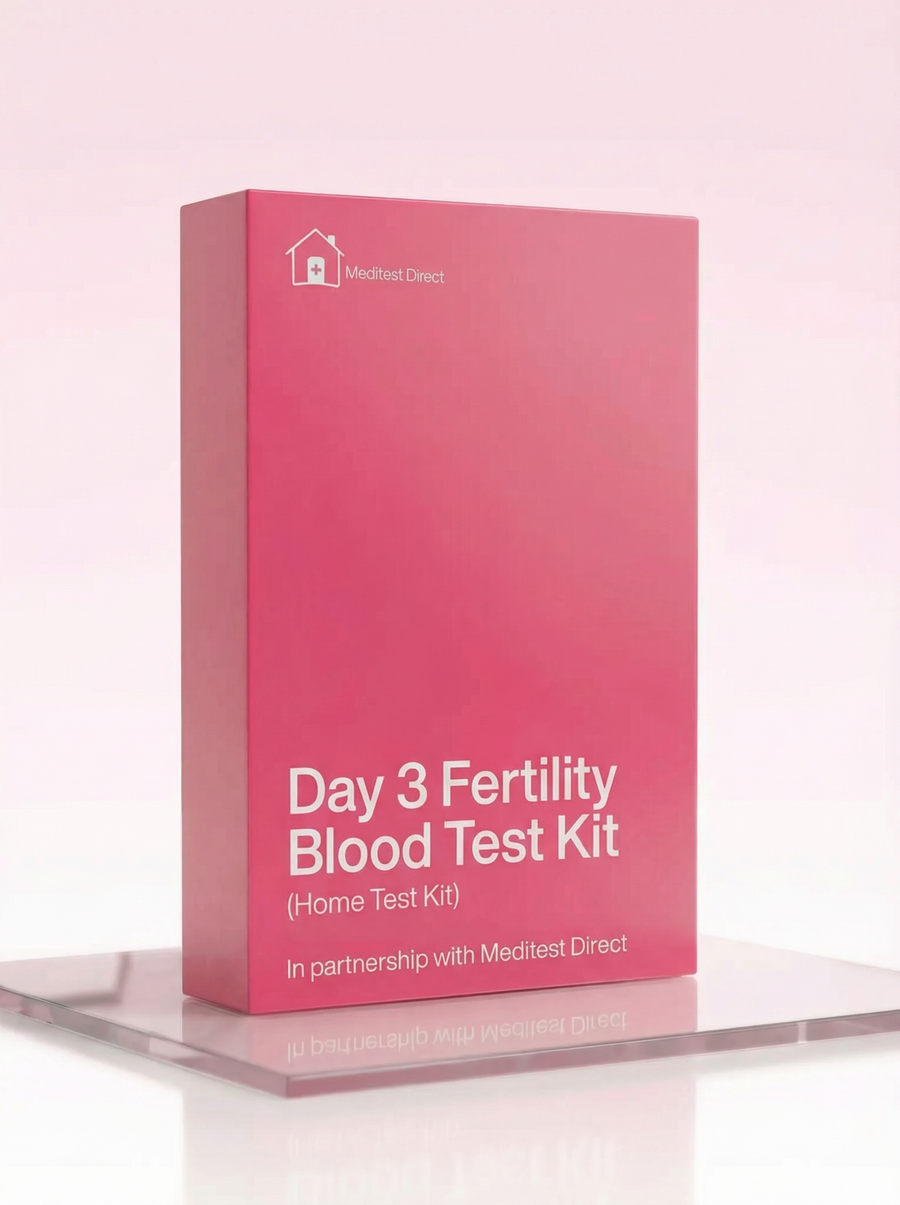
Day 3 Fertility Blood Test Kit
£54 ✓ In Stock
Your sample goes to a UKAS accredited laboratory meeting ISO 15189 standards.
After you receive your order confirmation email, please reply with your date of birth.
How it works
Your testing journey
From order to results in four simple steps. Full transparency on where each step happens and what it costs.

Receive your kit by post
Dispatched same working day if ordered before 3pm. Royal Mail Tracked delivery, typically 1–3 working days. 90% of kits arrive within 24 hours.

Visit a partner clinic
Book a phlebotomy appointment at one of our 365+ UK partner clinics. Take your kit with you — the phlebotomist will collect your sample using the materials provided.
Phlebotomy fee applies (paid at clinic)
Venous blood draw at a clinic
A trained phlebotomist takes a small blood sample from a vein in your arm using the vacutainers provided in your kit. The appointment takes around 10 minutes.

Return by prepaid envelope
Seal your sample in the biohazard bag provided and drop it in any Royal Mail postbox using the prepaid Tracked 24 envelope. Post Monday–Thursday for best results.
Venous Blood Collection Kit
This kit is sent to you and taken to your chosen clinic. The phlebotomist will collect your sample using the materials provided.
- 1Vacutainer blood collection tubes
- 2Needle and butterfly needle
- 3Tourniquet
- 4Alcohol swab
- 5Cotton wool and gauze
- 6Adhesive plaster
- 7Biohazard specimen bag
- 8Prepaid return envelope (Royal Mail Tracked 24)
- 9Laboratory request form
- 10Instructions for the phlebotomist
Follicle Stimulating Hormone (FSH) is produced by the pituitary gland in the brain and plays a central role in reproduction. In women, FSH stimulates the growth and maturation of ovarian follicles—the fluid-filled sacs in the ovaries that each contain an egg. During the early follicular phase of your menstrual cycle (days 1-5), FSH levels rise to recruit a cohort of follicles, one of which will become dominant and eventually release a mature egg at ovulation. As the follicles grow, they produce oestradiol, which provides negative feedback to the pituitary to reduce FSH secretion—this is how one dominant follicle is selected while others regress. Day 3 FSH is one of the most important markers of ovarian reserve—the quantity and quality of eggs remaining in your ovaries. The key principle is that if your ovaries have good reserve (plenty of responsive follicles), relatively little FSH is needed to stimulate follicle growth, so baseline FSH remains low. If ovarian reserve is diminished (fewer remaining follicles or less responsive ovaries), the pituitary must produce more FSH to achieve the same effect, resulting in elevated day 3 FSH. Higher FSH levels on day 3 therefore suggest reduced ovarian reserve. However, FSH alone doesn't tell the whole story—oestradiol levels on the same day help validate the result, and AMH (Anti-Müllerian Hormone, tested separately) provides additional complementary information about ovarian reserve. FSH levels naturally rise as women approach menopause. Results outside the normal range may need a follow-up with your GP or fertility specialist.
Luteinising Hormone (LH) is produced by the pituitary gland alongside FSH and works in concert with FSH to regulate the menstrual cycle and ovulation. During the early follicular phase, LH levels are relatively low and stable. As oestradiol rises from the growing dominant follicle, it eventually triggers a dramatic surge in LH (the 'LH surge') which causes the mature follicle to rupture and release its egg—this is ovulation. After ovulation, LH helps support the corpus luteum (the remnant of the follicle) to produce progesterone during the luteal phase. On day 3 of your cycle, LH should be at its baseline level. The relationship between LH and FSH on day 3 provides additional diagnostic information. In most women, FSH is slightly higher than LH in the early follicular phase, giving an LH: FSH ratio below 1. An elevated LH: FSH ratio (LH higher than FSH, or ratio above 2-3) on day 3 is one of the hormonal features of Polycystic Ovary Syndrome (PCOS), a common condition affecting ovulation and fertility. Women with PCOS often have tonically elevated LH which contributes to the hormonal imbalances and ovulatory dysfunction characteristic of the condition. However, not all women with PCOS show this pattern, and an abnormal ratio alone isn't sufficient for diagnosis—PCOS diagnosis requires additional criteria. Results outside the normal range may need a follow-up with your GP or fertility specialist.
Oestradiol (also spelled estradiol, abbreviated E2) is the most potent and abundant form of oestrogen in premenopausal women. It's primarily produced by the growing follicles in the ovaries, with small amounts also produced by the adrenal glands and fat tissue. Oestradiol has wide-ranging effects throughout the body: it maintains the uterine lining, supports bone health, influences cholesterol metabolism, affects mood and cognition, and maintains vaginal and skin health. During the menstrual cycle, oestradiol levels are low at the start, rise steadily as follicles grow (peaking just before ovulation), drop briefly after ovulation, then rise again during the luteal phase before falling if pregnancy doesn't occur. On day 3, oestradiol should be at a relatively low baseline level (typically below 200 pmol/L or 50 pg/mL). Day 3 oestradiol serves an important role in validating your FSH result. If oestradiol is elevated on day 3 (suggesting you may have tested at the wrong time, or that a follicle has already started growing early), it can suppress FSH through negative feedback—giving a falsely reassuring low FSH even if ovarian reserve is actually reduced. This is why interpreting FSH in isolation can be misleading; the oestradiol provides a quality check. An elevated day 3 oestradiol with a 'normal' FSH should be interpreted with caution. Low day 3 oestradiol combined with high FSH is consistent with diminished ovarian reserve or approaching menopause. Results outside the normal range may need a follow-up with your GP or fertility specialist.
This test is for screening and information only — it is not a medical diagnosis or professional advice. Please have your results reviewed by a qualified doctor or healthcare provider who can explain what they mean for your personal health situation. If your results show anything outside the normal range, or if you're worried about your health, see your doctor as soon as you can. Don't change any medications or treatments based on these results alone — always talk to your healthcare provider first.
NO CLINICS, NO QUEUES, NO HASSLE
Four steps to clarity
 01
01
Pick your panel
Browse over 200 clinically designed test kits and choose the one that fits your goals.
 02
02
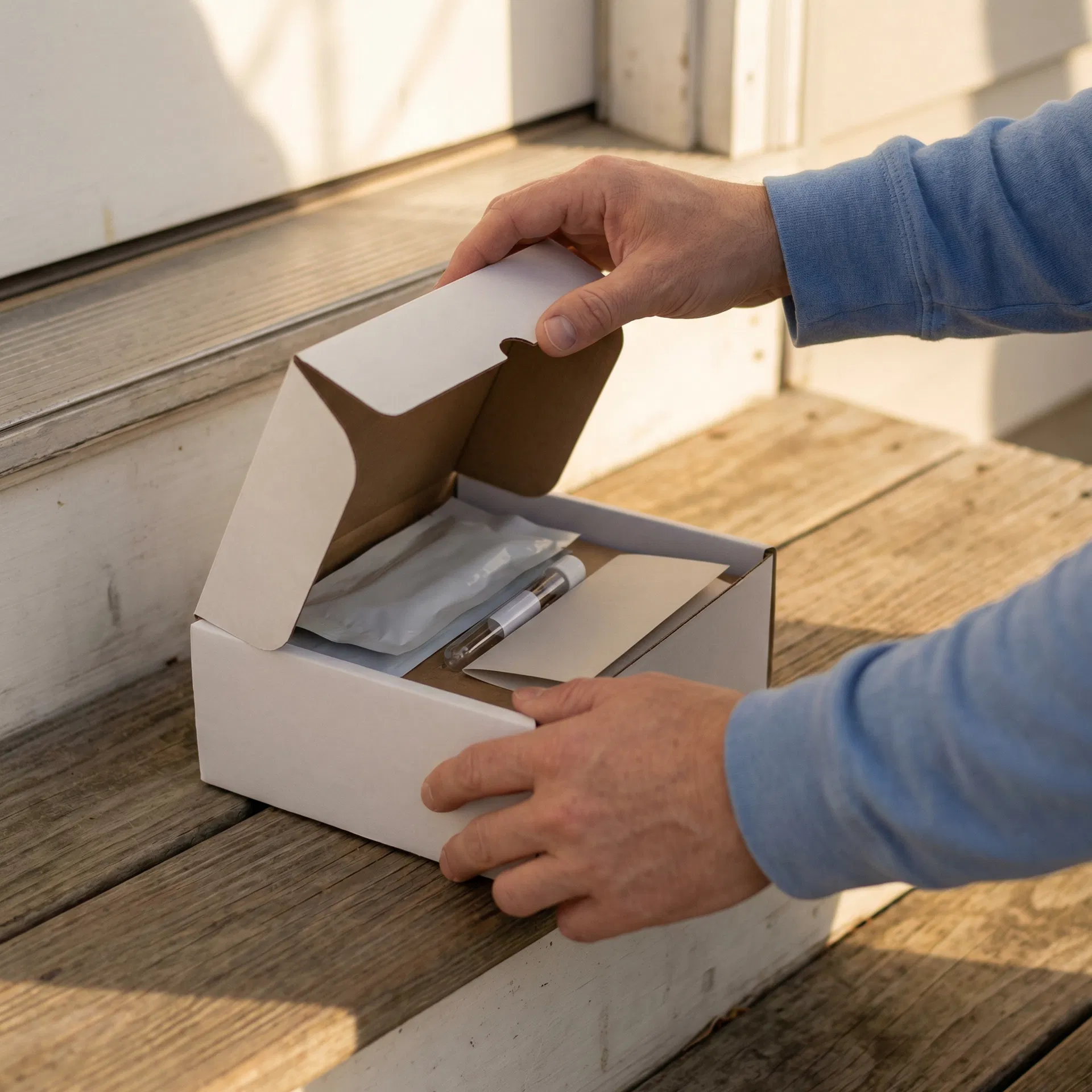
Kit to your door
Everything you need arrives in discreet packaging with step-by-step instructions inside.
 03
03
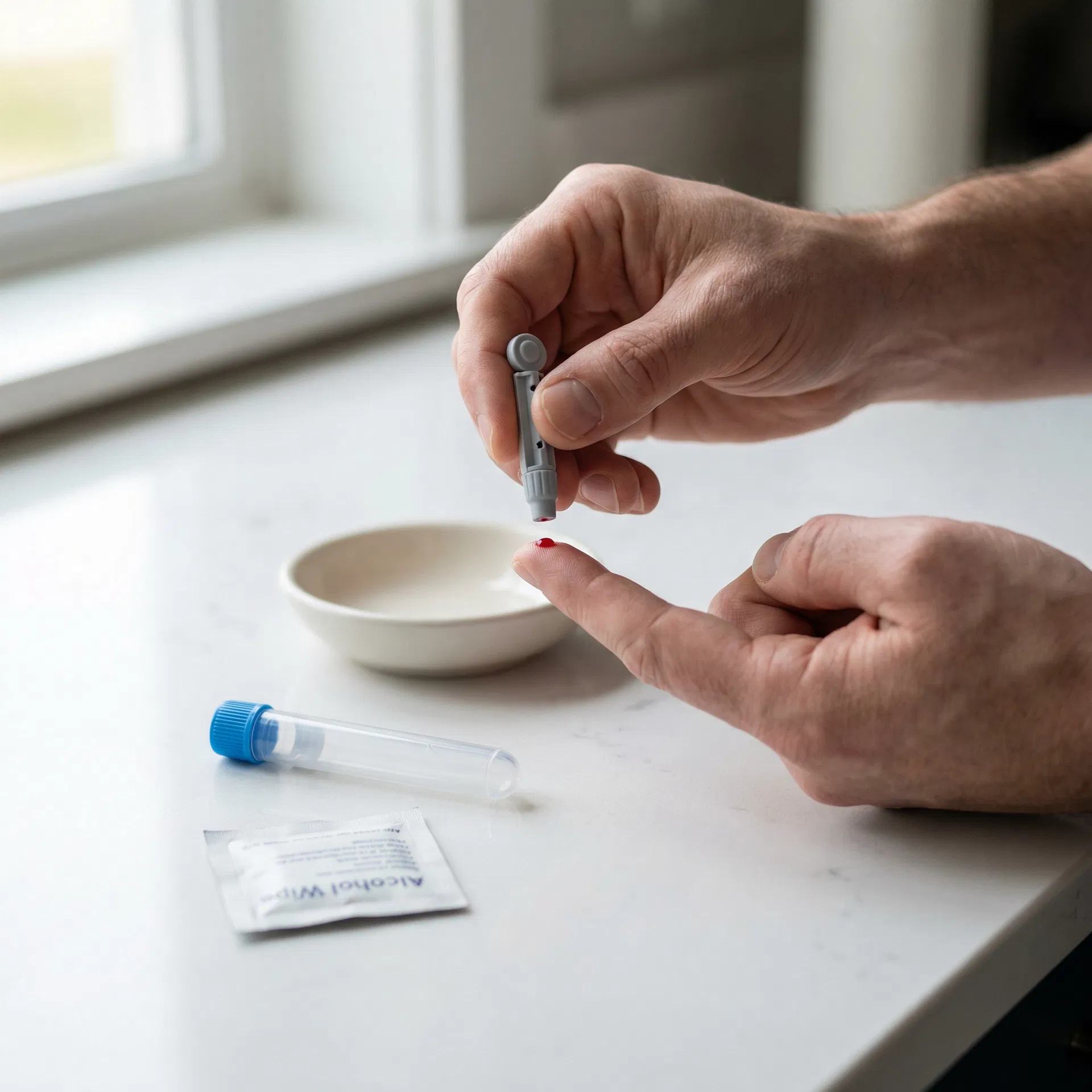
Collect your sample
Follow the simple instructions in your kit — whether it's a finger-prick at home or a venous draw at a partner clinic.
 04
04
Insights delivered
Clear, easy-to-understand results sent to you online with actionable health guidance.
Frequently asked questions
Day 2-5 for FSH, LH, oestradiol, AMH. Day 21 for progesterone/ovulation confirmation. Incorrect timing makes results uninterpretable.
AMH reflects ovarian reserve. It is stable across your cycle and declines with age. Lower AMH suggests reduced egg reserve, relevant for family planning and IVF decisions.
Hormonal contraception suppresses natural levels. AMH is less affected and can still be informative. For full baseline, stop contraception 3+ months — discuss with GP first.
No.
You may also be interested in

Advanced Male Fertility Hormone Blood Test Kit
A 7-biomarker venous blood,semen panel covering hormones and proteins — ideal for investigating male fertility and reproductive hormones.
Results estimated in 2 working days
7 biomarkers

Advanced Female Fertility Blood Test Kit
A 12-biomarker venous blood panel covering hormones and proteins — ideal for investigating female fertility and reproductive health.
Results estimated in 2 working days
12 biomarkers

Female Infertility Check Blood test
A 4-biomarker venous blood panel covering female fertility hormones — ideal for investigating female fertility and reproductive health.
Results estimated in 2 working days
4 biomarkers

Advanced Female Hormone Blood Test
A 12-biomarker venous blood panel covering hormones, proteins, thyroid hormones and autoimmunity — ideal for investigating relevant symptoms or monitoring health.
Results estimated in 2 working days
12 biomarkers