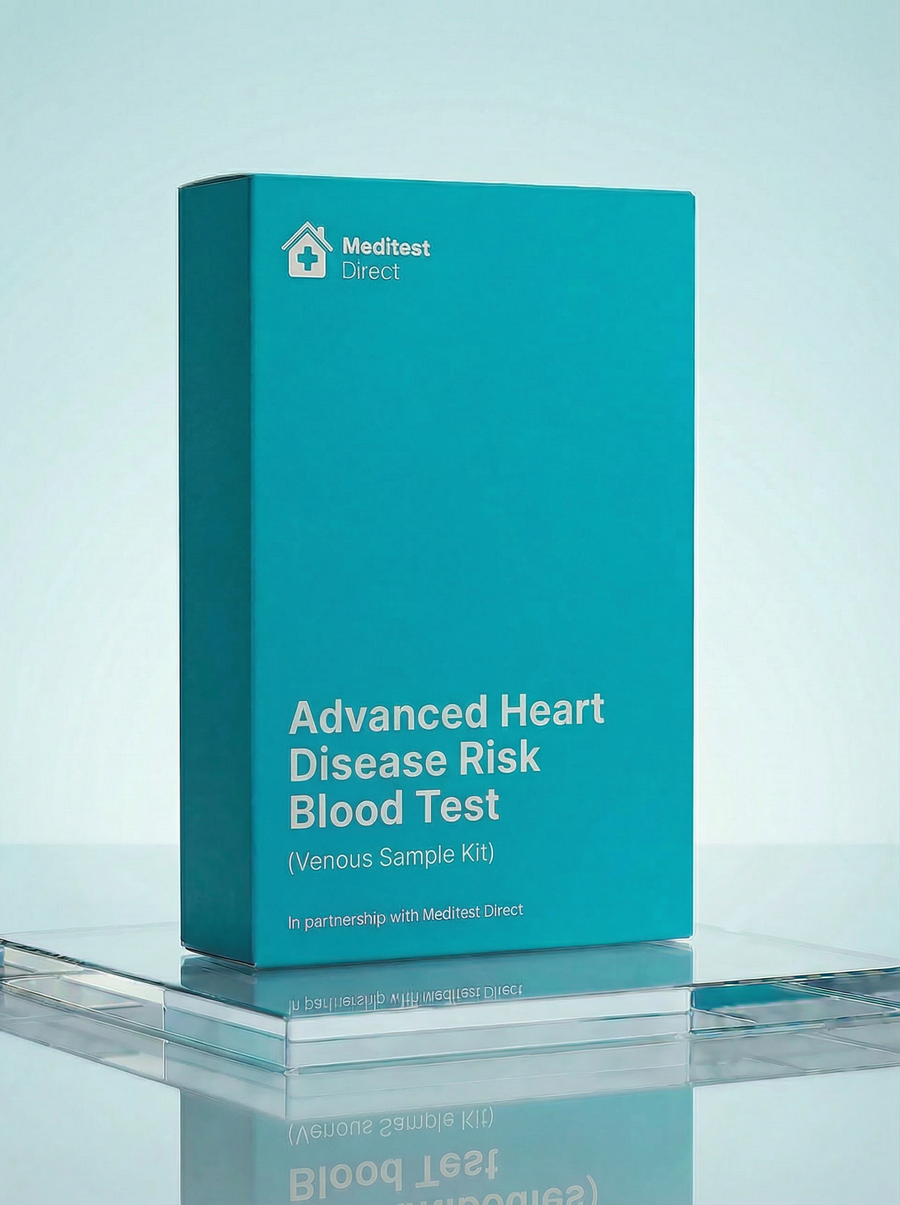
Advanced Heart Disease Risk Blood Test
£220 ✓ In Stock
Your sample goes to a UKAS accredited laboratory meeting ISO 15189 standards.
After you receive your order confirmation email, please reply with your date of birth.
How it works
Your testing journey
From order to results in four simple steps. Full transparency on where each step happens and what it costs.

Receive your kit by post
Dispatched same working day if ordered before 3pm. Royal Mail Tracked delivery, typically 1–3 working days. 90% of kits arrive within 24 hours.

Visit a partner clinic
Book a phlebotomy appointment at one of our 365+ UK partner clinics. Take your kit with you — the phlebotomist will collect your sample using the materials provided.
Phlebotomy fee applies (paid at clinic)
Venous blood draw at a clinic
A trained phlebotomist takes a small blood sample from a vein in your arm using the vacutainers provided in your kit. The appointment takes around 10 minutes.

Return by prepaid envelope
Seal your sample in the biohazard bag provided and drop it in any Royal Mail postbox using the prepaid Tracked 24 envelope. Post Monday–Thursday for best results.
Venous Blood Collection Kit
This kit is sent to you and taken to your chosen clinic. The phlebotomist will collect your sample using the materials provided.
- 1Vacutainer blood collection tubes
- 2Needle and butterfly needle
- 3Tourniquet
- 4Alcohol swab
- 5Cotton wool and gauze
- 6Adhesive plaster
- 7Biohazard specimen bag
- 8Prepaid return envelope (Royal Mail Tracked 24)
- 9Laboratory request form
- 10Instructions for the phlebotomist
Cholesterol is an essential fat (lipid) in the body with important functions including building cell membranes and producing hormones. Cholesterol is manufactured in the liver and also comes from food. The two main components of total cholesterol are HDL (high-density lipoprotein), which is protective against heart disease, and LDL (low-density lipoprotein), which in high levels can contribute to cardiovascular disease. Your total cholesterol result on its own is of limited value—understanding the breakdown into HDL and LDL is more important for assessing cardiovascular risk.
LDL cholesterol (low-density lipoprotein) is a molecule made of lipids and proteins which transports cholesterol, triglycerides, and other fats to various tissues throughout the body. Too much LDL cholesterol, commonly called 'bad cholesterol', can cause fatty deposits to accumulate inside artery walls, potentially leading to atherosclerosis and heart disease.
HDL cholesterol (high-density lipoprotein) is a molecule that removes cholesterol from the bloodstream and transports it to the liver where it is broken down and removed from the body in bile. HDL cholesterol is commonly known as 'good cholesterol' because higher levels are protective against heart disease.
Non-HDL cholesterol is calculated by subtracting your HDL cholesterol from your total cholesterol. It includes all the non-protective and potentially harmful cholesterol in your blood, including LDL, VLDL (very low-density lipoproteins), and other lipoproteins thought to be even more harmful than LDL. As such, non-HDL cholesterol is considered a better marker for cardiovascular risk than total cholesterol or LDL alone. The recommended level is below 4 mmol/L.
The cholesterol: HDL ratio is calculated by dividing your total cholesterol value by your HDL cholesterol level. It is used as a measure of cardiovascular risk because it gives good insight into the proportion of your total cholesterol which is protective (HDL). Heart disease risk tools use this ratio to calculate your risk of having a heart attack. A lower ratio is better.
Triglycerides are a type of fat (lipid) that circulates in the blood. After you eat, your body converts excess calories—whether from fat or carbohydrates—into triglycerides, which are then transported to cells to be stored as fat. Your body releases triglycerides when required for energy. High triglyceride levels are associated with increased cardiovascular risk.
Apolipoprotein A1 (ApoA1) is the main protein found in high-density lipoprotein (HDL) cholesterol. The higher your ApoA1 result, the more HDL cholesterol particles you have. HDL cholesterol helps clear cholesterol from the blood by removing cholesterol from organs and tissues to be broken down by the liver. A low ApoA1 level, especially with a raised ApoB result, is associated with an increased risk of cardiovascular disease.
Apolipoprotein B (ApoB) is the main protein found in lipoproteins such as low-density lipoprotein (LDL) cholesterol and ultra-low-density lipoproteins. Each of these lipoproteins contains one ApoB particle. So, your ApoB levels can tell you the number of these lipoproteins in the blood, which is why ApoB is considered a better predictor of heart disease risk than LDL cholesterol measurements alone. Too much ApoB is linked to conditions like atherosclerosis, heart attacks, and strokes.
Lipoprotein(a), or Lp(a), is a type of lipoprotein made by the liver. Lp(a) is very similar to LDL cholesterol but is more "sticky" as it also contains a protein called Apo(a). Lp(a) is thought to play an important role in the blood's clotting system, but raised levels are linked to a higher risk of cardiovascular disease, including heart attacks and strokes. The amount of Lp(a) in your blood is determined by your genes and not affected by your age, sex, or lifestyle factors.
The enzyme lipoprotein-associated phospholipase A2 (Lp-PLA2) plays a role in the inflammation of blood vessels, promoting the build up of plaque in the coronary arteries. Lp-PLA2 is a risk marker for cardiovascular disease and because it is produced in the plaque itself, Lp-PLA2 is thought to be more sensitive at assessing cardiovascular disease risk than traditional inflammatory markers, such as CRP.
High-sensitivity CRP (hs-CRP) is an inflammation marker used to detect low-level inflammation thought to damage blood vessels, which can lead to heart attack or stroke. When you suffer a serious injury or infection you experience significant inflammation around the site of injury—any injury like this will cause your hs-CRP to rise. hs-CRP is an important marker for assessing cardiovascular risk beyond traditional cholesterol measurements.
This test is for screening and information only — it is not a medical diagnosis or professional advice. Please have your results reviewed by a qualified doctor or healthcare provider who can explain what they mean for your personal health situation. If your results show anything outside the normal range, or if you're worried about your health, see your doctor as soon as you can. Don't change any medications or treatments based on these results alone — always talk to your healthcare provider first.
NO CLINICS, NO QUEUES, NO HASSLE
Four steps to clarity
 01
01
Pick your panel
Browse over 200 clinically designed test kits and choose the one that fits your goals.
 02
02
Kit to your door
Everything you need arrives in discreet packaging with step-by-step instructions inside.
 03
03
Collect your sample
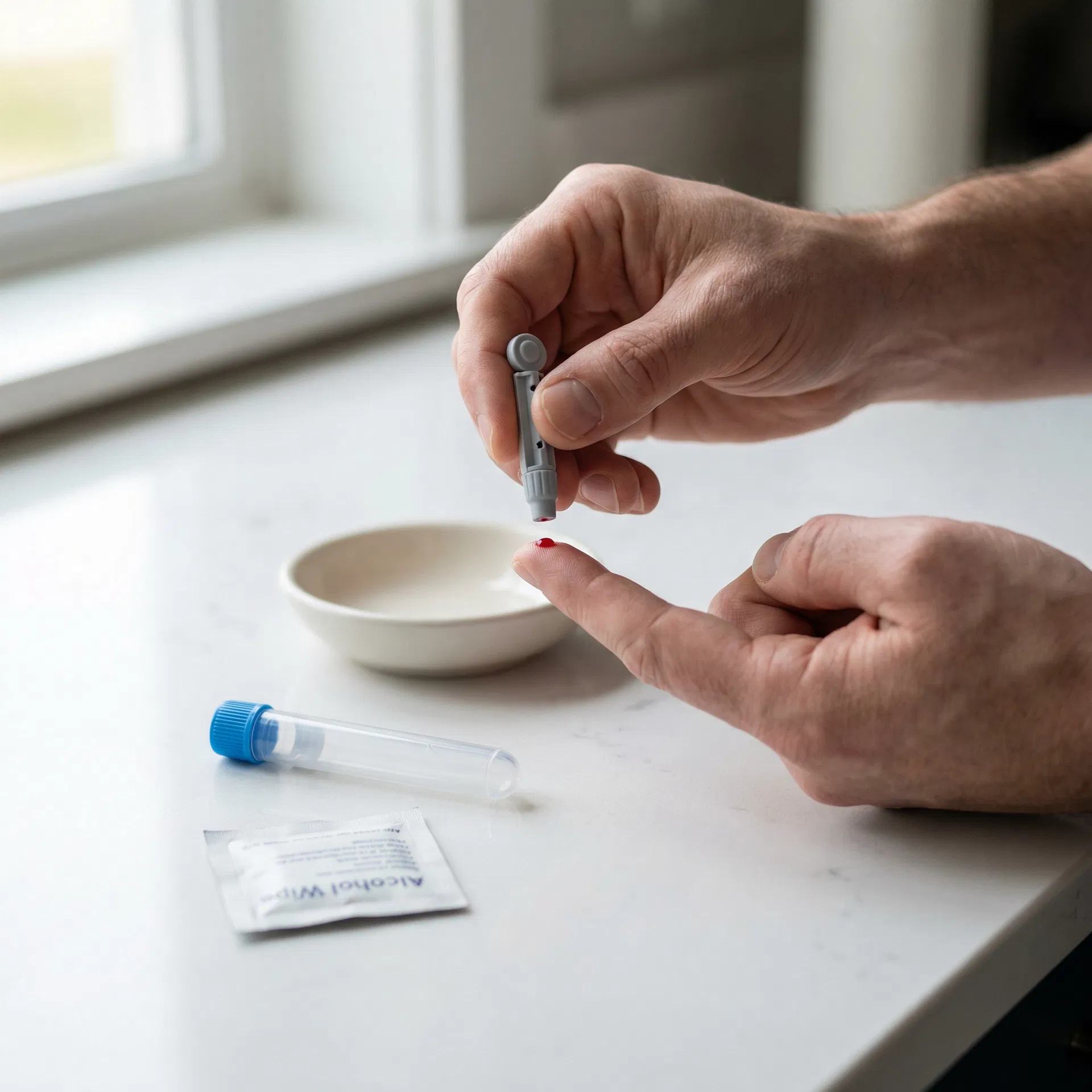
Follow the simple instructions in your kit — whether it's a finger-prick at home or a venous draw at a partner clinic.
 04
04
Insights delivered
Clear, easy-to-understand results sent to you online with actionable health guidance.
Frequently asked questions
This test measures Total Cholesterol, LDL Cholesterol, HDL Cholesterol, Non-HDL Cholesterol, Total Cholesterol:HDL Ratio. Check the full biomarker list on this page for detailed descriptions.
Check the Special Instructions on this page. General rule: fast 8-12 hours if cholesterol/glucose/insulin included. Most hormone, vitamin, and antibody tests do not require fasting. Morning collection (7-10am) is preferred.
Follow the instructions in your kit. For finger-prick: warm hands, use lancet as directed, fill tube to marked line. For venous: attend a phlebotomy clinic with your lab form. Post same day, avoid Fridays/bank holidays.
Results are typically available within the timeframe shown on this page. You will receive a notification when ready to view online.
You may also be interested in

VLDL Cholesterol Blood Test
A single-biomarker venous blood test covering cholesterol status — ideal for cardiovascular risk assessment and heart health monitoring.
Results estimated in 3 working days
1 biomarkers

Lipoprotein (a) Blood Test Kit
A single-biomarker venous blood test covering cardiovascular risk — ideal for investigating relevant symptoms or monitoring health.
Results estimated in 3 working days
1 biomarkers

Allergy Screen (Essential Foods) Blood Test
An essential food allergy panel testing for the most common food allergens responsible for IgE-mediated reactions — covering the key foods that account for the majority of food allergies in both children and adults.
Results estimated in 2 working days
9 biomarkers